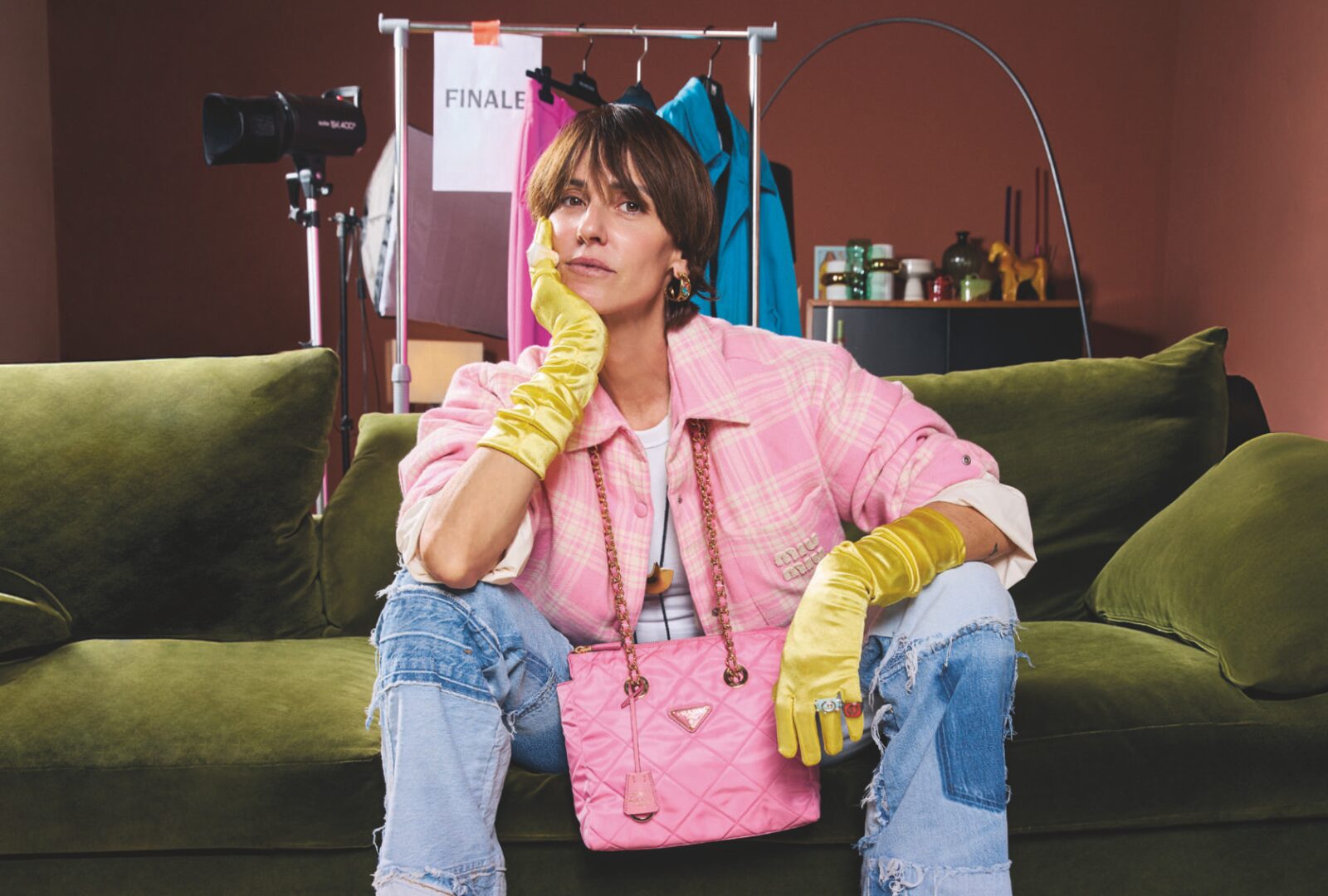
By Francesca Trovato. Cover image courtesy Rizzoli Libri
“Nothing to wear” is where it begins, but never where it ends. With S.O.S Styling (Rizzoli Libri), Rita Benedetto shifts the focus from accumulation to recognition, turning the wardrobe into a space where identity takes shape. After years in editorial fashion across TuStyle, Grazia and Cosmopolitan, and the growth of a 150,000-strong community with @stylist_a_porter, she distills her vision into a “sentimental guide” that moves between instinct and awareness, gesture and meaning.
The starting point is a paradox we all know: closets overflowing with clothes that fail to speak. Instead of adding more, Benedetto invites a decisive shift learning to “shop your own wardrobe,” to see again what is already there. Spontaneity, curiosity and experimentation become tools to activate what we already own. From inherited pullovers to masculine blazers and everyday jeans, styling turns into a democratic practice: not performance, but position. Not rules, but recognition.
Fashion Careers: Why Getting Lost Is Often the Best Move
How important was it for you to get lost, change direction, and go through false starts before finding your place in fashion?
It was the dream of anyone entering this field, a bit like The Devil Wears Prada, with all the imagery that world carries. I stepped into it with that vision, and in part it was true, but I often felt out of place. Editorial fashion is built on very rigid hierarchies, almost like castes, and within that system I had the feeling I could never fully become what I wanted to be.
I knew I was privileged — queues to enter a fashion editorial team are endless — but it wasn’t enough. You’re always pushed to aspire to something higher, more polished, more “perfect,” just as I had been taught. When the magazine shut down, which was also a very hard moment for me to process, I realized that loss was actually a space. Getting lost, changing direction, stepping away was essential. I didn’t find my place by entering a system, but by building one tailored to me.
Independent Styling vs Editorial Fashion: What You Gain by Choosing Freedom
What does it really mean to build fashion “your own way” without chasing predefined models?
When I founded my project, I wanted to be free, truly free. I came from a system where, even if you’re doing beautiful work, you never fully choose, because there are structures, editorial priorities, and stylistic directions you must follow, and they’re not always yours. At a certain point, I understood I didn’t want obligations anymore. I wanted to choose only what I truly liked: clients, garments, images. Everything had to pass through my taste, my aesthetic, my sense of desirability. It had to resemble me.
I never wanted polished fashion because I’ve always found it artificial. Even on my set, I’m not interested in posing as much as in capturing a real attitude. I realized I couldn’t be anything other than who I am. Video became my language because it’s more real, more direct, more immediate and more mine.
Personal Style Starts With Self-Knowledge, Not Shopping
How do you learn to listen to your own “visual vocabulary” and understand what you’re communicating, even unconsciously?
By getting to know yourself deeply. It took time for me. Lockdown was a turning point: the fear of losing my job, which I eventually did when the magazine closed, and the fact that everything had stopped. That’s when I went through a very intense inner journey. Awareness can be painful, but it’s also the moment you start to truly see. And once you see clearly, there’s no going back, not even in how you dress, because you begin to recognize what represents you and what doesn’t. I’m in love with fashion. I never stop searching, exploring, being curious. I feel in constant evolution. At some point, you stop looking outward and begin to understand what truly represents you, and that’s when you start building a language that is entirely your own.
Fashion Styling: One Accessory Can Change Everything
When does a detail or an accessory truly change the meaning of a look?
When it stops being just a detail. At first it’s something you add, but then there’s a moment when you put it on and everything shifts. It changes the weight of the look, its balance, what it communicates and how you feel. It happens when it introduces an interesting imbalance, when it breaks something that was too perfect. It could be a shoe, a bag, a piece of jewelry. That’s where the short circuit happens. It’s no longer just styling, it’s a statement. Before, you were simply dressed. After, you’re communicating something.
Why Personal Style Takes Time and That’s Exactly the Point
Is style something you have, or something you can build over time?
I believe some people have an innate sense of style, but I also believe it can be built. I built mine over time, through constant observation, especially in Milan, watching women on the street, in cafés, at aperitivo, their natural ease. Coming from a small town, I longed for that, and slowly I constructed it. Style is a process.
Female Style: Why Femininity Has Nothing to Do With What You Show
What is the hardest myth to dismantle when talking about female style?
That to be feminine, you have to show it explicitly: heels, cleavage, the body on display, as if that were the only way to be a woman. It’s an outdated, constructed image that leaves little room for personal interpretation. Femininity is not a performance. It’s not about how much you show, but how you inhabit what you wear. It can be far more powerful when it’s less declared, more subtle. Sometimes it’s in an open shirt, sometimes in a masculine pair of trousers, sometimes in a gesture. It’s quieter, but much stronger. And then there’s the myth of purchasing power, that you need a lot of money to have style.
Outfit Ideas: Why the Best Looks Are Never Fully Planned
How important are unpredictability and improvisation in building an authentic style?
They’re essential, even though I personally need control. When a look is overthought, it becomes predictable. When something unexpected enters, something real happens. A last-minute change, a mistake: that’s when a look comes alive. Style always has an instinctive, imperfect, slightly “messy” side. That’s what makes it alive, and that’s what I love.
Dressing Authentically: How Fear of Judgment Holds Your Style Back
Why are we sometimes afraid to take risks, even when we feel something truly represents us?
Because of judgment. It’s not the outfit, it’s what it says about you, and what others will say about you. We’re afraid of labels, of being read. We stay in a safe zone, but that same safety distances us from ourselves. You can immediately tell when a look works, but isn’t yours.
Capsule Wardrobe: Shop Your Closet Before You Buy Anything New
Where do you start, concretely, to build a more conscious style?
From your wardrobe. Not to buy, but to look. To understand what represents you and what doesn’t. To try, and try again. It’s emotional work, a personal journey. Your wardrobe tells much more than you think: who you were, who you are, and even who you think you should be. At some point, you have to stop and gain clarity. Because style doesn’t start by adding, it starts by removing. By recognizing yourself.
Fashion Trends vs Personal Style: Why Your Point of View Is Everything
How do you stay original in a world that constantly pushes us to imitate?
By looking, but not copying. If you replicate, you disappear. If you filter, it becomes yours. Originality is having a point of view.
Wardrobe Anxiety: Why Most Women Don’t Recognise Themselves in What They Own
What is the first block you most often encounter in women when they open their wardrobe?
Fear and disconnection. Many women don’t recognize themselves; they haven’t yet managed to truly see themselves beyond perceptions and labels. Styling gives direction, but above all, it gives permission to be yourself.
Curated Fashion: When Every Piece Comes With Its Own Styling Story
And your newly launched website?
The site was born from a question I’m always asked: “Where did you get that?” At a certain point, I realized answering wasn’t enough, because I often ended up disappointing my community. They were looking for that exact piece, and I would say: “old,” “from a past season,” “bought in Tokyo,” “Paris,” “vintage.” I wanted to create a space identical to my profile, something that truly represents me. Not a traditional e-commerce full of endless pages to scroll through and get lost in, but a curated container.
There are no full collections, only pieces I would personally choose. The work starts much earlier: from selection during buying campaigns, through the shoot, to full styling. Because for me, a garment never exists on its own, it always exists within fashion styling. That’s why every piece includes my styling tips, the “pair it with” section, reels where I show it worn and styled with items already in my wardrobe. Because styling is exactly that: making things work together. Even the packaging, the stickers, the newsletter follow the same logic. It’s a system built on reciprocity between seeing a garment and actually living it in real life.
S.O.S Styling was presented on April 29, 2026 at La Ménagère, in Florence, in conversation with journalist and Istituto Marangoni tutor Ginevra Barbetti.


