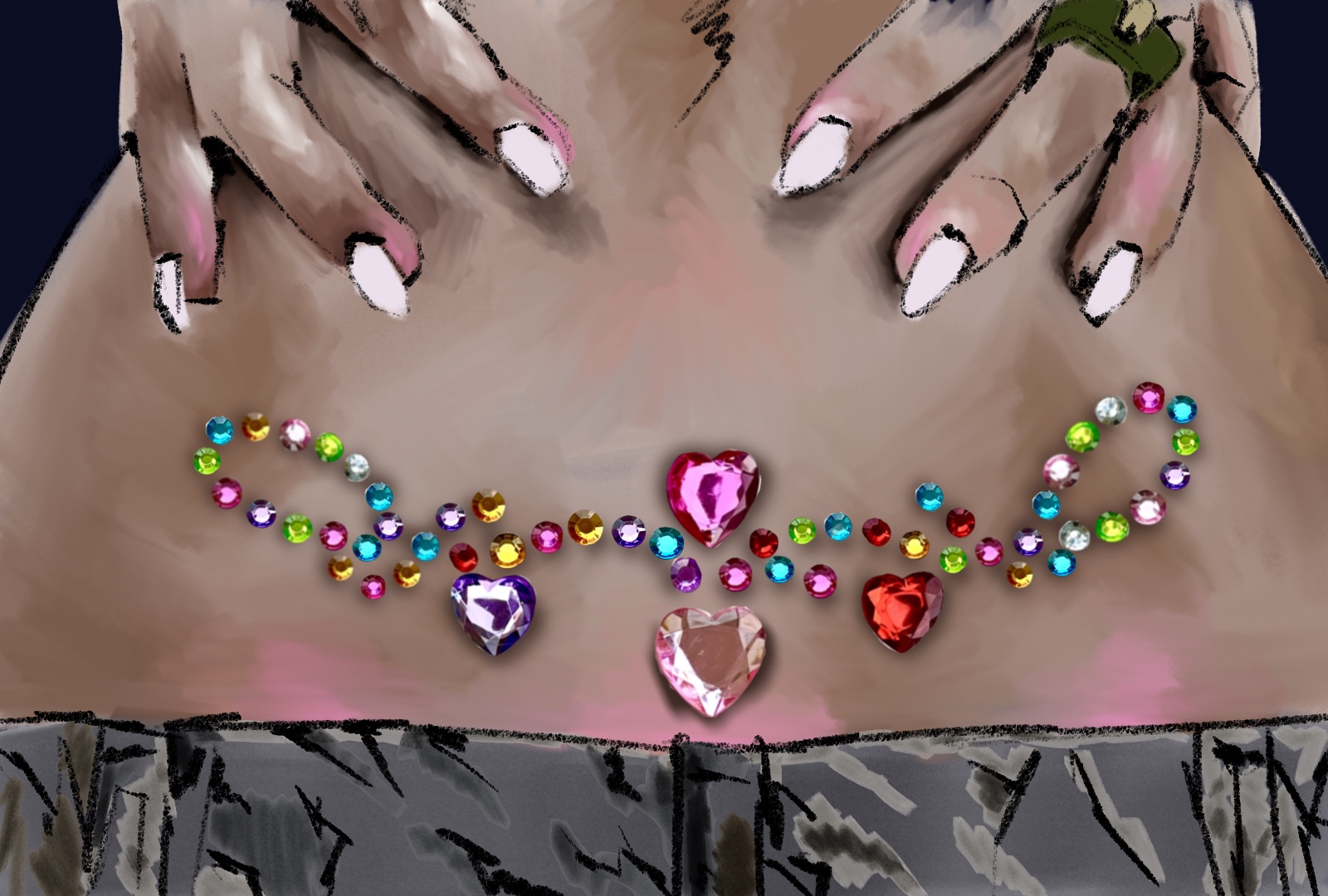
By Lola Tschung Serrano. Cover image by Diana Kolikova.
There was a time when a few crystals were enough. In 2026, apparently, the entire surface needs to sparkle. Rhinestones have moved from evening dresses to denim and menswear, while bedazzling has escaped fashion altogether and landed on lip glosses, skincare, phones, headphones, coffee cups, nails and even cakes. What began as embellishment has become something closer to an aesthetic language: if an object has a surface, someone will probably find a way to cover it in gems.
The latest explosion owes a lot to Kylie Jenner. For her 29th birthday in August, the beauty entrepreneur and social media star posted images of a celebration where even one of the cakes was covered in colourful jewel-like decorations. The idea quickly travelled across TikTok and Instagram, where creators began applying rhinestones to everything from face masks and Vaseline tubs to phone cases and coffee cups. Jenner then extended the aesthetic to her own manicure and phone case. Yet she accelerated rather than invented the phenomenon. Crystals had already been moving back into fashion, while 2026 has transformed that fascination into something much broader: a renewed desire for decoration itself.
It’s Not Just Y2K Anymore
The obvious reference is Y2K. Rhinestone logos, crystal-covered denim and unapologetically shiny accessories immediately recall the late 1990s and early 2000s, when embellishment was rarely interested in being discreet. That nostalgia is central to the current trend, particularly for Gen Z, who are rediscovering an aesthetic they were either too young to experience or encountered first through images of early-2000s pop culture.
But calling bedazzling another Y2K revival misses what has changed. The crystal is moving from detail to surface. Rather than adding a few rhinestones to finish a garment, designers and consumers are increasingly using embellishment to transform the identity of the object itself. A crystal brooch decorates a jacket; hundreds of crystals can make the original surface almost disappear. Embellishment stops being the finishing touch and becomes the visual idea.
This also explains why the phenomenon feels connected to the wider return of maximalism. After years dominated by clean silhouettes, neutral palettes and different versions of understated luxury, there is a growing appetite for things that are playful, excessive and immediately visible. Bedazzling sits comfortably alongside “whimsymaxxing” and other aesthetics built around the pleasure of adding rather than removing.
Fashion Wants to Be Seen Again
A rhinestone is almost the opposite of quiet luxury. It exists to interact with light and attract the eye. Once hundreds of them cover a surface, discretion becomes impossible. And perhaps that explains why sparkle feels particularly relevant now: fashion is rediscovering the pleasure of being noticed.
The shift is visible beyond womenswear. Rhinestones have become increasingly prominent in contemporary menswear, appearing across streetwear and luxury. During the Fall/Winter 2026 season, Dior, Louis Vuitton and Kartik showed sparkling looks, while labels including Amiri, Supreme and Versace have also embraced rhinestone-heavy pieces. What once carried relatively rigid associations with feminine glamour or stage costume is becoming part of a broader vocabulary of menswear and youth culture.
That movement matters. Bedazzling is no longer simply about making something “pretty”. Depending on where it appears, sparkle can communicate glamour, irony, performance or streetwear excess. The question is becoming less about who is allowed to sparkle and more about what sparkle can do to an otherwise familiar object.
The Sabrina Carpenter Effect
If there is one pop star who makes this renewed appetite for sparkle immediately understandable to a younger audience, it is Sabrina Carpenter. Rhinestones have become part of a visual universe in which contemporary pop meets deliberately nostalgic glamour. At the 2026 Met Gala, her custom Dior dress by Jonathan Anderson wrapped the body in strips of film edged with rhinestones, referencing Billy Wilder’s 1954 Sabrina. At the VMAs in September, she performed in rhinestone tights and bedazzled shorts, continuing a stage language in which sparkle is designed to move, catch the light and register immediately on camera.
Carpenter is interesting because her use of crystals sits between different periods. There is Old Hollywood glamour in the sparkle, the playful artificiality associated with Y2K and the hyper-visibility required of a contemporary pop performance. Today, a stage outfit needs to work simultaneously for the person watching from the audience and for the millions who may encounter it later as a ten-second video. Rhinestones perform exceptionally well in both spaces.
That makes sparkle more than decoration. It helps turn a garment into an image and an image into a recognisable persona. In an increasingly crowded pop landscape, fashion becomes part of the world an artist constructs around herself.
From Kylie Jenner to Your Lip Gloss
Kylie Jenner represents the other side of the phenomenon. If Sabrina Carpenter shows what crystals can do on stage, Jenner demonstrates how easily they can move into everyday life. After her birthday images circulated, beauty became one of the most fertile territories for the trend. Rhinestones appeared on gloss tubes, creams, perfume bottles, face masks and elaborate manicures, while brands including Clinique and Sol de Janeiro joined the visual conversation online.
The distinction is interesting because the product itself is being transformed. A lip gloss is no longer only something you use; once covered in crystals, its packaging becomes an accessory and potentially a piece of social content. The container begins competing with what is inside it.
And there is something deliberately absurd about carefully decorating a disposable face mask with rhinestones. That absurdity is part of the appeal. Contemporary bedazzling does not always aspire to conventional elegance. Sometimes the joke is precisely that an entirely ordinary object has received a completely disproportionate amount of glamour.
The Influencer Version: Liv Reese and the Viral DIY
The trend becomes even clearer when it moves away from celebrities. New York content creator Liv Reese, who has more than 100,000 followers across TikTok and Instagram, told Fortune that she began seeing bedazzling everywhere and decided to join the trend, decorating objects including a Dunkin’ cup, a face mask and eye patches. According to the publication, the resulting Reel generated almost ten times the likes of her usual posts.
That example reveals something fundamental about bedazzling in 2026: the process is almost as important as the finished object. There is a perfect social-media narrative built into it. You start with something ordinary, apply the stones one by one and reveal a radically different object at the end. Before, process, after — all within a few seconds of video.
Unlike many fashion trends, it is also remarkably easy to reproduce. You do not need access to a designer collection. A packet of adhesive gems and something already sitting in your bathroom or wardrobe are enough. This accessibility allows the aesthetic to move extraordinarily quickly from celebrities to creators and then into everyday life.
From Couture Technique to DIY Gesture
This is one of the most interesting contradictions surrounding bedazzling. At one end is the extraordinary technical tradition of crystal embellishment in fashion, where complex surfaces can require specialised craftsmanship. At the other is someone sitting at home sticking inexpensive rhinestones onto an old phone case.
Visually, the two belong to the same universe. Economically and technically, they could hardly be further apart. And that tension explains why sparkle moves so easily between luxury and TikTok. It is one of the rare fashion codes that can look extraordinarily expensive and completely accessible at the same time.
The DIY version also introduces something increasingly important to younger consumers: authorship. You do not simply buy the finished aesthetic; you participate in creating it. An old pair of jeans can be altered. A generic bag becomes recognisable. A phone case identical to thousands of others becomes yours.
Why Are We Bedazzling Ordinary Things?
Perhaps the most contemporary development is precisely that the rhinestones are no longer staying on clothes. Phones, headphones, reusable cups, beauty products and other objects that accompany everyday life are increasingly treated as fashion accessories.
There is a logic to this. The phone may now appear in more mirror selfies than an evening bag. A lip gloss is pulled out repeatedly in public. Headphones are worn around the neck. These functional objects have become visible extensions of personal style, so decorating them begins to make as much sense as decorating clothing.
Bedazzling performs a very simple transformation: it turns the generic into the specific. Two people may own exactly the same phone, but once one of them covers the case in pink crystals and tiny hearts, the mass-produced object acquires the appearance of individuality.
The Paradox of Algorithmic Individuality
There is an obvious contradiction. Thousands of people are personalising their belongings in remarkably similar ways because they have encountered the same trend online. Social media shows us identical mass-produced objects; users customise them to escape that sameness; they upload the results; the algorithm amplifies the aesthetic; thousands more people repeat it.
We are all trying to look different together.
That does not make the desire for personalisation meaningless. It reveals something more interesting about contemporary style. Individuality increasingly works through shared visual codes that people recombine themselves. Charms, stickers, rhinestones and customised accessories become a vocabulary rather than a finished look.
This is also why bedazzling connects naturally with the broader revival of DIY. In an extremely digital culture, there is pleasure in doing something repetitive and physical with your hands. The finished result may be destined for Instagram, but the act of making it remains tactile.
Why Crystals Work So Well on a Screen
There is another, extremely practical reason sparkle is back: it photographs beautifully. Crystals change as the object moves, react to flash and create an immediate visual payoff. A relatively ordinary silhouette can become dynamic simply because its surface catches light.
That quality makes rhinestones almost perfectly suited to short-form video. They work on Sabrina Carpenter under stage lights and on a creator’s phone case filmed at home for exactly the same fundamental reason: movement activates them.
Bedazzling therefore bridges the physical and digital worlds unusually well. Applying the crystals is analogue and tactile; displaying the result is highly digital. It is essentially handmade decoration engineered for the camera age.
Can Sparkle Also Be About Spending Less?
There may also be an economic dimension. Fortune has connected Gen Z’s current fascination with bedazzling to the idea of the “Lipstick Index”: when large purchases become harder to justify, smaller forms of pleasure and self-expression can acquire greater appeal. The interpretation should not be treated as the single explanation for the trend, but the logic is interesting. A handful of inexpensive crystals can dramatically change an object without requiring the purchase of an entirely new one.
That places bedazzling somewhere between consumption and creativity. You can buy endless kits and newly crystal-covered products, of course. But you can also take something you have stopped noticing and make it desirable to yourself again.
And perhaps that is one of the strongest ideas behind the trend: transformation without replacement.
But There Is a Sustainability Problem
The contradiction cannot be ignored. Many of the adhesive gems used in viral DIY projects are plastic-based, can easily detach and are difficult to recover, while decorating disposable packaging introduces additional materials into objects already destined to become waste. The current craze has consequently attracted criticism over its environmental implications.
There is therefore an important difference between covering an old denim jacket in stones because it makes you want to wear it again and buying a succession of cheap rhinestone-covered objects simply because they fit the aesthetic of the month. One potentially extends the emotional life of something already owned; the other reproduces the same rapid cycle of consumption under a shinier surface.
The most interesting version of bedazzling may consequently be the simplest one: use decoration to rediscover what you already have.
What Comes After Bedazzling?
The rhinestone-everything moment will eventually reach saturation. That is almost inevitable for an aesthetic whose entire purpose is visibility. Once everything sparkles, sparkle itself stops being surprising.
But the larger shift is likely to matter for longer. Bedazzling belongs to a wider return of embellishment, humour and visible personality after a period in which good taste was repeatedly associated with restraint. The important development may therefore be less about whether we will still be gluing gems onto lip glosses next year and more about the permission the trend represents: fashion can be excessive again.
That is why the phenomenon connects Sabrina Carpenter’s stage wardrobe, Kylie Jenner’s birthday cake, a crystal-covered menswear jacket and an influencer decorating a coffee cup. They operate at completely different levels of fashion culture, yet all depend on the same impulse: take something recognisable and make it impossible to overlook.


