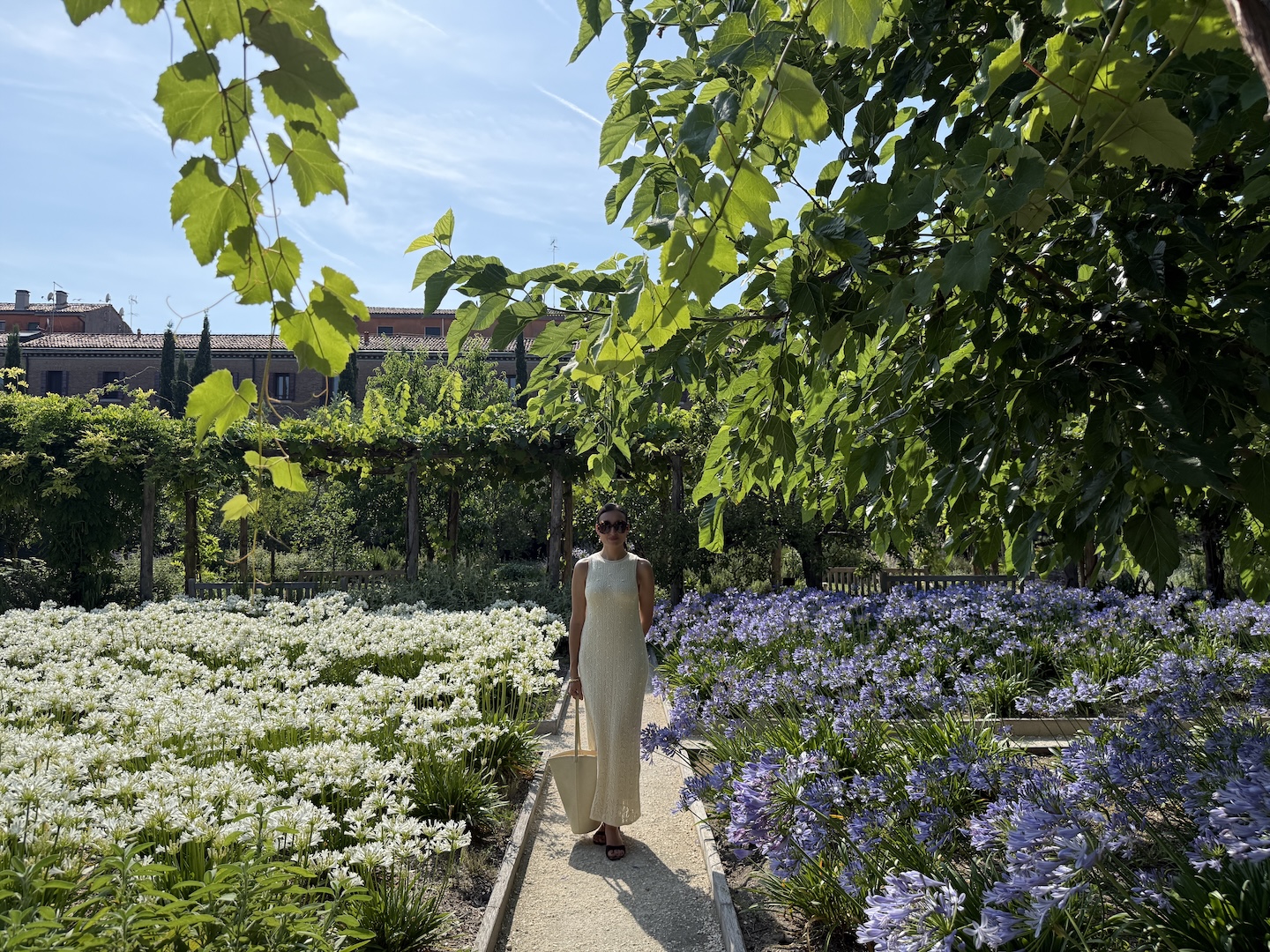
By Vittoria Giubbolini. Cover image: Federica Gerini, photo by Mario Porrovecchio.
An architect by training, a photographer by passion and a content creator by choice, Federica Gerini has built a career around her own distinctive perspective. After four years working in interior design, she moved into digital communication in 2020, finding a new way to explore her interests in art, travel and fashion. Along the way, she has contributed to National Geographic and Artribune, experimented with photography projects and recently launched a newsletter. On social media, she follows her own instincts rather than chasing the latest trends, while her love of vintage fashion reflects her desire to dress differently. We caught up with her to talk about creativity, career choices and life online, as well as her favourite places in Florence, inspiring art spaces and an unforgettable journey through the former Yugoslavia.
From studying architecture to developing a passion for photography and social media, how did you turn these interests into a career?
I worked as an architect at an interior design studio for four years. I actually started before graduating, while I was still working on my thesis. I absolutely loved interiors, architecture and design, as well as exhibition design. Then an opportunity came along in communications, and I decided to take a chance on something that felt very much like me. At the time, I was still figuring out what I wanted to do, and trying something new seemed like a good idea. It was January 2020, and then everything that followed pretty much made the decision for me. Digital communication grew exponentially during that period, while the architecture industry was at a standstill. You could say fate put me on the right path at exactly the right moment. I should also mention that, back then, I was writing my blog, contributing to National Geographic and Artribune, and running a small Instagram account where I shared my photographs. I was experimenting, trying to understand what I really enjoyed and where I wanted to go. To be honest, I’m still doing that today. I love trying new things, making changes and starting new projects. About a year ago, for example, I started writing a newsletter.
What does working in digital communication mean today?
What does working in digital communication mean? Hmm, mainly spending your life in front of a screen. And I don’t mean that negatively. You’re constantly up to date, informed and discovering new things! As a child and teenager, I read whatever books I could find at home, and that was pretty much it. Now, I have endless sources of inspiration and places to look for answers to whatever I’m curious about.
And which skills really make a difference?
Having something to say and having personality. Maybe, in the end, they’re the same thing.
If you’re copying someone else, you’ll always be just another person doing what everyone else is doing. You can probably succeed that way too, and I see plenty of people choosing that route. But I believe having your own point of view is what truly sets you apart. As for technical skills, I think you can learn a great deal in this industry simply by doing things, especially if you’re curious and quick to learn. So, if I had to sum it up, I’d say the most important qualities are personality and intelligence.
How difficult is it to stay authentic when building a public image?
I think it depends on how much confidence you have in your own personality and taste. For me, at least, it isn’t particularly difficult. What I share is genuinely what I like, what catches my eye and what I feel like showing others. I photograph places I actually visit and things I genuinely enjoy, things that are part of my everyday life. I’ve never felt the need to create a persona or post something just because it might perform well on social media. I think that once you have a clear sense of what you like and what you don’t, everything becomes much more natural.
What do you look for in a brand before agreeing to a collaboration?
It has to reflect who I am and respect the way I work and communicate. Over the past few years, though, another factor has become essential: the brand needs to align with my values and the way I choose to live. I’ve turned down collaborations with some very famous brands because I didn’t feel they shared my values or my view of what it means to be human. I believe there comes a point when you have to make choices and learn to say no, even when an opportunity might seem financially attractive. On many occasions, I’ve put integrity first, and I’m very proud of that.
Between algorithms and emerging trends, how much room is left for personal creativity? And how has your relationship with fashion evolved?
I don’t really follow trends. In fact, when something becomes trendy, I often automatically lose interest in it. I scroll past so much of that content, and this might sound a little harsh, but I think people who constantly chase trends don’t have much personality. They end up following the crowd, trying to find their own way to survive on social media and beyond. And even when the result looks nice, you’re still just one of countless people who have made that video, taken that trip or bought that bag. What I enjoy, both on social media and in life, is seeing how certain places or subjects are presented, forming my own opinion and then reinterpreting everything from my perspective. I spend a lot of time looking at social media and searching for inspiration, but what really catches my attention is someone who manages to communicate something meaningful and makes me want to stop scrolling within three seconds. I think that’s exactly how we should use social media: to find inspiration without simply copying what others do. Social media is an incredible tool. It all depends on how you use it.
I follow very few influencers, but I really enjoy following international creators and photographers. And what I said earlier applies to fashion too. These days, it feels as though absolutely everything has to become a trend, and honestly, I find that a little exhausting. When I see someone wearing the same shoes as me, for example, I almost feel like I don’t want to wear mine anymore. I think that also explains my relationship with fashion. Vintage shopping, for example, gives me the chance to find something that nobody else on the street will be wearing that day. I like the idea of walking around without having the same coat as the person coming towards me 🙂
Where do you draw the line between your private life and what you share on social media?
I actually share very little of my private life. Occasionally, I’ll post a photograph with friends, but it’s pretty rare. I think it’s important to keep certain things just for yourself. It already happens quite often that I’m out somewhere, walking down the street or sitting in a café, and I run into people who follow me on Instagram. Sometimes they come across me during quite personal moments. That’s why I prefer to keep most of my private life to myself.
What are your favourite places in Florence to work, have breakfast and enjoy an aperitivo?
For working, my living room. Candles lit, soft lighting and absolute silence. I really can’t concentrate if there’s background noise or too many distractions. I have several favourite breakfast spots, but there’s only one place that feels like home: Gilda. For an aperitivo, the Four Seasons. The best Negroni in town is served at the Atrium, the service is unmatched, and the setting is simply a dream.
Which recent trip has stayed with you the most, and why?
It’s difficult to choose because every trip is special to me in some way. But without thinking too much about it, I’d say the road trip through the former Yugoslavia that I took with two friends last summer. We fulfilled a dream we’d had since studying architecture: going in search of the Spomeniks, the monumental memorial structures scattered across the former Yugoslavia, often in completely isolated locations.
Is there an exhibition you’ve visited recently that particularly impressed you?
Rather than an exhibition, I’d say a museum: the Piccolo Museo del Diario in Pieve Santo Stefano.
It’s one of those places where, at a certain point, you find yourself struggling to hold back tears. Not necessarily because something is sad. Sometimes you smile, sometimes you’re surprised, and sometimes you’re deeply moved. The museum brings together stories preserved in the National Diary Archive: diaries, letters, memoirs and autobiographies written by ordinary people. And that’s exactly what struck me most. It’s not the great figures of history telling Italy’s story, but the people who actually lived through it: their everyday lives, their love stories and their experiences of war. It almost feels as though those people are right there, telling you their stories themselves. And with every new story, you find yourself becoming completely immersed in their lives. I really recommend visiting.
Which emerging art gallery would you recommend discovering, and what makes it special?
I really like Una Vetrina in Rome. It’s a genuinely unusual exhibition space, with a very clear vision and an identity that I find particularly interesting.
What I especially appreciate is the way it treats the shop window as an exhibition space: somewhere an artwork can connect directly with passers-by, without requiring them to enter a conventional gallery or exhibition venue.


