By Rebecca Ceccatelli. Cover image: photo by Leonardo Morfini.
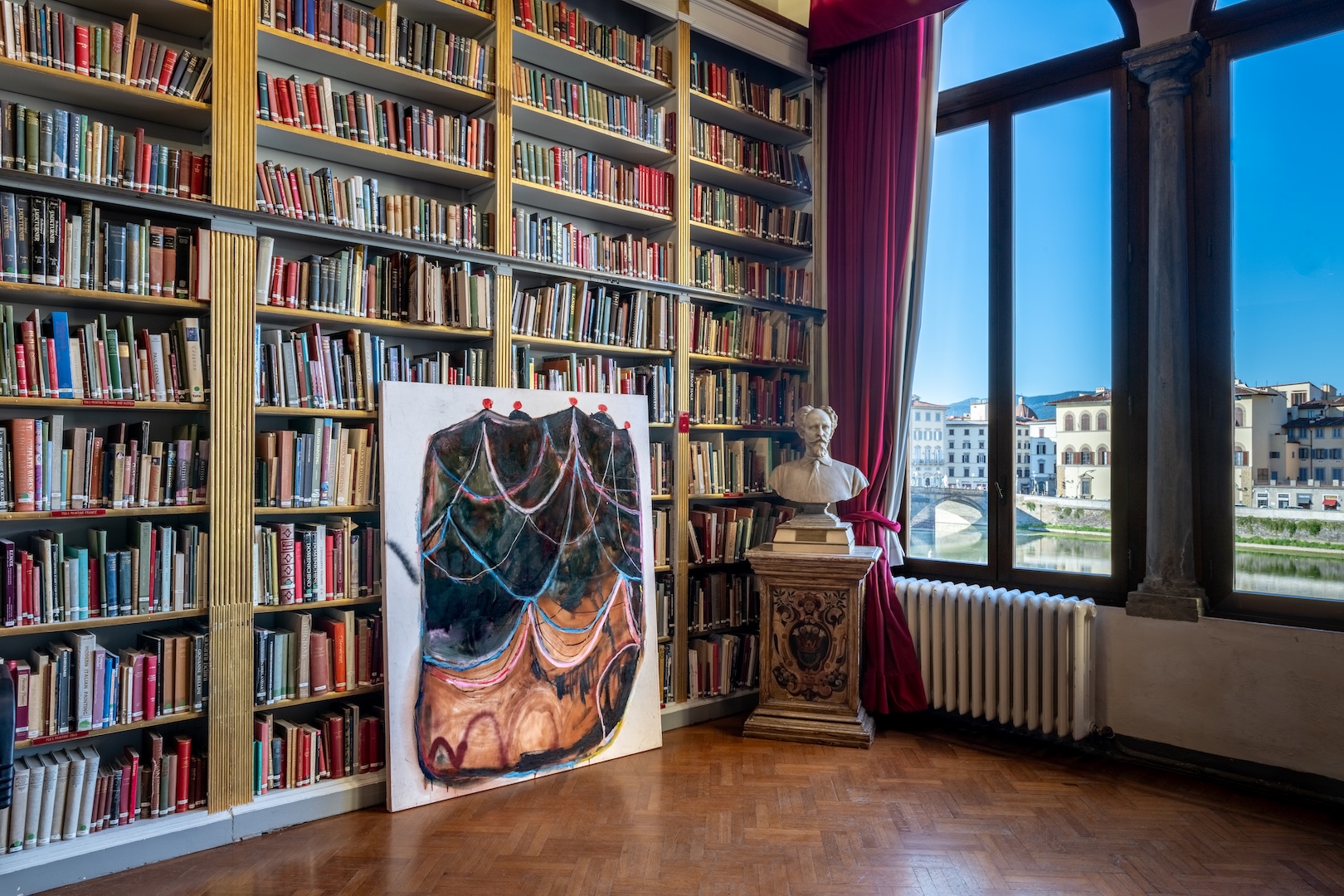
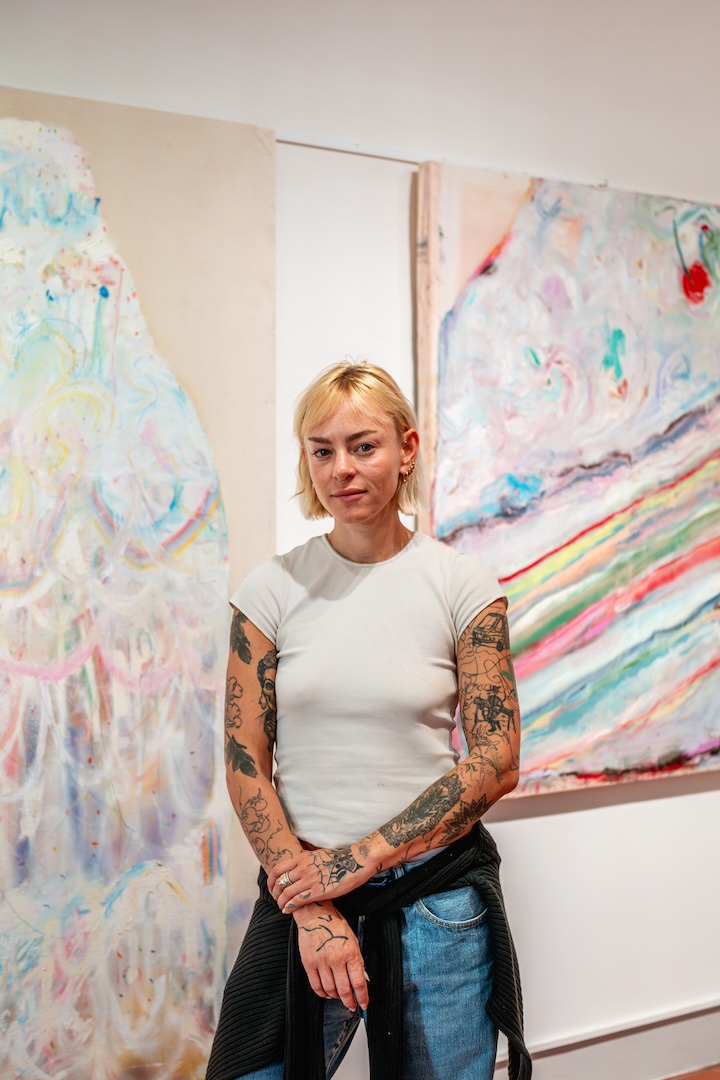
If you look at Rachel Weinstock’s paintings, you’ll probably feel an irresistible craving for something sweet. It’s easy to see why. Cakes, frosting and the remains of parties fill her work, somewhere between celebration and memory. In Piece of Cake, her recent solo show at the British Institute of Florence, curated by Jemma Elliott-Israelson, the American artist turns what is left after the party into paintings and sculptures, exploring our desire to hold on to moments that are destined to disappear. We met her in Florence to talk about the exhibition, her work and what it means to be a young artist today.
Rachel Weinstock’s Piece of Cake: Art, Memory and Celebration
RC: Let’s start with Piece of Cake: where did the idea come from?
RW: Piece of Cake grew out of a body of work I’ve been developing around celebration and, more specifically, what remains after a celebration is over. I became interested in that strange moment when something that was joyful and full of anticipation suddenly becomes evidence that the event has passed; an empty plate, a stained tablecloth, a collapsed decoration, a piece of cake that has been left behind.
The exhibition looks at that desire to hold on to something that is inherently temporary. A party is designed to disappear. You eat the cake, people leave, things get thrown away. My work is partly about trying to preserve that moment, while knowing that you never really can.
RC: Why has cake become such a recurring image in your work?
RW: Cake is such a loaded symbol. It represents celebration almost universally; birthdays, weddings, milestones, achievements, so it immediately carries this sense of expectation and happiness.
But I’m especially interested in cake once it starts to fall apart. It gets cut, touched, eaten and destroyed almost immediately after it is presented. There’s something very beautiful and slightly grotesque about that transformation.
I also love the visual language of cake: the frosting, artificial colors, decoration and excess. It can be incredibly seductive, but if there is too much of it, it can also become almost nauseating. That line between desire and discomfort is something I return to a lot.
RC: You work with used tablecloths, napkins and party leftovers. What draws you to these everyday objects?
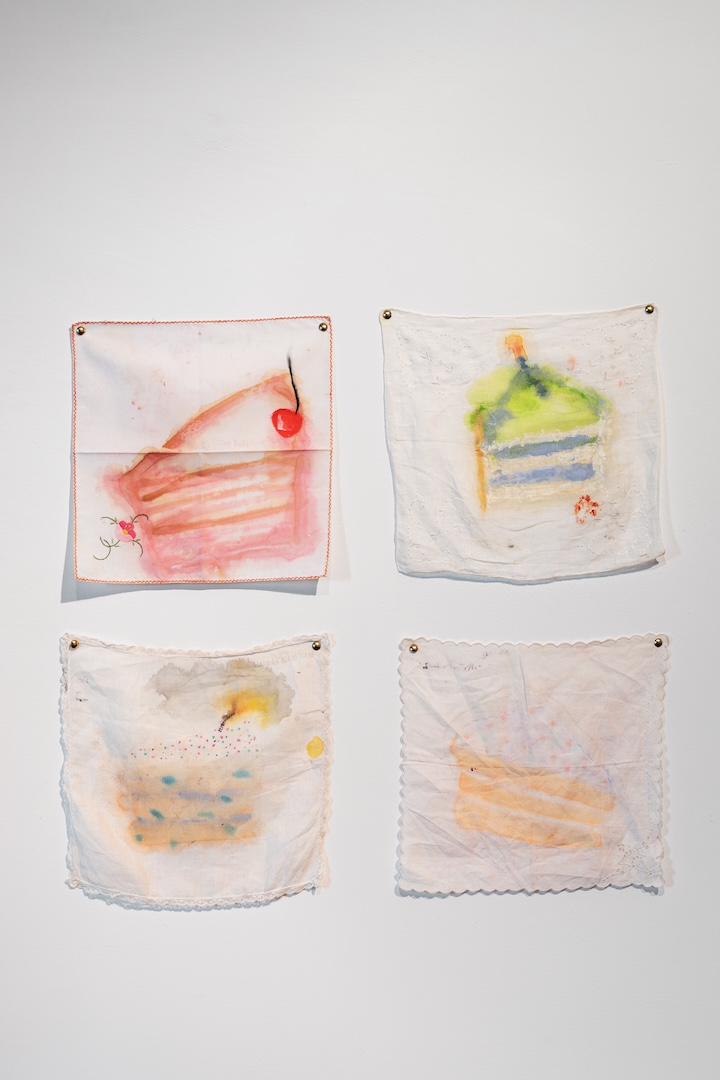
RW: I like materials that already have a history before I use them. A used tablecloth or napkin has stains, folds and traces of something that happened before it entered the studio. I don’t know exactly what that event was, and that ambiguity is important to me.
Instead of starting with a completely neutral canvas, I’m working on top of something that has already lived a life.
The same is true of the objects I preserve in resin. They might normally be seen as disposable or insignificant: ribbons, decorations, cards, remnants from a party — but once they are preserved and isolated, they begin to feel almost archaeological. They become evidence of a moment.
RC: Your work moves between celebration and excess. Where does that tension come from?
RW: I think celebration already contains that tension. We try to create these perfect moments through beautiful tables, decorations, food, photographs and at the same time we know they are temporary.
There is also something interesting about the point where pleasure becomes excessive. Something can be beautiful and inviting, but when there is too much of it, it starts to feel uncomfortable.
I’m attracted to that instability. I don’t want the work to be purely nostalgic or purely critical. I like it when something can feel joyful, seductive, sad and slightly disturbing at the same time.
RC: What does showing Piece of Cake in Florence add to the exhibition?
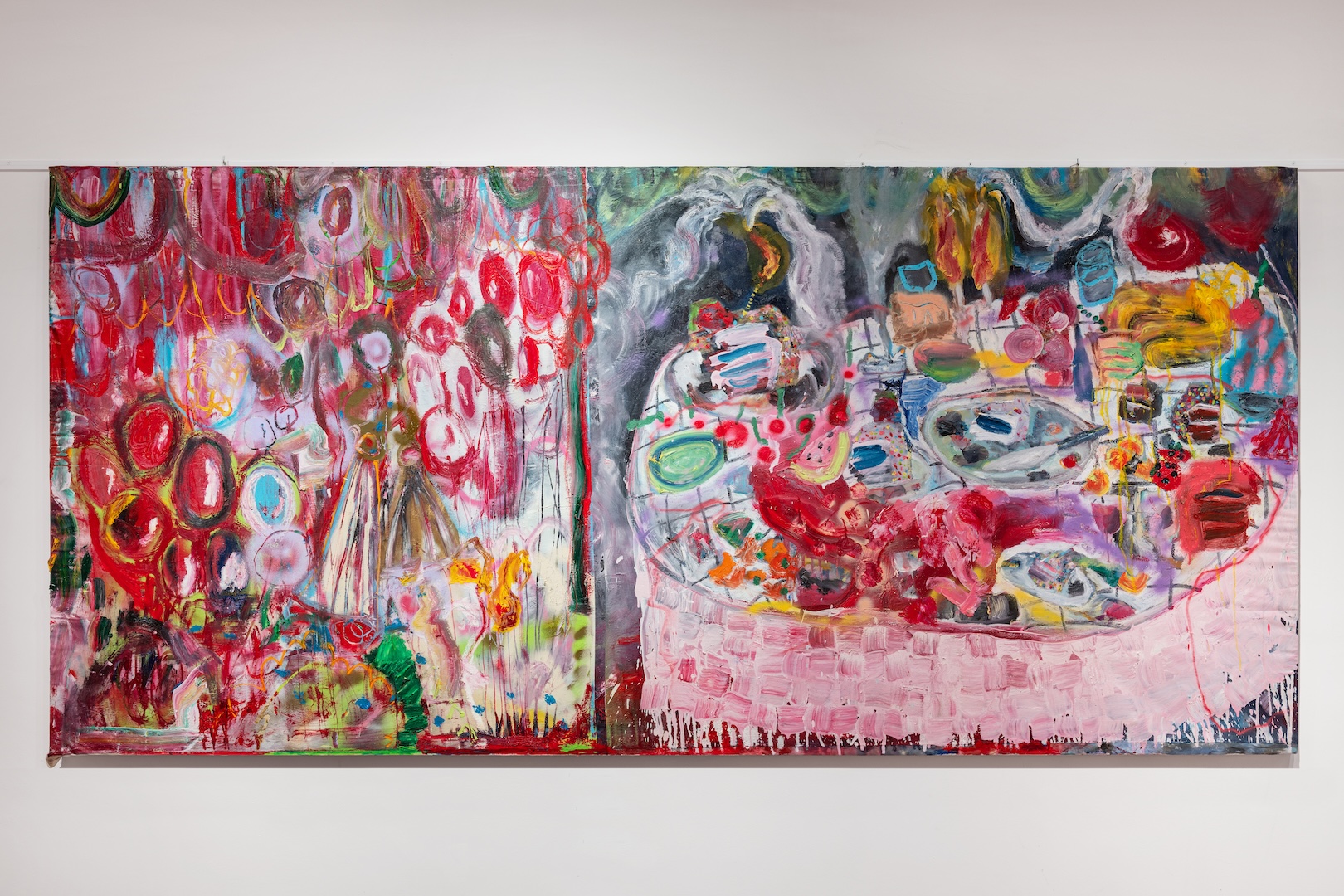
RW: A lot of my work draws from classical themes in painting, especially vanitas and memento mori — ideas around pleasure, excess, mortality and the fact that everything is temporary. There’s also an obvious connection between The Feast and the history of banquet scenes in painting, including works like The Last Supper, but I bring those references into a contemporary language through cakes, disposable decorations and stained tablecloths.
Showing the work in Florence makes those connections feel especially present. It’s a city so tied to Renaissance painting, preservation and cultural memory, which creates an interesting contrast with the fragile, everyday materials and temporary moments I’m trying to preserve.
RC: You studied Psychology before art. How has that shaped the way you work?
RW: Psychology definitely influenced the way I think, even though I don’t consciously approach the work through psychological theory.
I’m very interested in why we become attached to objects, how memories become connected to physical things, and why we try to preserve certain experiences.
A lot of my work comes from observing behaviors that are very ordinary like keeping a birthday card, saving something from a party, taking photographs of a beautiful table before anyone touches it.
I’m interested in the emotional meaning we give to objects and rituals, especially when we know that the experience itself can’t actually be preserved.
Creativity and the Challenges of Being a Young Artist
RC: What does it mean to be a young artist today, surrounded by so many images and social media?
RW: It can be inspiring and overwhelming at the same time.
We have access to an incredible amount of art and information. You can see exhibitions happening anywhere in the world almost instantly, which is exciting, but it also means you are constantly surrounded by other people’s images and careers.
There can be pressure to make work that communicates immediately on a screen, or to constantly show that you are producing something.
For me, it’s important to protect the part of the process that is slower and more private. The studio has to remain a place where I can experiment, make mistakes and make things that don’t necessarily need to become content.
At the same time, social media can be an amazing way for young artists to find communities, opportunities and audiences that they might not otherwise have access to. I think the challenge is learning how to use it without allowing it to dictate the work.
RC: What would you say to someone young who wants to become an artist today
RW: I think you have to become comfortable with uncertainty. There isn’t one clear path to becoming an artist, and a lot of the time you are figuring it out while you are doing it.
I would say to make as much work as possible, see as much art as possible and find people whose opinions you trust.
It’s also important not to wait for permission. You don’t necessarily need a gallery, an institution or someone else to tell you that you can make an exhibition or start a project.
And maybe most importantly, try not to make work based on what you think people want to see. Trends move very quickly. The things that are genuinely specific to you — even if they initially seem strange, personal or insignificant — are usually the things worth following.


