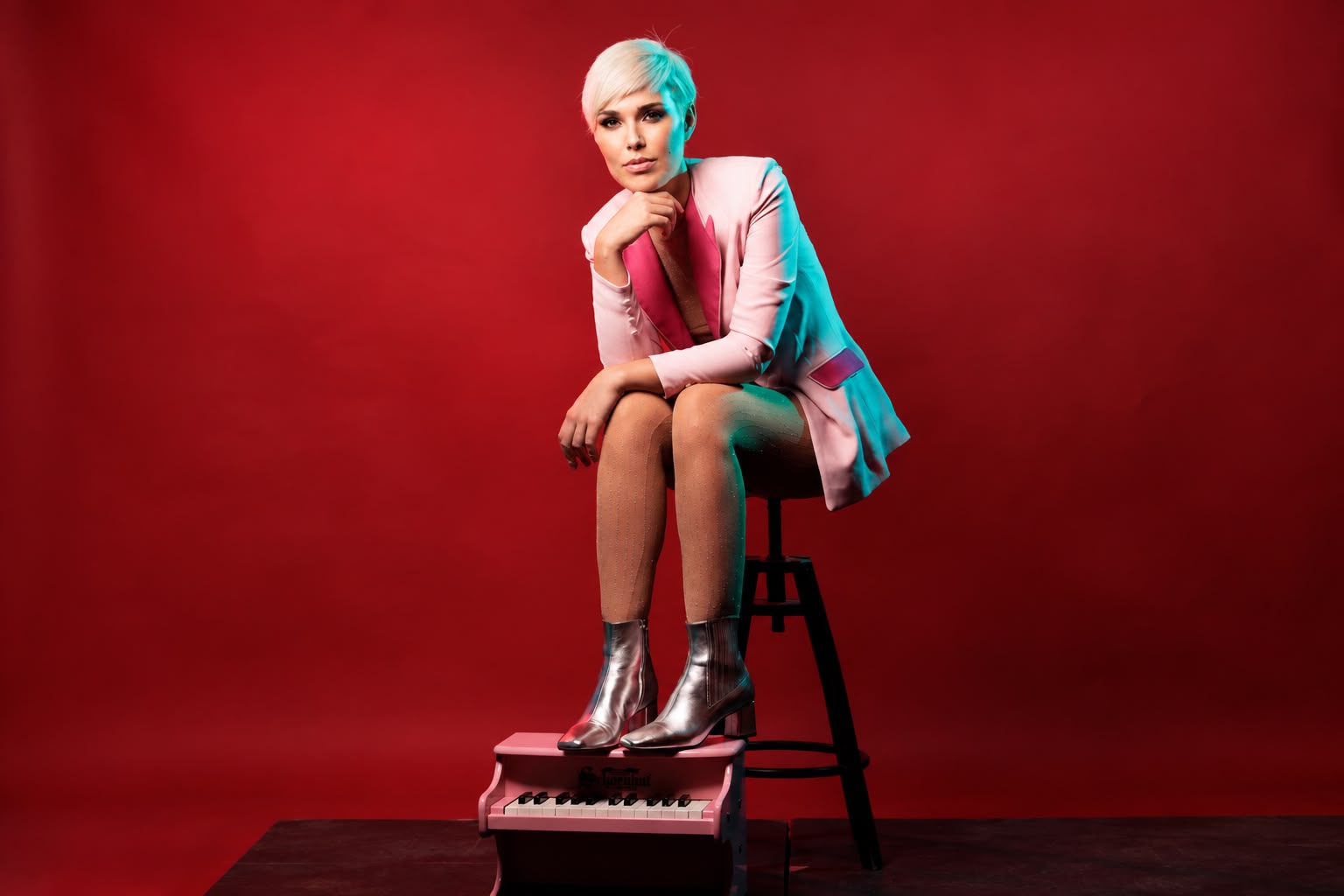
By Camilla Sarra. Cover image by Fabrizio Cestari.
Giulia Mazzoni has taken her music from Florence to international stages, building a particularly strong relationship with China over more than a decade. Alongside her work as a composer and pianist, she has increasingly used music to engage with the present, from women’s rights to cyberbullying and the pressures of digital identity. Ahead of the FánHuā Chinese Film Festival, running at La Compagnia in Florence from 14 to 18 October, where Mazzoni will open the festival with her music, we spoke to her about what it means to be a woman and a composer today, how classical music can reach younger audiences and why music can still bring different cultures closer.
Classical Music as a Living Language
You built an international career at a young age. What do you really want to say through your music today?
That classical music is still a living language. Building an international career at a young age allowed me to encounter different cultures and ways of understanding music, and I realised that I wanted to create a language that belongs to the present while remaining deeply connected to the great classical tradition. Being a composer today means respecting tradition without being imprisoned by it. Tradition does not need imitators; it needs new authors. This is at the heart of Nuova Classica: music written today that still believes in melody, emotion, beauty and the expressive power of acoustic instruments. We live in an incredibly fast world, saturated with information. Music can do the opposite: it can stop time and bring us back to listening and wonder. Beauty does not belong to the past. We still have the responsibility to create it.
Being a Composer Today
What does it mean to be a young composer in a world still shaped by the great names of the past?
I don’t see the great composers of the past as a shadow over us. I see them as a foundation. Writing today means entering into dialogue with centuries of extraordinary music. At first that can be intimidating, but then you understand that tradition is not asking you to compete with the past; it is asking you to find your own voice. We cannot write as if Bach, Mozart, Beethoven or Puccini never existed, but neither can we write as if music ended with them. Every generation has its own emotions, contradictions, fears and dreams to express. The challenge is to carry memory with you without allowing it to become nostalgia.
Women in Music
Have you ever felt you had to prove more because you are a woman?
Yes, and the difficult thing to admit is that I still feel it today. When I entered the composition class at the Conservatory in Milan, I was the only woman. Throughout my career, I often felt that being young and being a woman came before my music. I was considered “too young” to be at a certain level and received comments and insults that I would never wish on anyone, but I never allowed them to make me stop.
Even today, people sometimes hesitate to call me Maestro. They call me Signora or Maestra, but Maestro is my professional title as a musician. I worked for it and earned it. To me, it is actually a neutral word: on stage, it tells you what I do, not whether I am a man or a woman.
In 2024, I became the first woman composer to open the season of an Italian opera institution. Think about how recent that is. I am proud of it, but it should also make us reflect. I believe first of all in the person, in their uniqueness and what they can bring into the world. We spend so much time defining people by categories that we risk forgetting the person underneath. I don’t want to be considered a good female composer. I want to be considered a composer. So please, enough with Signora. And no, not Maestra either. When I walk onto that stage, just call me Maestro.
A New Generation of Women Musicians
What has changed for a young woman trying to build a career in music today?
A great deal. A young woman beginning her career today finds more doors open, but those doors did not open by themselves. Someone had to push them open, sometimes at a very high personal cost. I have benefited from some of those battles and have also found myself opening doors that had remained closed for a long time. Once a door opens for you, you should try to leave it open for those who come after you.This is also why social commitment has become increasingly important to me. The moment we step onto a stage, people give us something extraordinarily precious: their attention. And attention creates responsibility. Instrumental music has no words, but that does not mean it has no message. My international work has also shown me how musicians can become instruments of cultural diplomacy, creating relationships between countries while carrying something of their own culture with them. The privilege of creating beauty comes with responsibility.
Music and Responsibility
When you address issues such as violence and women’s rights, how strongly do you feel the responsibility to take a stand?
Very strongly. I have never believed that an artist should remain indifferent to the world around them. I have always spoken publicly about violence against women and women’s rights, but I have tried to turn that commitment into action and music. I have been a testimonial for La Toscana delle Donne since its first edition and have taken part in initiatives supporting women who have experienced violence. When I was very young, I also worked through music with female inmates at San Vittore prison. That experience taught me something fundamental: before judging a human being, you have to listen.
I wrote Artemisia, inspired by Artemisia Gentileschi, who endured violence and prejudice and transformed them into art. I also had the honour of naming one of the Steinway pianos in the Fabbrini & Bussotti collection, historically identified by the names of great male artists. I chose Artemisia, so for the first time a woman entered that symbolic history.
More recently, I wrote 404: Woman Not Found, about cyberbullying, the violence of words and identity in the digital world. Today a face, a voice or an identity can be copied and manipulated without consent. A screen does not make us less responsible for what we do to another human being. I don’t want to tell young people what to think. I want to encourage them to feel, to question and to recognise the humanity of the person in front of them.
Reaching Young Audiences
How do you bring classical music closer to a generation raised on Spotify and TikTok?
I think the problem begins with the name itself. When many young people hear “classical music”, they imagine something old, distant, perhaps even boring. Nuova Classica is anything but boring. It is instrumental music rooted in the classical language that belongs completely to the present and can interact with technology, visual art, cinema and new ways of experiencing a performance.
But how can young people choose instrumental music if they are rarely given the opportunity to discover it? Algorithms learn what you already like and keep giving you more of the same. If classical music never enters a young person’s world, how can we blame them for not knowing it?
We need to bring them inside our world: show them what happens in a recording studio, what a composer does, how a piece is born and why interpretation matters. We should never assume knowledge or judge someone for not knowing. Curiosity is born when someone opens a door for you, not when someone makes you feel inadequate for standing outside it.
Musicians also need to go where people are. We can use social media and new technologies without simplifying our music. Perhaps young people do not dislike classical music. Perhaps they simply haven’t met it yet.
A New Classical Language
What needs to change for classical music to really speak to young people today?
Perhaps the first thing that needs to change is the idea that classical music itself needs to change. Young people do not need a simplified version of it. What needs to change is everything around the music: how we teach it, how institutions present it and how early we allow people to encounter it.
I would like every child to have the possibility to experience an instrument, enter a theatre, hear an orchestra live and meet a composer, so they understand that a composer is not necessarily someone who died two hundred years ago. We should teach Beethoven, absolutely, but also show them who is writing music today. Tradition survives when someone continues it, not when we simply preserve it.
Institutions should ask themselves whether they are listening to young people and giving space to the artists of their time. You do not need permission to be moved by music. Knowledge can come later. Emotion can be the beginning. Classical music does not need to become young. It needs to allow young people to recognise that it belongs to them too.
Women and Digital Identity
With 404: Woman Not Found, you explore cyberbullying. What concerns you most about the relationship between young women and social media?
What concerns me most is losing control over our own identity. 404: Woman Not Found was born from something very personal. Early in my career, I received threats, insults and extremely aggressive comments online. I know how deeply words written behind a screen can hurt.
Young women today grow up with their image constantly exposed to judgement. They are pushed to compare themselves and perform, and the distance between who you really are and your digital version can become dangerously large. With artificial intelligence, your face, body and voice can also be reproduced or manipulated without consent. So the conversation is no longer only about cyberbullying. It is about identity theft, consent and the right to remain the owner of ourselves.
With 404: Woman Not Found, I became the first composer in the world to create a music video entirely with artificial intelligence. I explicitly consented to the use of my image because consent itself was part of the artistic concept. I am fascinated by technology, but it must serve the human being, not replace or violate them.
In a way, Artemisia and 404 speak to each other across centuries. Artemisia refused to allow others to define her identity; 404 asks what happens when a woman risks losing control of hers in the digital world. The technology has changed. The question of dignity has not.
Italy Meets China
After more than ten years of working in China, what can Italy and China still learn from each other through music?
After more than ten years, China is no longer simply a country where I perform. It has become part of my artistic and human story. I first went there when I was 21 and have returned many times, performing in some of its most important opera houses and concert halls. I have watched China change, but China has also watched me change as a woman, composer and artist.
What struck me from the beginning was the curiosity. I remember concert halls full of young people, families and children, with audiences recognising my melodies and singing them almost as if they were songs. It showed me that instrumental music does not have to belong to an elite. A piano can communicate with a child on the other side of the world without a single word being translated.
People have affectionately called me a sort of “Marco Polo of music”. I like that image because his journey became an encounter between worlds. When I perform abroad, I carry part of Italy with me: its tradition and the Italy that is being created today. But exchange has to work in both directions. China has taught me curiosity, respect for study and a willingness to approach instrumental music without prejudice. Italy can share a relationship with beauty shaped by centuries of culture and the idea that tradition can become the starting point for new creation.
Ultimately, the most interesting question is not what Italy can teach China or China can teach Italy. It is what we can create when we really listen to each other. Culture does not ask us to become the same. It teaches us how to remain different without remaining distant.
FánHuā in Florence
On 14 October, you will open the FánHuā Chinese Film Festival at La Compagnia. What will you bring to the stage, and what does this encounter between Italy and China mean to you?
It is a great honour to have been chosen as the international guest to open FánHuā. For the first time, the Festival will open with a concert, and I was invited because of the relationship I have built with China over more than ten years.
I will bring my own compositions, accompanied by images that create a dialogue with cinema, alongside a musical journey between our cultures. I will perform Jasmine Flower, one of the most recognisable melodies in Chinese musical tradition, in my own arrangement; Hao, an original composition born from my connection with China; and Puccini’s Nessun dorma in my own piano version.
Puccini has a special meaning here. Nessun dorma comes from Turandot: more than a century ago, one of Italy’s greatest composers looked towards China through his own musical language. I find it beautiful to continue that dialogue today in a contemporary way.
And then there is Florence. For years, I have brought my music and a part of Italy to China. On 14 October, something almost mirror-like will happen: through the piano, I will have the privilege of symbolically welcoming China to Italy. I will bring more than ten years of journeys, encounters, friendships and memories between our two countries. I don’t see this concert simply as the opening of a festival. I see it as a new chapter in a story between two cultures that continue to meet through art.
Art Against Indifference
Is there anything that still scares you as an artist today?
Yes. Indifference scares me. Perhaps even more than failure or criticism, I fear the possibility of becoming indifferent to one another. We have never been so connected, yet we have rarely been so alone. I am concerned by extreme individualism, by the idea that everything must revolve around our success, our image and our visibility.
I think we need to rediscover humanity itself: the ability to care, to listen and to understand that freedom cannot exist without responsibility towards others. Art begins exactly there. Music exists because one human being feels something and tries to communicate it to another.
A concert is the opposite of indifference. Strangers enter the same room, become silent and allow themselves to feel something together. In a world that constantly encourages us to look at ourselves, art can remind us to look at one another. What I am afraid of losing is not our ability to be connected. It is our ability to be human.


