by Camilla Sarra.
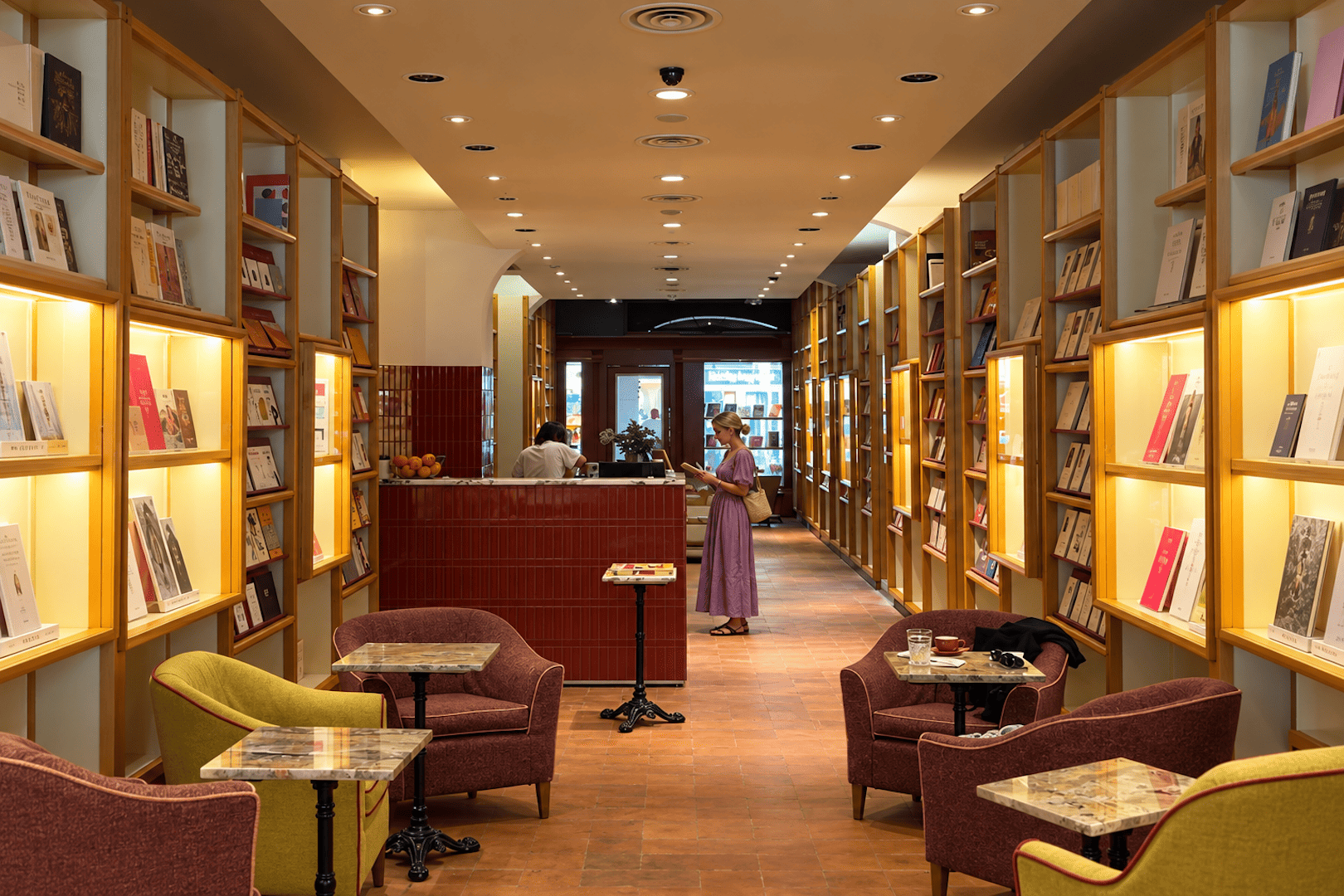
We’re willing to bet that inside this beautiful bookstore you’ll feel even more at home than on your own sofa, especially with a good book and a steaming coffee in front of you. Brac&Co, the new space at Borgo Ognissanti 97r in Florence, has exactly that kind of atmosphere: warm, intimate and made for staying longer than planned. An extension of Libreria Brac in Via dei Vagellai, it was created by co-owners Melisa Di Nardo and Sandro Sandri Olmo around a selection of books chosen for their content and for the care that goes into making them. Art books sit alongside fiction and essays, while limited editions and numbered prints turn browsing into something closer to discovering objects you want to live with. There is also a café, which makes the temptation to settle in for the afternoon even stronger. The best part is that books were already part of this address long before Brac&Co arrived. Before the space became the historic Benigni shoe shop, run by Fiorella and Giuliano, generations of the Bruscoli family worked here as printers and bookbinders. Di Nardo says they immediately felt the space could become a bookstore and only later discovered, with some surprise, that it had once housed a restoration workshop. Existing structures and furnishings were preserved, restored and adapted to the new collections, giving the project an unexpected connection with what happened inside these rooms decades ago.
Why Independent Publishing and Book Design Matter at Brac&Co
Brac&Co pays particular attention to publishers that still treat the book itself as part of the creative process. Its selection includes Tallone, Franco Maria Ricci, Nuages, Henry Beyle, Else, La grande illusion, Tara Books, Ronzani, Boîte Editions, Ediciones Comisura and Gost. From Mantua-based Corraini, the bookstore also carries texts and numbered prints by artists including Bruno Munari. Here, paper matters. Typography matters too. Some volumes are explicitly dedicated to the history of printing or publishing, while others communicate that culture through the way they have been designed and produced. You start looking at a book before you have even read the first page, which makes browsing feel much closer to discovering an object than simply scanning titles on a shelf.
How Is Brac&Co Different from Libreria Brac?
Anyone who already knows Brac in Via dei Vagellai will recognise the same curiosity around independent publishing, although the new space follows a broader editorial direction. According to Di Nardo, Brac&Co moves beyond a selection closely tied to contemporary art, opening its shelves to narrative, essays and illustrated books alongside artist editions. The Borgo Ognissanti space also has no kitchen, while the café serves natural drinks such as kombucha and juices, together with vegetarian and vegan food and desserts. A small newsstand area will also be added following requests from visitors, bringing newspapers and magazines into the space. That mix makes Brac&Co feel less like a specialist shop and more like a place where different kinds of readers can spend time, moving from a book to a print and perhaps discovering something they had never planned to look for.
The History of Bookbinding and Printing Behind Brac&Co
The story goes back to 1881, when Egisto Bruscoli founded a bookbinding and printing company in Via dell’Anguillara. His sons Carlo and Francesco later joined the business, and in 1930 Francesco moved the activity to the Borgo Ognissanti and Via Montebello area, later adding leatherwork to bookbinding. His expertise eventually led the Biblioteca Laurenziana to invite him to establish a restoration workshop inside the monastery of San Lorenzo, where particularly precious volumes could be treated without having to be transported elsewhere. It is easy to imagine these rooms filled with presses and movable type, with books being bound by hand. Today, contemporary publishing has returned to the same stretch of Florence. The context has changed completely, yet the attention to paper and the physical life of a book somehow feels perfectly at home here.
Why Brac&Co Is Worth Exploring for Art and Design Students
Books share the space with limited editions, numbered prints and works of art, alongside fine-art materials from names including Viarco, Nitram, Molotow and Lamy. The original Brac&Co selection also includes specialist papers and products from international art-material brands, giving the bookstore another dimension for anyone working in art or design. For students especially, it is the kind of place where one thing easily leads to another. You might arrive looking for a book and leave thinking about paper or an artist edition you had never seen before. That sense of discovery is probably one of the best reasons to browse slowly.
Brac&Co and the Cultural Identity of Borgo Ognissanti
Di Nardo and Sandri Olmo have lived in the neighbourhood for fourteen years, and their relationship with it is part of the project. Di Nardo describes an area where a strong sense of community still survives through local shops and bakeries, and says the first response to Brac&Co has been warm and curious. Their aim is to bring different audiences closer to publishing they consider courageous and refined. Visitors from outside Florence are part of that conversation too. The idea is that someone entering Brac&Co can also encounter a fragment of the city’s printing and typographic history. Di Nardo connects this to a wider responsibility towards Florence itself: keeping its identity alive also means learning again how to recognise the authenticity of its places.
Save the Date: Cinzia Cognetti with Lilith Moscon at Brac&Co
On October 15, in the afternoon, Brac&Co will host Cinzia Cognetti for the presentation of her debut novel, Note a margine del mio dolore, published by HarperCollins. The conversation will be led by Lilith Moscon, writer and therapist (and the author of beautiful books for young readers). The novel follows Eva, a young trainee lawyer who returns from Rome to Bari after her father decides to sell the family home. There, the memory of her mother Ambra resurfaces through the objects she left behind, until a hidden diary reveals a secret love connected to a man named Fabio and to the siege of Sarajevo. Eva’s relationship with Valentina gradually creates another space in which she can understand herself. Cognetti’s debut explores grief as part of the construction of identity and the moment when we realise that the people we love always contain parts of themselves we never fully knew.


