By Sofia Ble. Images reworked from materials available on the Palazzo Strozzi website.
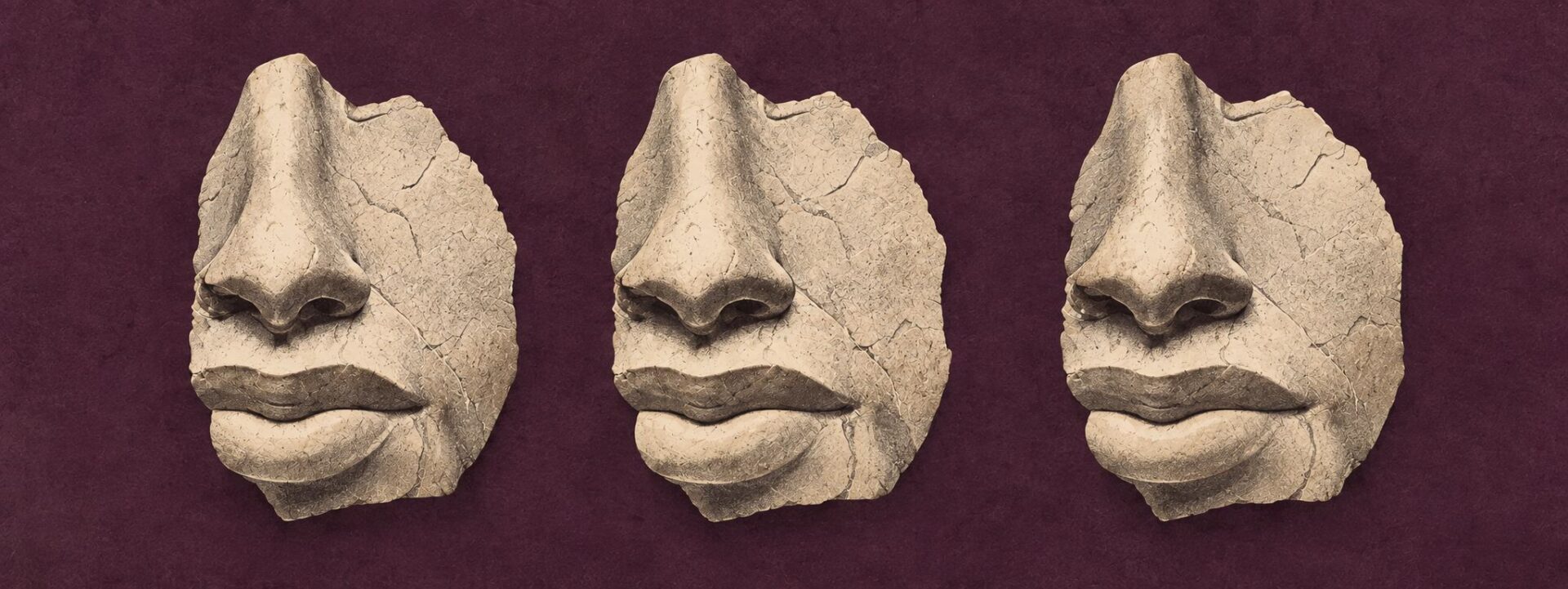
We haven’t seen Broken. The Power of the Fragment yet, because the new Palazzo Strozzi exhibition opens in Florence on September 25, 2026, but we are already counting the days. A missing face, a damaged body or a piece of sculpture separated from everything that once surrounded it can completely change the way we look at an artwork, and this is exactly where Broken begins, bringing together more than eighty works and artefacts to explore the fragment as something capable of acquiring a life and meaning of its own. Organised by Fondazione Palazzo Strozzi with the National Gallery of Art in Washington, the exhibition moves from archaeology to contemporary art, placing Michelangelo and Rodin in the same wider story as Louise Bourgeois and Danh Vo while asking how an object can continue to speak to us after its original form has disappeared. The project will later travel to Washington in a renewed version from March 3 to June 27, 2027.
Why are we so fascinated by broken things?
A fragment immediately creates space for imagination because what survives carries the marks of everything that has happened to it, and Broken looks at sculpture through precisely this idea, considering the fragment as an autonomous object capable of holding memory and transformation rather than simply as what remains of something once complete. Some works carry the traces of ancient or modern iconoclasm, while others were changed by war, revolution, vandalism or natural disaster, including the Florence flood of 1966, and together they show how a fracture can give a sculpture new artistic, political or symbolic meaning while turning the fragment into a way of understanding the past and questioning the present. The exhibition is curated by C.D. Dickerson III and Andrew Sears of the National Gallery of Art, in collaboration with Arturo Galansino, Director General of Fondazione Palazzo Strozzi.
More than 80 works travel across centuries
The exhibition brings more than eighty works and artefacts to Florence from major international collections including the Metropolitan Museum of Art in New York, the Louvre in Paris, the British Museum in London and the Museo Nacional de Antropología in Mexico City, creating a route that crosses very different periods and cultures. Ancient Egypt appears alongside the Etruscan and Greco-Roman worlds, while the exhibition also reaches premodern cultures from territories corresponding to present-day Mexico, Mali, Peru and Cambodia, before arriving at artists including Giovanni Pisano, Michelangelo and Auguste Rodin and contemporary figures such as Huma Bhabha, Robert Gober and Francesco Vezzoli.
When the fragment becomes an artistic choice
One of the ideas that makes Broken particularly relevant today is that fragmentation can also begin as a deliberate artistic decision, because an incomplete body or an isolated part can become the starting point for a new work and change the relationship between the viewer and what stands in front of them. Palazzo Strozzi places artists who have actively used the fragment as an expressive language alongside objects whose appearance was altered by history, allowing very different moments in time to meet through the same question of what happens when completeness stops being necessary.
Mark Manders takes over the Palazzo Strozzi courtyard
The conversation begins before you even enter the Piano Nobile, because Dutch-Belgian artist Mark Manders has created a new installation for Palazzo Strozzi’s Renaissance courtyard around his monumental Tilted Head, a sculpture that appears fragile and unfinished, almost as if it had survived from a lost civilisation. What looks like clay is actually a resin cast of the original clay model produced specifically for the exhibition, and that uncertainty between appearance and reality becomes part of the work itself, fitting naturally into Broken’s wider exploration of memory, perception and the way we construct meaning from what survives. Manders’ practice has long explored the relationship between matter and idea, with the fragment returning as something suspended between archaeology and imagination.
Broken turns incompleteness into the main story
What makes the premise of Broken so compelling is that the exhibition does not treat a damaged work simply as evidence of something that has been lost, because the fragment itself becomes the object we are asked to look at and understand, carrying the history of what happened to it while gaining another identity in the process. That shift opens up a much wider way of thinking about sculpture, where absence can become part of the work and the traces left by time can be as significant as the form an artist originally intended. It is also why we are already counting down to September 25: Broken seems designed to make us look longer at the parts we might usually dismiss as incomplete.


