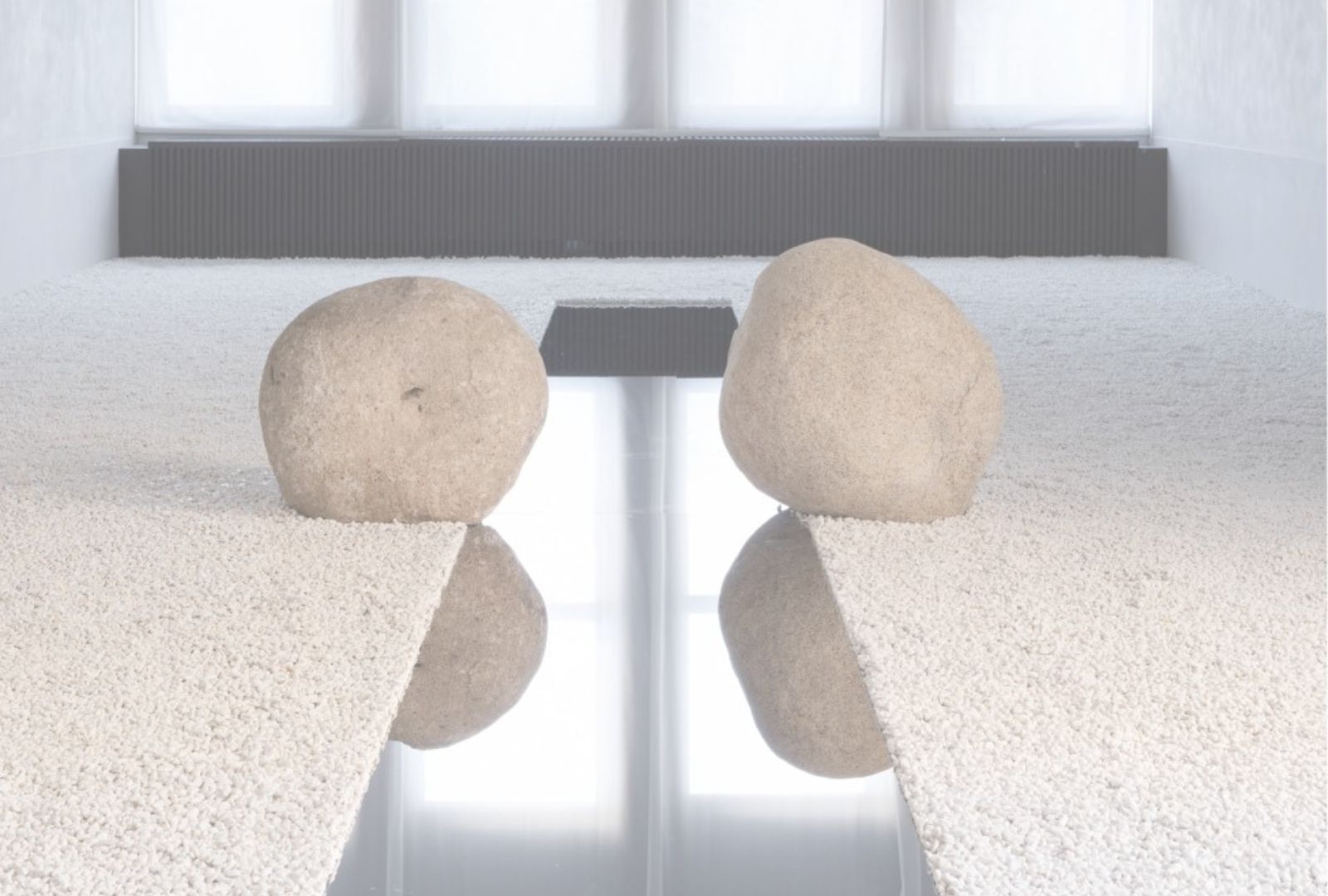
By Rebecca Ceccatelli. Lee Ufan at SMAC Venice. Ph. Lorenzo Palmieri
The 61st edition of the Venice Biennale is here, and it has already sparked intense debate — not only for its artistic propositions, but also for the political tensions, protests, and public conversations that have once again transformed Venice into a stage where contemporary art and current affairs inevitably collide.
By now, much has already been written about this year’s Biennale. Many of you may have rushed to Venice during opening weekend, weaving through crowded vaporetto stops, packed vernissages, and endless exhibition routes; others are likely planning a visit in the months ahead. Yet, beyond the official pavilions and headline exhibitions, Venice during the Biennale reveals another kind of vitality altogether.
What follows is a series of alternative routes through the city: exhibitions, independent spaces, foundations, and collateral events that exist outside the Biennale’s orbit. Because while a weekend may be enough to glimpse the main exhibition, a longer stay reveals the extraordinary cultural ecosystem that emerges across Venice during these months, one that stretches far beyond the Giardini and the Arsenale.
Erwin Wurm at Museo Fortuny: Where Humour Meets the Uncanny
6th May – 22nd November 2026
There is something unexpectedly perfect about encountering Erwin Wurm’s swollen, distorted sculptures inside the dark and layered interiors of Palazzo Fortuny. Spread across the museum’s three floors, Dreamers places new works alongside some of the artist’s most recognisable series, creating a dialogue between Wurm’s ironic contemporary language and the historic atmosphere of the palace.
Humour is central to Wurm’s practice, but so is a subtle sense of discomfort. His exaggerated bodies and altered objects become reflections on consumption, social pressure, and the strange performativity of everyday life. Within the shadowy elegance of Palazzo Fortuny, these sculptures feel at once playful and unsettling, acquiring an almost uncanny presence — at once comic, melancholic, and deeply human.
Strange Rules at Palazzo Diedo: Inside the Age of Algorithms
4th May – 22nd November 2026
Among the most ambitious new openings this season, Strange Rules transforms Palazzo Diedo into a space where contemporary art, technology, and research continuously overlap. Rather than focusing on digital aesthetics alone, the exhibition explores the invisible systems that increasingly shape how culture is produced and experienced today: algorithms, AI models, platforms, and technological infrastructures become the exhibition’s actual material.
The project revolves around the idea of “Protocol Art”, a field that shifts attention away from the finished artwork and toward the rules, instructions, and systems behind it. Spread across the palace’s different floors — between immersive installations, video works, performances, and collaborative commissions — the show feels like an evolving laboratory for thinking through the relationship between humans, machines, and authorship.
Lara Favaretto at Biblioteca Nazionale Marciana: Where Memory Meets the Archive
9th May – 22nd November 2026
Inside the monumental rooms of the Biblioteca Nazionale Marciana, founded around Cardinal Bessarion’s collection and designed by Jacopo Sansovino, Lara Favaretto presents the final chapter of her long-running project Momentary Monument – The Library. The installation gathers hundreds of books sourced from universities, institutions, and private collections, arranged within a large shelving structure that functions both as archive and exhibition display.
Each volume is paired with an image from the artist’s personal archive, building a living system of references, memories, and fragments where rarity is beside the point. The result feels quiet yet deeply layered, transforming the library into a space where knowledge appears unstable, constantly shifting between preservation and disappearance.
Canicula at Complesso dell’Ospedaletto: Eight Artists, One Hypnotic Experience
6th May – 22nd November 2026
With Canicula, Fondazione In Between Art Film concludes its Trilogy of Uncertainty, once again transforming the spaces of the Complesso dell’Ospedaletto into a striking “cinematic architecture.” Curated by Alessandro Rabottini and Leonardo Bigazzi, the exhibition brings together eight newly commissioned site-specific video installations by international artists including Lawrence Abu Hamdan, Janis Rafa, P. Staff, and Maya Watanabe.
Moving through the exhibition feels almost like entering a sequence of suspended emotional states: darkened rooms, immersive soundscapes, and fragmented narratives continuously blur the line between film, installation, and physical experience. The title, derived from the Latin word for the “dog days” of summer, evokes a moment poised between vitality and collapse — a tension that runs throughout the exhibition and gives Canicula its unsettling and hypnotic atmosphere.
Hernan Bas at Ca’ Pesaro: The Paintings That Feel Like Unfinished Stories
7th May – 30th August 2026
For his first major exhibition in Venice, Hernan Bas brings his theatrical and dreamlike universe to the rooms of Ca’ Pesaro. The Visitors unfolds through a series of paintings inhabited by solitary figures, ambiguous characters, and suspended narratives that seem to exist somewhere between adolescence, performance, and fantasy.
Bas’ works are filled with literary references and subtle humour, but also with a sense of melancholy that quietly runs beneath their lush surfaces. Seen within the historic interiors of Ca’ Pesaro, these scenes feel almost cinematic, as though each painting were part of a larger story left deliberately unresolved.
Joseph Kosuth at Casa dei Tre Oci: Inside the Fragility of Language
6th May – 22nd November 2026
The-exchange-value-of-language-has-fallen-to-zero, Kosuth’s new show at Casa dei Tre Oci, asks visitors to slow down and pay attention to language itself: how meaning is constructed, how words shape reality, and how fragile communication can become.
The exhibition moves through a selection of historical works spanning several decades, including pieces originally connected to the 1976 Venice Biennale, creating a subtle dialogue between different moments in the city’s cultural history. Inspired by Michel Foucault, the exhibition brings together historical works and language-based installations that continue Kosuth’s long investigation into how meaning is constructed, shared, and destabilised.
Rather than feeling archival, the show remains surprisingly sharp and contemporary, particularly in the way it reflects on communication, authorship, and the fragility of language itself. Works such as One and Three Mirrors and Text/Context resonate strongly within today’s hyper-mediated reality, while the reappearance of projects originally connected to the 1976 Venice Biennale creates an interesting bridge between past and present.
Rachel Youn at Scuola Piccola Zattere: Inside a World That Won’t Stop Moving
8th May – 18th October 2026
One of the most curious and slightly uncanny exhibitions this season can be found at Scuola Piccola Zattere, where Rachel Youn transforms discarded wellness devices, exercise machines, and artificial plants into restless kinetic sculptures. Nothing in Unruly Vessel ever seems fully still: objects vibrate, rock, repeat gestures endlessly, creating an atmosphere suspended somewhere between care and exhaustion, pleasure and discomfort.
Developed during the artist’s residency in Venice, the exhibition draws unexpected connections between self-optimisation culture, religious ritual, and systems of bodily control. Some of the strongest works reference rowing benches and the historic image of the “ship of fools,” turning repetitive mechanical movement into something almost absurdly theatrical. The result is both funny and disturbing at the same time — the kind of exhibition that catches you slightly off guard and lingers in your mind afterwards.
Lee Ufan at San Marco Art Center: How to Find Silence in Venice
9th May – 22nd November 2026
Finally, few exhibitions this season feel as calm and meditative as the intervention dedicated to Lee Ufan at San Marco Art Center. Spread across the eight rooms of the newly opened SMAC Venice in Piazza San Marco, the exhibition brings together works spanning nearly seven decades, from historical paintings to large-scale installations and a new site-specific commission created for the space.
A central figure of both the Japanese Mono-ha movement and Korean Dansaekhwa painting, Lee has spent decades exploring the relationship between gesture, emptiness, material, and perception. His works often appear minimal at first glance, yet they demand a slower kind of attention: brushstrokes, stones, steel, and open space become ways of measuring time and presence rather than simply producing images.
In the middle of Venice’s usual Biennale intensity, the exhibition offers something increasingly rare: silence, balance, and the possibility of looking carefully. It feels less like moving through a retrospective and more like entering a sequence of spaces designed for reflection.


