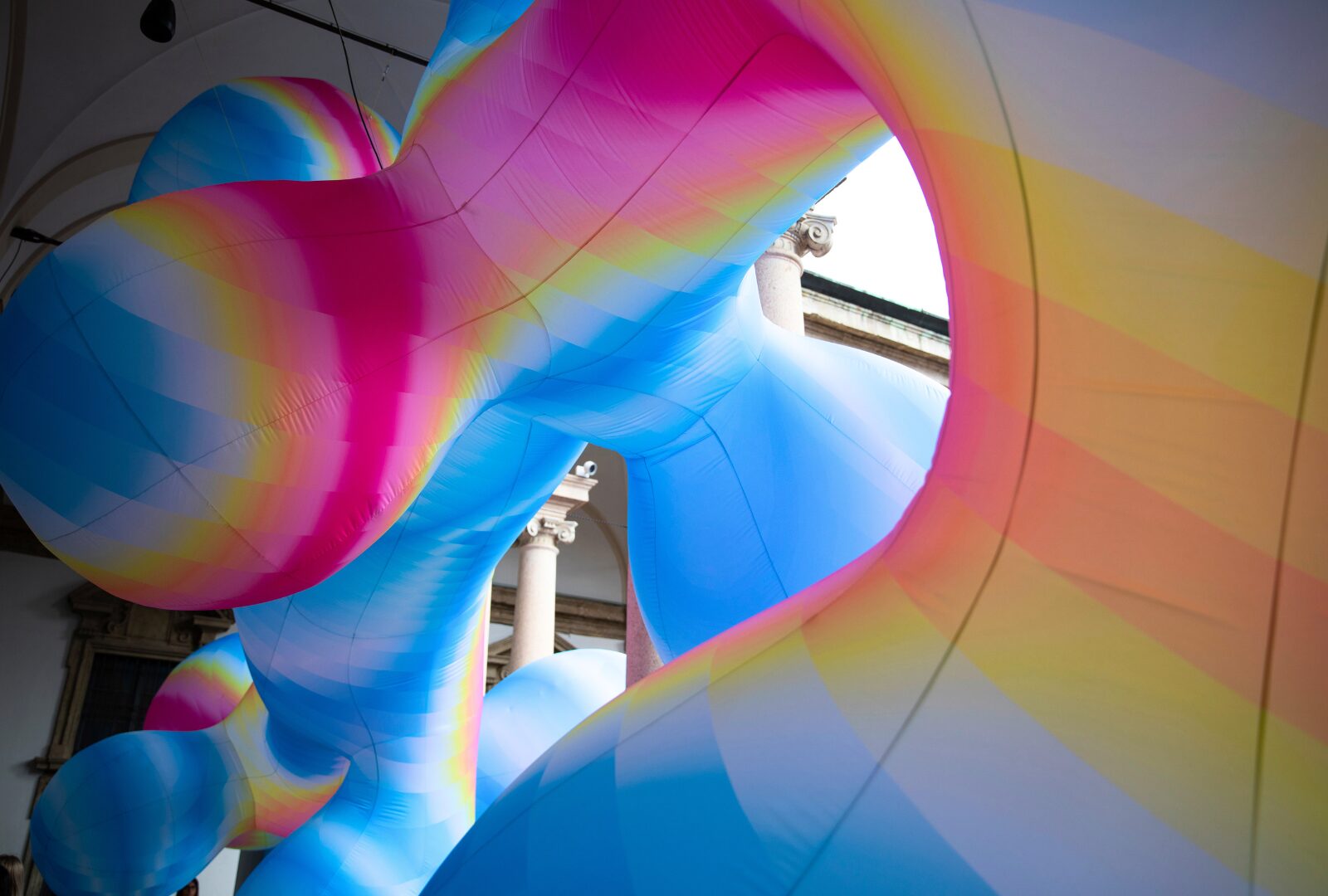
By Giulia Piceni. Cover image Amex installation by Sara Ricciardi at Palazzo Brera. Ph. Lorenzo Fraschetti
To arrive in Milan on the eve of Fuorisalone was to encounter a city already absorbed into its own projection. The sudden accessibility of courtyards, the theatrical reactivation of palazzi, and the convergence of design, fashion, and art did not simply expand the cultural offer of the city but reorganised it into a continuous field of visibility. What emerged was a constellation of distinct experiences rather than a carefully orchestrated surface of beauty to admire. The installations appeared already mediated, as if conceived not to be seen but to be translated into images that would persist long after their material dismantling. Within such a framework, the expectation of excitement felt less spontaneous than prescribed, as though enthusiasm itself were part of the script one was tacitly invited to perform.
May the FOMO Be With You
This sense of premediation became particularly evident in the anticipatory phase that preceded the week. The proliferation of event calendars, shared with a frequency that bordered on compulsion, produced a form of cognitive saturation that undermined the very possibility of desire. One was confronted with an excess where the distinction between what was essential and what was merely available collapsed under the weight of abundance. FOMO, in this context, is a structural condition that organises participation. The subject is positioned not as someone who attends, but as someone who inevitably fails to attend everything. To navigate this condition requires a form of selective refusal that is at once practical and critical. To choose becomes a way of reclaiming a degree of agency within a system that thrives on the illusion of total accessibility. The crowd itself reinforces this dynamic, each engaged in the production of an image that confirms their presence within the event.
Why Are People Selling Their Free Design Week Gifts on Vinted?
A different but related issue unfolded through the circulation of objects that accompanied the week. The distribution of free artefacts, ostensibly designed to extend the experience beyond its temporal limits, revealed a more ambivalent logic. These items did not merely operate as souvenirs but entered into a broader economy in which their value was defined by their potential for display and exchange. Their rapid migration onto platforms such as Vinted exposed the extent to which the experience itself was entangled with speculative forms of consumption. The queue, in this sense, became a site of calculation, where time invested was measured against the anticipated return, whether symbolic or monetary. What was framed as a gesture of cultural generosity risked being reduced to a transactional mechanism, in which the object preceded and, in some cases, eclipsed the encounter it was meant to commemorate. To resist this logic entails a conscious disengagement from the imperative to acquire, an attempt to re-situate the object within the ephemeral temporality of the event rather than within the enduring circuits of accumulation.
Are Cultural Installations Designed to Be Seen or Just Photographed?
More problematic still was the increasing dominance of aesthetic surface over interpretative depth. The installations that populated the city were frequently calibrated to produce immediate visual impact, their formal qualities aligned with the demands of photographic reproduction. This does not necessarily imply a lack of conceptual ambition, but it does suggest a reorientation of priorities, in which the conditions of visibility exert a determining influence on the work itself. The spectator is thereby repositioned as an operator, tasked with extracting an image that will stand in for the experience as a whole. The act of looking becomes inseparable from the act of capturing, and the temporality of engagement is compressed into a series of fleeting encounters. To counter this tendency requires an investment in duration that appears increasingly at odds with the rhythm of the event. It involves remaining with a work beyond the moment of its initial legibility, allowing its surface to exhaust itself in order to ascertain whether anything persists beneath it. In many instances, what emerges is not a hidden complexity but a conspicuous flatness, a confirmation that the image was never a secondary aspect of the work but its primary condition of existence.
Why No One Is Allowed to Criticise a Cultural Event
The erosion of critical distance further complicates the possibility of meaningful engagement. Within the context of Fuorisalone, critique is often displaced by a tacit consensus that privileges affirmation over interrogation. This is not merely a matter of individual disposition but a consequence of the structural entanglement between cultural production and branding strategies. Installations are frequently embedded within promotional frameworks that render their evaluation inseparable from their function as instruments of visibility. To question their coherence or relevance risks disrupting a network of relations that extends beyond the work itself, implicating institutions, sponsors, and audiences alike. Under such conditions, the suspension of judgement becomes a form of social compliance, while the exercise of critique acquires the character of a minor transgression. To insist on critical distance is therefore to reassert the autonomy of perception in a context that subtly discourages it, to recognise that disengagement can function as a legitimate mode of engagement.
The Inclusivity Myth: Who Does Culture Actually Belong To?
Equally significant is the incoherence between the rhetoric of openness and the reality of cultural literacy. While the events are nominally accessible to all, their intelligibility often presupposes a familiarity with a set of implicit codes that are unevenly distributed. The ability to navigate the city during this period, to identify what is worth seeing and to interpret what one encounters, constitutes a form of knowledge that cannot be taken for granted. The inclusivity that is so frequently celebrated risks obscuring the mechanisms through which exclusion continues to operate, not through overt barriers but through more subtle forms of differentiation. To move through these spaces without fully mastering their language can produce a sense of estrangement, yet this estrangement may also serve as a critical vantage point from which to observe the processes that sustain the illusion of universal accessibility.
When the Cultural Event Is Over, What Actually Remains?
Finally, there is the question of temporality, which underpins the entire structure of the event. Culture, in this configuration, is increasingly organised around the logic of the occasion, defined by its intensity, its concentration, and its inevitable disappearance. What is produced is not only a series of works but a sequence of moments that demand to be experienced within a limited timeframe. Once the week concludes, the installations are dismantled, the spaces revert to their previous functions, and what remains is largely immaterial, preserved in the form of images and narratives that circulate independently of their original context. The encounter with culture thus becomes both immediate and elusive, fully present in the moment of its occurrence yet resistant to any sustained form of engagement. This raises a more fundamental question about the conditions under which culture is produced and consumed, and about the extent to which the event has come to define not only how we experience culture, but how we conceive of it in the first place.


