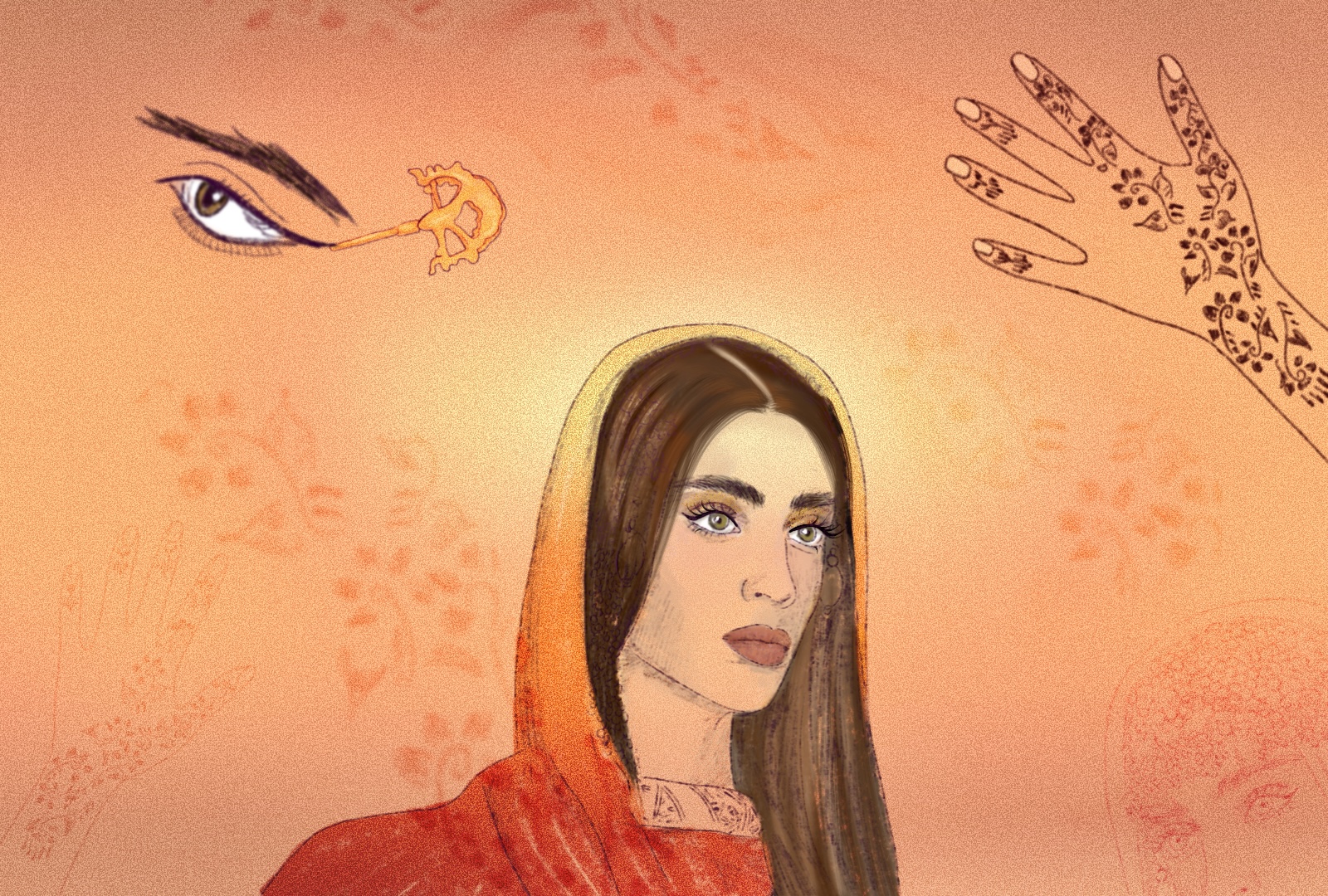
By Sanjana Viswanath Mundhwa. Cover by Taleen Raed Eid Nesheiwat.
Whether the West chooses to accept it or not, the majority of our most celebrated beauty trends are not inventions of the modern age. Instead, they are rooted in Arabic and Indian cultures, supported by a depth of science and philosophy that is only now beginning to be understood. In Arabic and Indian traditions, beauty has never been merely surface-level. It is ritual, inheritance and intention, woven into the fabric of daily life. These practices are not isolated “hacks” or beauty shortcuts, they are part of larger systems, most notably Ayurveda, which dates back roughly 5,000 years, making it one of the world’s oldest holistic wellness systems.
Today, however, many of these rituals are being lifted out of context and repackaged as bite-sized, fleeting trends, often stripped of their depth and meaning. The question is no longer whether these beauty rituals work, but why their origins are so consistently left out of the conversation.
Hair Oiling: From Ayurvedic Tradition to TikTok’s Sunday Reset
Hair oiling is perhaps the clearest example of a cultural tradition being reframed as a modern trend. While it currently dominates TikTok and beauty editorials worldwide, the ritual itself stems from Indian Ayurveda and has been practised across South Asia for over 5,000 years.
Traditionally, oils such as coconut, amla, neem, bhringraj and sesame were selected according to hair type, season and the body’s internal balance. In Ayurvedic practice, for example, sesame oil is often recommended during colder months, while coconut oil is favoured for its cooling properties in warmer climates.
Modern research supports these longstanding traditions. Studies, including a frequently cited review published in the Journal of Cosmetic Science, have found that coconut oil in particular can reduce protein loss in hair fibres, helping to prevent breakage and dryness. Beyond the science, what makes this ritual so powerful is its emotional dimension. In many South Asian households, including my own, hair oiling is an act of care and bonding passed through generations, often from mother to daughter. What is now framed as a luxurious Sunday reset was historically a deeply familial gesture.
What Is Mehndi? The Ancient Ritual Behind the Henna Trend
Henna, known as mehndi in Hindi, is far older than many realise. Its use has been traced back at least 3,000 years, with evidence of its presence spanning India, Persia and the Arab world.
In both Indian and Arabic cultures, mehndi is not simply decorative. It is symbolic, traditionally used for weddings, Eid and Diwali celebrations, and other rites of passage. Certain motifs carry specific meaning, associated with prosperity, fertility, joy and protection.
Today, adaptations such as “henna freckles”, henna hair dye or minimalist festival body art at events like Coachella circulate as temporary aesthetics. Yet what is frequently overlooked is the visual language and symbolism embedded in traditional mehndi designs.
Oud: The Arabic Perfume Ingredient That Took Over Luxury Fragrance
From Tom Ford’s Oud Wood to niche Middle Eastern-inspired collections from luxury houses, oud has become one of the most striking fragrance trends to emerge in Western markets. Often described as rich, smoky and complex, oud derives from resin-saturated agarwood and has been central to Arabic perfumery for centuries.
Having grown up in the Middle East with the region’s culture and practices woven into my daily life, I can say that fragrance there is not merely an accessory, it is part of identity and hospitality. Smelling well-presented is a mark of respect. Oud is traditionally used not only as a perfume oil but also as a fragrant incense known as bakhoor, burned to scent clothes, homes and gatherings. Its growing presence in Western luxury fragrance reflects a broader fascination with Middle Eastern scent profiles, yet the cultural significance of oud as a marker of status, ritual and hospitality is rarely acknowledged.
Turmeric, Rose Water, Saffron: The Ingredients in Your Skincare That Come from Ancient Traditions
Many ingredients currently dominating the DIY skincare market have, in fact, been staples of Indian and Arabic households for centuries.
Turmeric has been used in Indian beauty rituals for generations, commonly recognised for its ability to calm hyperpigmentation and promote a more even, radiant complexion. It also carries deep ceremonial significance, most notably in the Haldi ceremony performed before Indian weddings. Today, the same ingredient is repackaged under a skin-brightening sales pitch in various Western creams and face masks.
Rose water has long been used across Arabic and Indian skincare, as well as in Arabic perfumery.
Moringa, now marketed as a “superfood” in supplement form, has been a staple of Indian Ayurvedic medicine, beauty and cooking for generations.
Saffron has historically been associated with brightening and luxury in both cultures.
These ingredients predate modern cosmetics by thousands of years. What was once considered traditional — or even dismissed as old-fashioned — is now sold as innovation. The irony speaks for itself.
Kajal: The Ancient Eye Ritual the Eyeliner Trend Never Credits
Long before the Western waterline eyeliner trend, kajal was used across South Asia and the Middle East for both aesthetic and practical purposes.
Its use can be traced back to ancient civilisations as far back as 3000 BC. Traditionally, kajal was believed to protect the eyes from sunlight and dust, while also providing a cooling sensation that helped relieve irritation and fatigue. Today’s smudged eyeliner and waterline looks mirror this aesthetic almost exactly — without acknowledging the centuries of cultural lineage behind it.
What Is Cultural Appropriation in Beauty and Why Does It Matter?
What makes this conversation more complex, and that much more important, is the way these practices seem to gain legitimacy only once filtered through Western branding. Hair oiling becomes “luxury scalp care”. Mehndi becomes “festival body art”. Oud becomes “niche luxury fragrance”. The issue is not cultural exchange itself, but the loss of context and the erasure of ownership. Practices that were once overlooked, exoticised or even mocked often gain acceptance only when reintroduced through Western beauty standards.
Cultural exchange in beauty can be enriching when it is rooted in respect and acknowledgement. Without the origin story, however, it risks becoming erasure.
These are not just trends. They are traditions, some thousands of years old, carrying memory, heritage and meaning that extend far beyond aesthetics. These practices survived centuries without Western validation. The least we can do now is learn where they actually come from.
Perhaps the real trend today is not discovery, but recognition.


