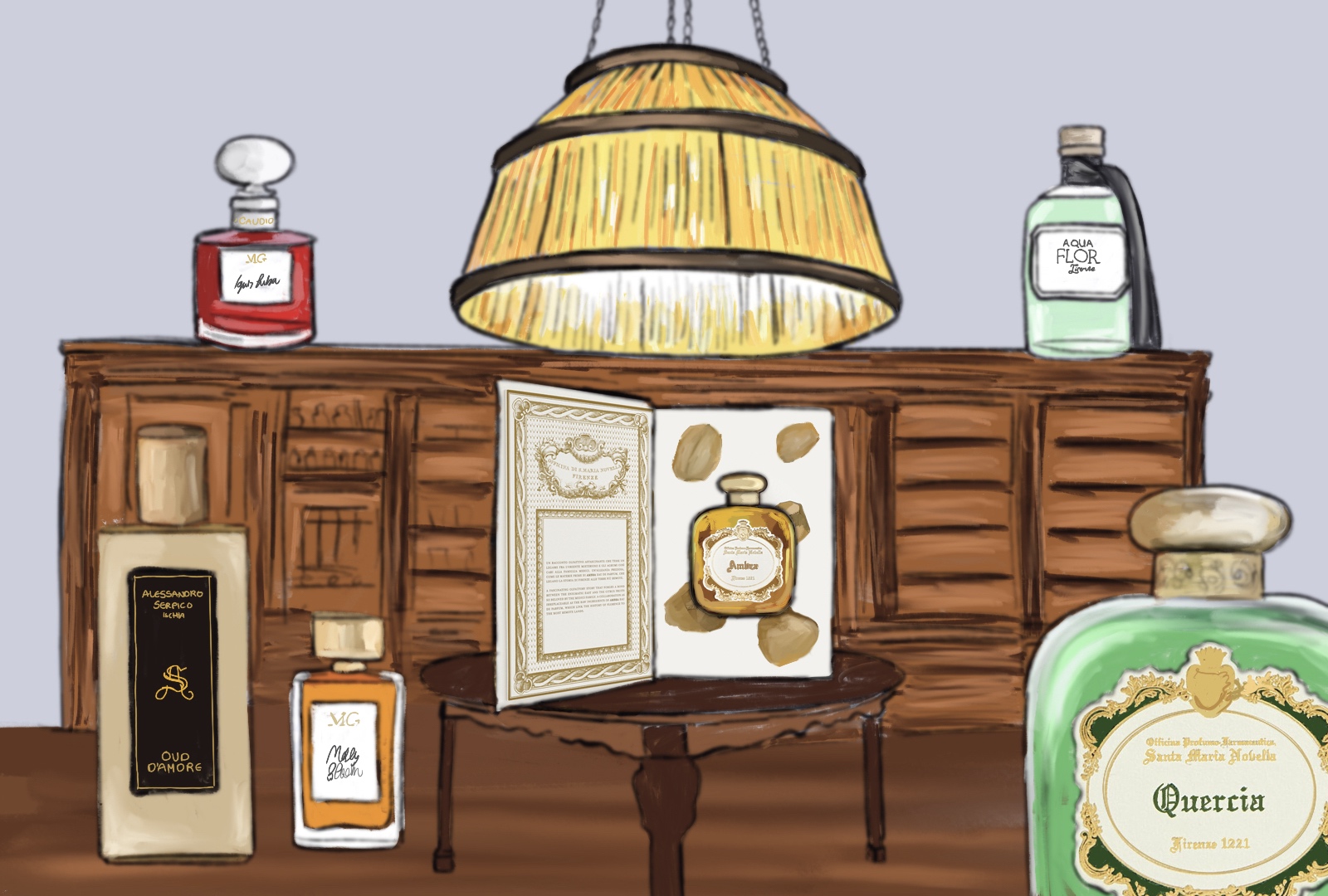
By Isabella Medrado. Cover by Taline Nesheiwat.
There’s a version of Florence that never made it onto the tourist map, where tradition is bottled, bound, and breathed in. A city where perfumery never stopped being a serious pursuit: rooted in monastic apothecaries, refined over centuries, and still alive today in back-street workshops and quiet ateliers that most visitors walk straight past. These seven spots belong to that Florence. Some are institutions, some are barely-known discoveries. All of them offer something you won’t find in a duty-free: fragrance that is handcrafted, thoughtfully developed, and genuinely rooted in where it comes from.
Alessandro Serpico Parfum: Fragrance as a Personal Practice
Located in San Niccolò — an artisan-heavy, non-touristy neighbourhood — this boutique belongs to an independent Italian perfumer with an unusual origin story. Alessandro Serpico began his career as a dancer, drawn to the psycho-physical balance that movement requires. That search led him to the natural world: collecting flowers, plants, salts, and roots from his native island of Ischia, he discovered a way to work with raw materials that don’t overload the skin or damage the environment. The boutique carries that quietness into its atmosphere — intimate, unhurried, and full of things that feel genuinely handmade. From lemon body oils to soaps and parfums, each piece is its own small world.
Via di S. Niccolò, 67 R, Florence
Magno Gaudio: Florence’s Best-Kept Olfactory Secret
A tiny, almost invisible shop in the Oltrarno. The kind of place only the most committed fragrance lovers tend to find — and they rarely tell anyone about it. Magno Gaudio feels like entering a private lab: no big branding, no retail logic, just hand-decanted perfumes made entirely from scratch. Founded in 2021 by Luca Fisichella, the project had been quietly developing for seven years before it opened to the public. Fisichella calls it his “olfactory workshop,” where each scent begins with a memory or a place. The debut fragrance, Nº1, opens on the ancient streets of Palermo on a spring morning — bergamot, neroli, and black pepper — before settling into magnolia, tonka bean, vetiver, amber, and patchouli. It’s the kind of discovery that stays with you.
Via Maggio 45r, Florence (Oltrarno area)
Sileno Cheloni: The Philosopher of Florentine Perfumery
One of the most philosophical figures in contemporary Florentine perfumery, Sileno Cheloni built his name from deep Tuscan roots into something respected at the highest levels of the industry. He has created ambient scents and luxury candles for brands including Gucci, designing experiences around “incense ceremonies” and “sensory dinners”. His philosophy is grounded in a simple chain: smell creates memory, memory builds identity, and fragrance becomes a way to rediscover yourself. Located in San Niccolò, the space doubles as an olfactory library, a massive archive of over 2,000 raw materials, where you can work with Cheloni to develop your own personal formula. The experience of stepping inside is, without exaggeration, therapeutic.
Via di San Niccolò 72R, Florence
Lorenzo Villoresi: Florence’s Most Complete Perfume House
Lorenzo Villoresi spent years travelling the Middle East, studying raw materials, spices, and incense before founding his maison in 1990. Most visitors walk in expecting a standard fragrance boutique, what they find is considerably more: an atelier where perfumes are formulated, tested, and refined; a perfume museum; and a garden of aromatic plants used directly in the perfumery. Three of the brand’s signature creations — Teint de Neige, Alamut, and Piper Nigrum — cover an extraordinary range, from powdery, delicate florals to explosions of spice, pepper, and cloves. Villoresi’s philosophy holds that “each scent is a world unto itself”. Visiting confirms it.
Via de Bardi 12, Florence
AquaFlor: A Living Atelier of Florentine Perfumery
Slightly off the main tourist flow, near Santa Croce and set inside Palazzo Corsini Antinori Serristori, AquaFlor is one of those places that rewards wandering. The real working lab sits beneath the palazzo, where raw materials, blending stations, and perfumery tools make the craft visible. The store itself is designed to draw you into the process of finding your fragrance, including a glass-topped display system where each scent is revealed as you lift the cover, releasing the aroma in a controlled, almost ceremonial way. The atmosphere is dark and woody, with warm amber tones and carefully placed light that makes every product worth looking at. AquaFlor is a sensory experience as much as a shopping one.
Borgo Santa Croce 6, Florence
Vranjes Firenze: The Florentine Heritage Brand That Keeps Evolving
Founded in 1983 as the Antica Officina del Farmacista, Vranjes Firenze is one of the city’s most storied fragrance houses, and one of its most quietly global. Today the brand operates across 75 countries, with boutiques in Tokyo, Dubai, London, and beyond, but its heart remains firmly in Florence. The historic address is Via della Spada 9R, a short walk from Via de’ Tornabuoni, where the boutique offers a complete olfactory experience: personalised fragrance consultations, the full range of reed diffusers, scented candles, and home fragrances, alongside the personal perfume line the brand launched in 2022. In 2025 that line expanded into Firenze in Translation, a new collection of eight unisex Eau de Parfum, each one rooted in the city, each one pushing the house into new territory. For those wanting to explore further, Vranjes Firenze also has boutiques in Vigna Nuova and Borgo la Croce.
Via della Spada 9R, Florence
Officina Profumo-Farmaceutica di Santa Maria Novella: Where European Perfumery Began
The most iconic address on this list, and arguably in all of Florence. Open to the public since 1612 and rooted in its ties to the Medici Court, the Officina is less a shop than a living monument. The story begins in 1533, when Caterina de’ Medici commissioned a scent for her wedding. The resulting fragrance, Acqua della Regina, is still sold today. The house was founded by Dominican monks who grew botanical ingredients and medicinal herbs on the grounds; it never began as luxury, but as necessity. Walking inside means frescoed ceilings, chapel-like halls, and displays that feel more like an archive than a retail floor. It is not simply the oldest perfume house in Florence, it is the historical root of European perfumery.
Via della Scala 16, Florence


