
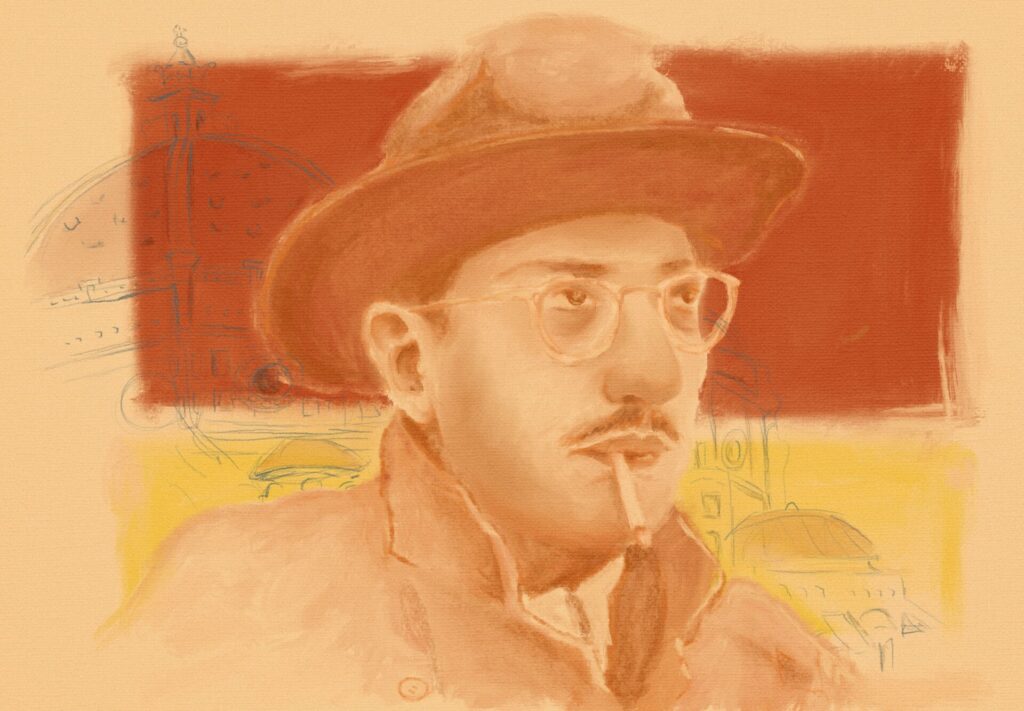
By Ana Karen García. Cover Image by Taline Nesheiwat for I’M Firenze Digest.
Rothko in Florence: A Major Exhibition at Palazzo Strozzi (2026)
There are paintings you simply look at. And then there are paintings that look back at you. Standing before a canvas by Mark Rothko is not about understanding composition or decoding symbolism. It is about entering a space — emotional, architectural, almost spiritual. From March 14 to August 23, 2026, Palazzo Strozziin Florence will host“Rothko in Florence”, one of the most important exhibitions of Mark Rothko ever held. More than a retrospective, the exhibition feels like a return — revealing how Florence’s architecture and culture of contemplation shaped Rothko’s understanding of space, color, and transcendence.
How Mark Rothko Turned Color into Pure Emotion
Rothko is often grouped under Abstract Expressionism, though he spent much of his life resisting the label. He never considered himself an abstract painter. On the canvas, he pursued something immediate and visceral: emotion — tragedy, ecstasy, doom, silence.
Born in 1903 and active in mid-century America, Rothko began with figurative works influenced by Expressionism and Surrealism. Over time, the human form gradually dissolved into floating shapes — soft, hovering “Multiforms” that would eventually evolve into his signature color fields. By the 1950s, his canvases had grown in scale and ambition. Vast rectangles of red, plum, ochre, and deep blue pulse against one another, suspended in luminous tension. These fields carry suggestion, narrative, feeling — and they create environments rather than decoration. Rothko painted the way he felt, not the way the world looked. Cities, landscapes, and figures melt away, leaving the interior logic of perception. What remains on the canvas is not a scene but a state of mind.
He believed that a painting should be experienced up close, almost enveloping the viewer. Scale matters. Light matters. Time matters. The surface seems to breathe; colors shift as you move. What looks simple at first — two or three floating rectangles — reveals instability and atmosphere under closer scrutiny. A Rothko is not decoded; it is lived. And the longer you stand, the more it opens.
Why Mark Rothko’s Paintings Demand That We Slow Down
A Rothko takes time. The longer you remain in front of it, the more the painting alters — reds warm, blues darken, the space between the forms grows charged. For him, painting functioned as an event unfolding in the present tense, shaped by duration and attention. Emotion lives in the surface, suspended in color. He preferred viewers to face the canvas alone, without commentary guiding the encounter. Meaning forms gradually, through proximity and patience. Analysis can come later. In the moment, what matters is the exchange between body and painting — the quiet recalibration that happens as you keep looking.
Auction records may assign the work a market value, measured in millions. The actual measure feels more private. It happens in the stretch of minutes spent standing there, when the room recedes and the canvas begins to feel atmospheric, almost architectural.
In a culture built on speed, that sustained attention carries weight. Rothko’s large paintings extend beyond aesthetics into something closer to a psychological space. Edges soften. Colors thicken. A subtle internal shift takes place. The experience moves from the eye to the body, like stepping into a chapel where color alone structures the silence. And that is where Florence enters the conversation.
Rothko in Florence: When Color Meets the City
The exhibition at Palazzo Strozzi traces Rothko’s evolution, from his early figurative works of the 1930s to the monumental abstractions of the 1950s and ’60s, with loans from the Museum of Modern Art, Tate, and other major institutions. What sets this show apart, however, is its dialogue with Florence itself.
Two satellite sections extend the exhibition into the city. At Museo di San Marco, five works engage directly with Fra Angelico’s frescoes, while at the Biblioteca Medicea Laurenziana, designed by Michelangelo, two additional paintings resonate with the vestibule that profoundly moved Rothko during his visits. For Christopher Rothko, co-curator of the exhibition and the artist’s son, bringing these works to Florence is deeply personal: managing the legacy of an artist whose paintings define twentieth-century spirituality is as much emotional as it is curatorial.
In Florence, Rothko’s paintings never hang in a neutral white cube. They converse with spaces conceived — like his canvases — as environments for contemplation. Rothko worked alone; no one entered his studio while he painted. His process was intimate, almost ritualistic. In this, he shares an unexpected kinship with Fra Angelico, who painted in the quiet of the convent of San Marco, creating frescoes meant for meditation, not spectacle. Centuries apart, both artists pursued a similar goal: transcendence through surface. Fra Angelico achieved it with divine figures in serene architectural space; Rothko stripped away the figure entirely, leaving fields of color capable of carrying the same emotional weight.
For decades, Rothko was framed as a radical break in Western painting — a move away from figuration and European tradition toward distinctly American abstraction. In Florence, that narrative softens. Among the frescoes of Fra Angelico and the austere architecture of the Biblioteca Medicea Laurenziana, Rothko’s work becomes part of a continuum. The colors begin to resemble contemporary frescoes stripped of iconography, their impact shaped as much by context as by paint.
The spiritual charge that animates Fra Angelico’s frescoes finds an abstract echo in Rothko’s canvases. Both create spaces for contemplation; both rely on silence. In Florence, where centuries of art have taught patience and stillness, Rothko invites a question that lingers long after the museum doors close: can abstraction itself feel devotional?


