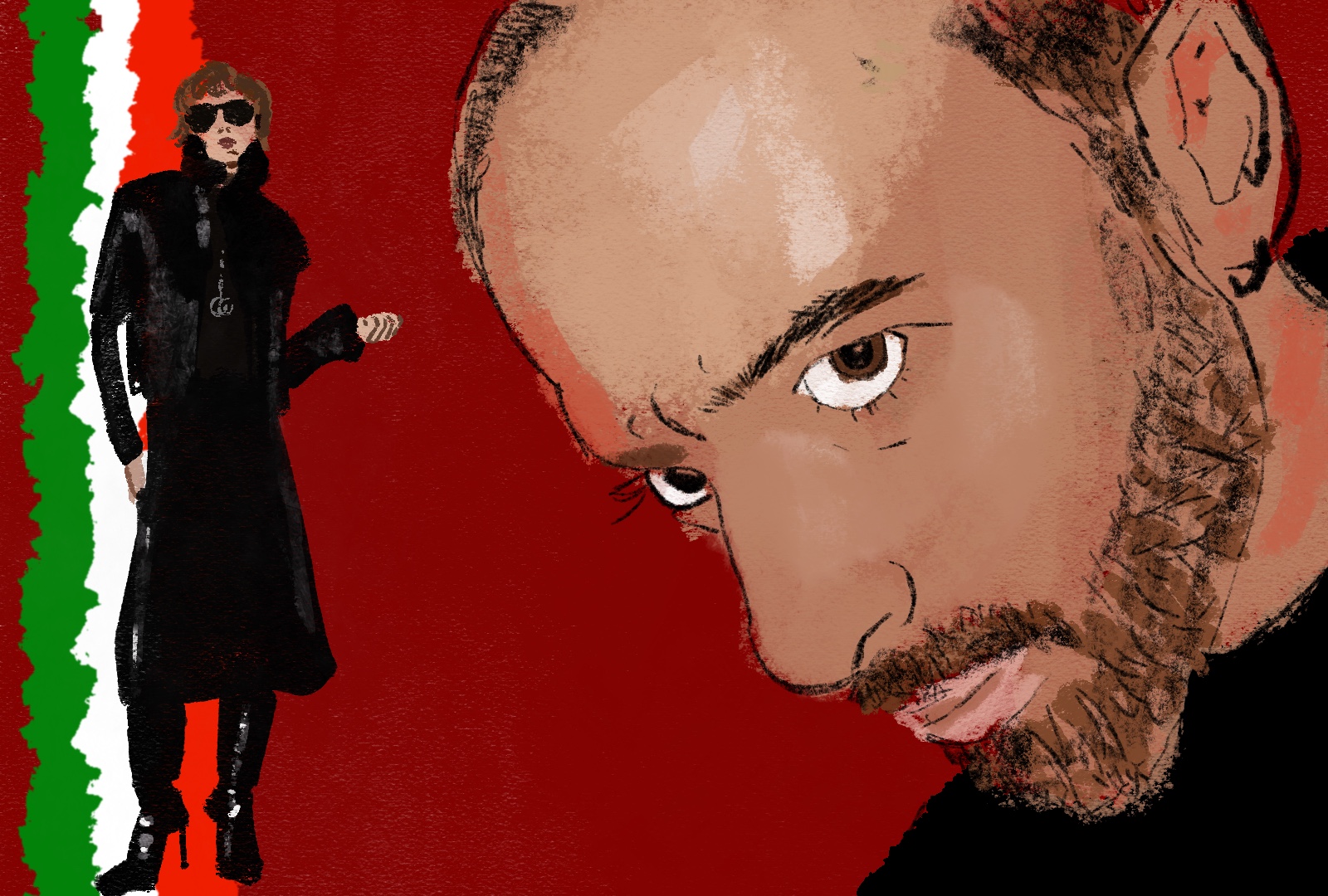
By Giulia Piceni. Cover image Anano Esartia
Demna’s Gucci Debut FW 26-27: Rewriting the House Legacy
After years spent redefining the visual grammar of contemporary luxury through disruption, irony, and cultural friction, Demna now faces a subtler task at Gucci. His debut for the house took place at the Milan Fashion Week with the Autumn/Winter 2026–27 collection, a moment charged with expectation and scrutiny. Gucci is not an empty vessel awaiting reconstruction, but a maison both burdened and enriched by one of fashion’s most recognisable emotional legacies. Any engagement with it inevitably invites comparison with the era of Tom Ford, whose vision transformed the brand into a global symbol of controlled eroticism and unapologetic confidence. Demna’s response was neither rejection nor revival, but rather an act of translation: a recalibration of Ford’s codes into his own vocabulary, where sensual precision gives way to tension, subversion, and a different kind of modern desire.
How Demna Translates Italian Life into Gucci Archetypes
From the opening passage of the show, coherence emerged as its governing principle. Rather than inventing a new aesthetic lexicon, Demna extended a narrative already embedded in his own practice. The runway functioned as a catalogue of archetypes, figures constructed through clothing that signals social identity as much as personal belief. This methodology has long defined his work.
At Balenciaga, where Demna served as creative director from 2015 to 2025, these characters carried autobiographical residue, evoking migration, institutional uniformity, and the psychological landscapes of post-Soviet existence that shaped the Georgian designer’s formative years. Their awkward silhouettes and unsettling realism possessed emotional density because they felt lived rather than imagined.
At Gucci, however, the archetype undergoes a transformation that raises more complex questions about the use of this device. The figures presented suggest an external gaze cast upon Italian life and its cultural signifiers, filtered through Demna’s analytical distance. Tailored sensuality, nightclub minimalism, bourgeois casualwear, and street-influenced silhouettes coexist as visual quotations, a kind of bestiary of Milanese inhabitants. The designer appears to reconstruct what he observes in the city, translating impressions into a form of fashion theatre.
This process does not register as cultural appropriation in any moralistic sense. Fashion has always thrived on reinterpretation; yet the shift from internal memory to external observation alters the emotional stakes of the work. Where earlier collections felt animated by biography, this one occasionally risks becoming scenography: the characters exist convincingly as images, but less so as psychological presences. One admires their clarity while sensing a certain absence beneath the surface.
Paradoxically, this distance also enables moments of considerable success. The inclusion of garments that verge on anonymity is not an act of provocation, but a continuation of his belief that meaning in fashion emerges through context rather than complexity. A tightly cut white shirt paired with leggings demonstrated this principle with striking effectiveness. The look carried unmistakable echoes of Gucci under Tom Ford — its disciplined sensuality grounded in the body — yet the proportions and styling rendered it unmistakably contemporary. Through minimal intervention, Demna succeeded in transforming the ordinary into something fully legible within the house’s identity.
Such gestures reveal an intelligence often overlooked in discussions of his work. The scandal once associated with apparent normality has faded, replaced by a more strategic deployment of restraint. These garments did not rely on novelty; instead, they derived power from recognition, inviting audiences to reconsider familiar clothing through altered framing. Equally notable was the collection’s engagement with contemporary rap aesthetics and vintage culture. Slimanesque tightly fitted outerwear, layered sports references and subtly nostalgic silhouettes reflected a broader cultural phenomenon in which fashion increasingly operates through archival memory. The revival of past decades no longer functions merely as retro styling but as a reflection of how identity is constructed in the digital age. Images circulate endlessly, collapsing temporal boundaries and transforming nostalgia into an active mode of self definition. As a matter of fact, luxury fashion today competes not only with other brands but with second hand markets, online archives and algorithmic taste making. By incorporating visual languages associated with vintage consumption, Demna acknowledges the fragmentation of authority within fashion itself, making Gucci capable of addressing multiple audiences simultaneously.
What Makes Desire Work Differently on Demna’s Gucci FW 26-27
Nevertheless, admiration for this analytical clarity does not entirely dispel a lingering sense of emotional detachment. The erotic charge that once defined Gucci under Tom Ford appeared refracted; seduction was present, but mediated — filtered through irony and a degree of intellectual control. Even moments of overt sensuality carried a self-awareness that prevented complete immersion. The clothes suggested desire while simultaneously analysing it. This tension may, in fact, constitute the central paradox of Demna’s Gucci. His practice thrives on critique, on exposing the mechanisms through which fashion constructs aspiration. Gucci, by contrast, has historically succeeded through surrender to fantasy. The meeting of these impulses produces fascination, but also friction.
The experience extended beyond the runway. The following day, press and showroom observers reported a notable shift in perception when encountering the garments in person. Construction and material quality granted the pieces an authority less immediately apparent during the show. Even when the fabrication stopped short of exceptional craftsmanship, the clothes possessed presence. This duality speaks to Demna’s enduring understanding of desirability. The appeal of his work rarely depends on personal identification; many viewers may struggle to imagine themselves wearing these garments. They succeed instead because they communicate across disparate cultural groups, generating recognition among audiences who approach luxury from radically different perspectives.
The shock once synonymous with his name also persists, though in transformed form. At Balenciaga, disruption often emerged through discomfort or confrontation. Here, the shock lies in familiarity itself. Demna reveals how easily codes associated with glamour, streetwear, or bourgeois elegance can be rearranged into something simultaneously recognisable and strange.
Why Demna’s Gucci Serves as a Cultural Commentary on Fashion
Ultimately, the collection resists simple judgment. It is neither radical reinvention nor nostalgic retreat. Instead, it operates as an exploration of translation itself. Tom Ford’s legacy survives not through imitation, but through reinterpretation — refracted through Demna’s fascination with archetypes and social observation.
The show succeeds precisely because it acknowledges contradiction. It entertains while questioning its own premises. It seduces while maintaining distance. The cultural reading is sharp. The coherence within Demna’s creative trajectory remains undeniable. Yet the emotional immediacy that once animated his most powerful work feels partially displaced. Gucci under Demna speaks fluently to the present moment, but it does so in the measured tone of an observer; perhaps that distance is intentional. In an era saturated with image and reference, authenticity itself has become performative. Demna’s Gucci may therefore reflect not emptiness, but the very condition of contemporary fashion — where identity is assembled from fragments: the archetype survives, while its origins dissolve into spectacle.
What remains undeniable is the collection’s capacity to provoke discussion. In a landscape increasingly dominated by safe commercialism, Demna continues to insist that fashion can function as cultural commentary while still operating within the market’s rules. Even when the characters feel less inhabited than before, they compel attention. And in today’s fashion system, attention remains the most powerful currency of all.


