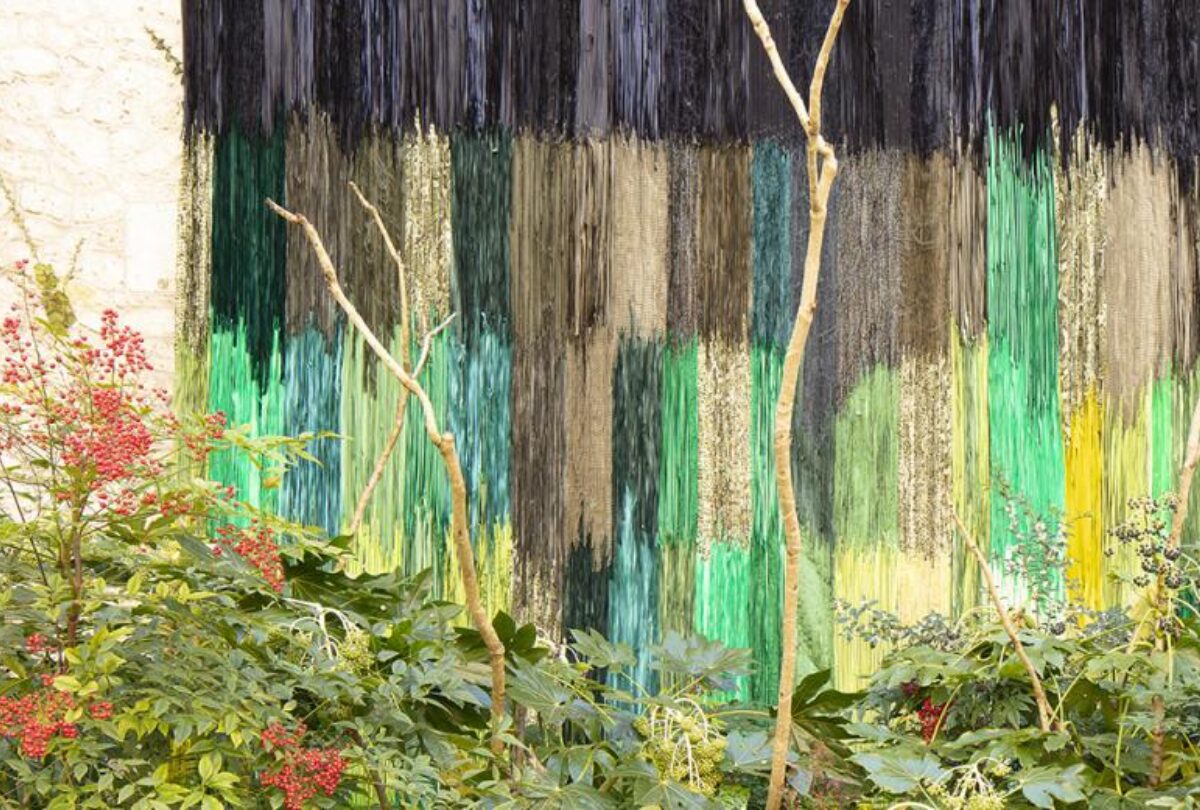
By Giulia Piceni. Cover image Les herbes folles du vieux logis, installation of Joël Andrianomearisoa (2021)
Why Textile Art Is Central to Contemporary Art Today
For much of the twentieth century, textile art was relegated to the margins of contemporary art. Fiber was seen as craft, domestic labor, or decorative practice — rarely exhibited in galleries or museums. Today, that hierarchy is shifting. Across Europe, Africa, and beyond, a new generation of textile artists transforms cloth, thread, and weaving into a conceptual and expressive medium. Their work engages with memory, gesture, technique, and the materiality of fabric itself, proving that textile is now central to contemporary art discourse. Here are five artists leading this transformation.
Joël Andrianomearisoa: Textile as Architecture and Emotional Space
Textile is central to his vocabulary as he approaches it as spatial language: vast fields of black paper or cloth cascade from ceilings and walls, forming environments that feel architectural. Born in 1977 in Antananarivo, Joël Andrianomearisoa moves between Madagascar and France, shaping a practice that resists disciplinary boundaries. Trained in architecture in Paris, he emerged in the mid 1990s through performance before expanding into installation, design and scenography. In 2019, he represented Madagascar at the 58th International Art Exhibition of La Biennale di Venezia, marking a pivotal moment in his international recognition. Andrianomearisoa has described his works as neither painting nor sculpture nor architecture, but installations that contain elements of all three while also addressing love, desire and loss. That refusal of categorization is key. His materials are carefully selected and composed to generate atmosphere rather than narrative. Folds, tears and layers become vehicles for feeling.
Hermann Bergamelli: Compressing, Immersing and Testing the Limits of Fabric
Within contemporary textile art, Hermann Bergamelli approaches fabric not as surface but as action. If Joël Andrianomearisoa constructs atmospheres, Bergamelli pushes textile art toward material experimentation and physical resistance. Born in Bergamo in 1990, he studied New Technologies for the Arts before receiving a scholarship at Central Saint Martins in London. His exhibitions at A+B Gallery have consolidated a practice in which fiber, cloth and dye become sites of pressure, compression and transformation.
Bergamelli’s practice begins with gesture. He is less interested in the finished object than in the movement that generates it. Cloth is torn, folded, stitched, immersed in dye or subjected to intense pressure. The material reacts, absorbs and alters under these conditions. The artwork records that exchange. In the series Stratificazioni, strips of fabric are layered into dense surfaces where seams and loose threads remain exposed. The making is deliberately visible. Immersioni introduces repeated baths of color, allowing unpredictable chromatic shifts to emerge from the interaction of water, pigment and time. Compressioni forces stacked textiles into vises or iron structures, transforming pliant material into compact mass. In Sottrazioni, pigment is applied and then partially removed, leaving traces of a process that seems to evolve beyond the artist’s direct control. What unites these series is tension: textile is not passive support but active participant in the evolution of movement. Bergamelli’s work challenges the assumption that fabric signifies softness or comfort. Instead, it becomes a field where force, pressure and erosion are made visible.
Sabrina Mezzaqui: Stitching Literature into Textile Art
Within contemporary textile art, Italian artist Sabrina Mezzaqui has built a distinctive practice that weaves literature, thread and slow craftsmanship into intricate fiber-based works. Born in Bologna in 1964 and working in Marzabotto, Sabrina Mezzaqui has developed a practice defined by discipline and introspection. Her work often begins with literature and personal writing, which she then translates into meticulous, time intensive constructions. Mezzaqui operates through self imposed rules and extended periods of concentrated labor. She cuts, folds, knots and assembles materials in repetitive gestures that border on the ritualistic. Words are fragmented and reconfigured, gradually losing their direct semantic function and acquiring a tactile presence. Textile methodologies play a crucial role. Paper is treated like fabric, folded and stitched into delicate formations. Construction and deconstruction occur simultaneously, generating works that feel suspended in time. Her recognition with the Premio BPER at Arte Fiera affirmed the relevance of her approach within the Italian art landscape. Yet her significance extends beyond awards. Mezzaqui demonstrates how the slow accumulation of small gestures becomes a means of reclaiming attention and memory. In her hands, fabric and thread articulate a quiet but persistent refusal of haste.
Igshaan Adams: A South African Textile Artist Mapping Identity Through Weaving
South African artist Igshaan Adams uses textile to map the social and spiritual geographies of his upbringing in Cape Town. Working with weaving, embroidery and beadwork, Adams creates suspended tapestries that hover between abstraction and cartography. His compositions often resemble aerial views of terrain. Pathways traced in thread evoke routes shaped by segregation and faith. Beads and rope introduce texture and shimmer, complicating the surface with moments of added weight. Adams frequently collaborates with artisans, underscoring the collective dimension of textile production. The works carry political histories while being immersed in undeniable beauty, yet it is inseparable from the lived realities they encode. In Adams’s practice, textile becomes both archive and bridge for the present; threads intersect and diverge, forming networks that mirror the complexities of identity and community.
Teresa Lanceta: Reframing Amazigh Textile Traditions in Contemporary Art
Spanish artist Teresa Lanceta offers a different model of engagement with textile traditions. For decades, Lanceta has studied and worked alongside Amazigh weavers in Morocco, integrating their techniques into a contemporary artistic framework. Her woven compositions are geometric, restrained and deeply attentive to structure. They do not appropriate craft motifs for decorative effect. Instead, they examine weaving as a system of knowledge transmitted across generations. Lanceta’s practice acknowledges the social and communal dimensions of textile production while asserting its relevance within contemporary art. By situating weaving within galleries and museums, she challenges the hierarchy that once separated ethnographic artifact from fine art. Her works insist that textile is not peripheral but foundational, a language capable of carrying history, labor and formal rigor.


