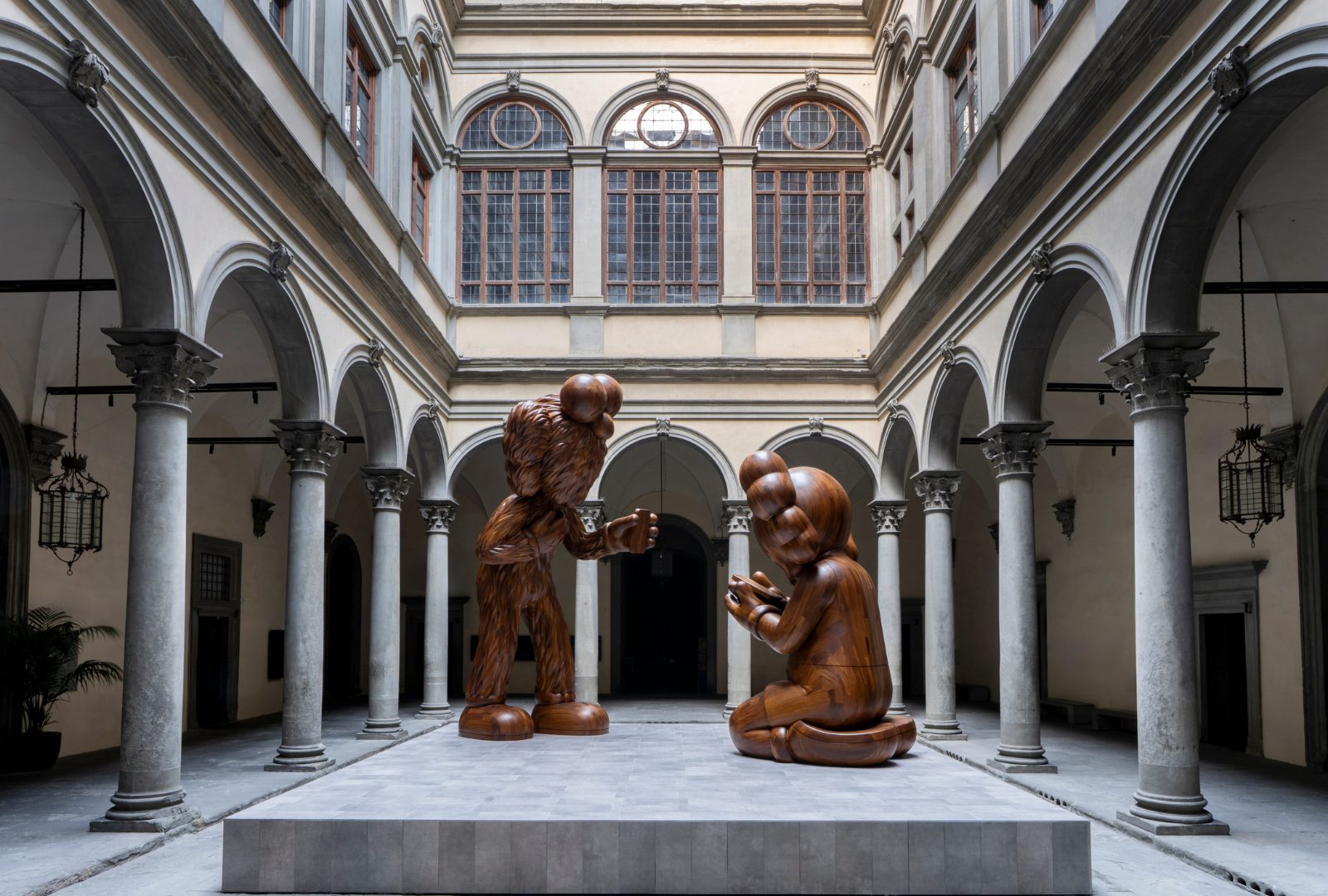
By Francesca Trovato. Cover image KAWS: THE MESSAGE Photo Ela Bialkowska, OKNO Studio.
There’s a message reverberating across centuries, from Fra Angelico’s Renaissance frescoes to the glow of a smartphone screen. It’s called THE MESSAGE, a monumental new installation by American artist KAWS, unveiled in the courtyard of Palazzo Strozzi and on view through January 25, 2026.
Two colossal wooden figures, each more than six meters tall, face each other like Mary and the Archangel Gabriel. But instead of a lily or a ray of divine light, they hold smartphones. A simple, everyday gesture becomes transcendent — a contemporary Annunciation rendered in pixels and timber.
“I started thinking about what the Annunciation would look like today, with all the devices we use,” KAWS said at the exhibition preview. “The phone has become part of who we are, and the sculpture is a reflection of that.”
Inside KAWS’s THE MESSAGE at Palazzo Strozzi
Inside Palazzo Strozzi, visitors encounter the spiritual calm of Fra Angelico, whose luminous paintings defined Florence’s early Renaissance. Step into the courtyard, however, and that serenity gives way to something familiar yet unsettling. KAWS’s trademark figures — COMPANION and BFF — stand in quiet confrontation, heads bowed toward their glowing screens. The conversation is no longer celestial but digital.

Curated by Arturo Galansino, the museum’s director general, THE MESSAGE collapses the distance between sacred and secular, transforming a moment of divine revelation into a meditation on communication and disconnection. “It’s about people and how they communicate,” KAWS said. “About what’s said, and what gets lost.” In Florence, where revelation once arrived in gold leaf and tempera, it now flashes as a notification.
Who is KAWS: The Artist Behind the Iconic Figures
Born Brian Donnelly in 1974 in New Jersey, KAWS came of age in the graffiti scene of 1990s New York. His early “interventions” on fashion billboards, where he painted cartoon skulls and X-ed-out eyes, blurred the line between vandalism and critique.
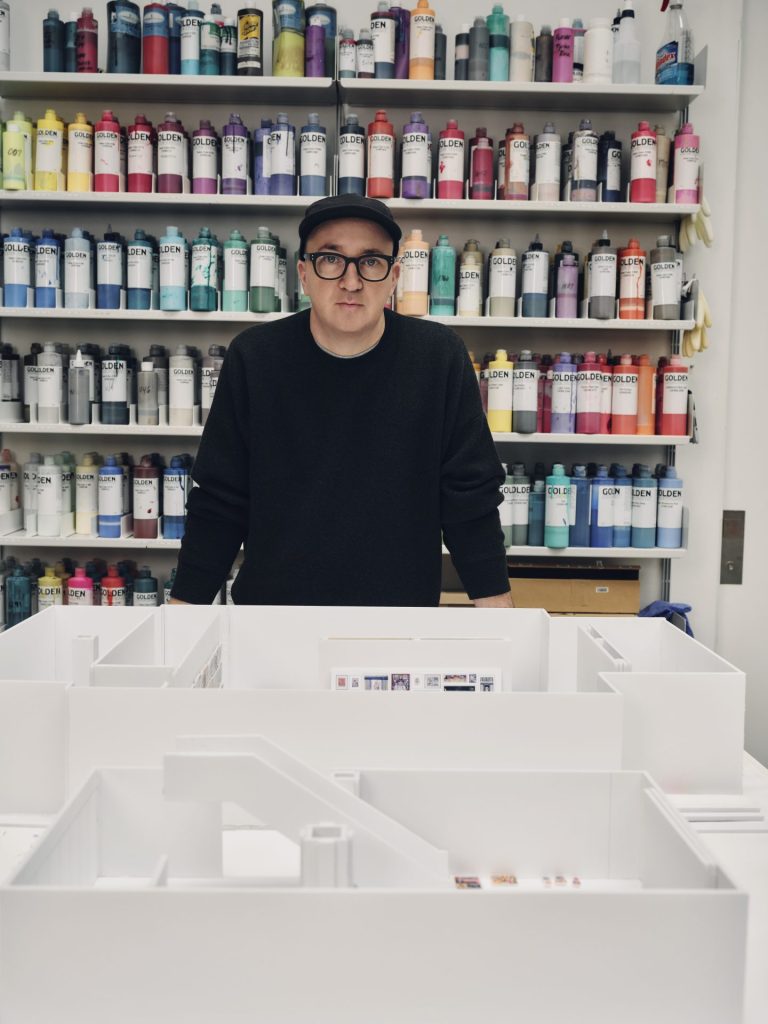
These bold gestures evolved into an aesthetic that now spans fine art, design, and pop culture. His figures — part Mickey Mouse, part memento mori — combine tenderness and melancholy, nostalgia and unease. Today, his sculptures and paintings sell for millions and are exhibited in museums from Tokyo to Paris. Yet at their core, they communicate a universal language of empathy, irony, and recognition.
What KAWS’s THE MESSAGE Teaches Us About Art and Tech
With THE MESSAGE, KAWS steps into the cradle of the Renaissance not as a provocateur, but as a translator, reframing ancient iconography for a culture that now prays through its devices. Beneath the stone arcades of Palazzo Strozzi, his two wooden giants hold their phones like relics. The glow from their screens becomes a kind of modern halo, suggesting that belief, once vertical, has turned horizontal — from heaven to the handheld.
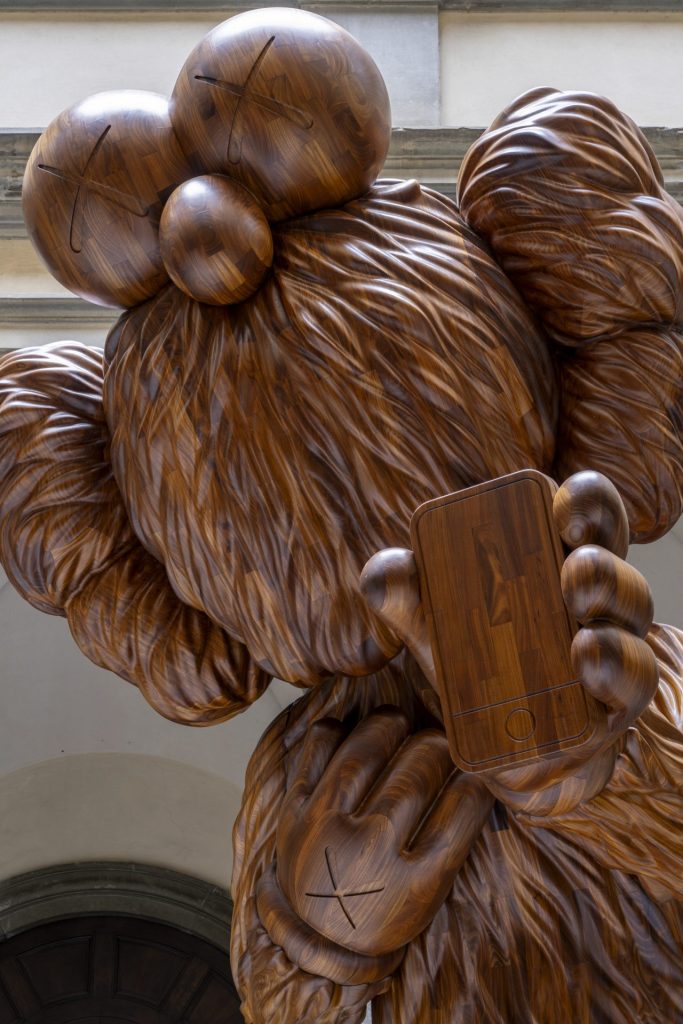
Supported by the Hillary Merkus Recordati Foundation as part of Palazzo Strozzi Future Art, the installation is free to the public. Tourists, students, and scholars alike are drawn into a scene that feels both sacred and strikingly familiar. The question lingers: in a world of constant communication, are we still truly speaking to one another?
The Real Meaning of KAWS’s THE MESSAGE
Behind their pop veneer, KAWS’s sculptures are profoundly human. Their cartoon eyes and slumped shoulders convey a kind of digital melancholy — the quiet ache of connection without contact. THE MESSAGE is not about technology itself, but about faith: faith that something meaningful still passes between us, even when filtered through a screen. As the Florentine light sweeps across the courtyard where Fra Angelico once painted angels with gold halos, KAWS’s wooden figures stand in silence, phones in hand, waiting for a signal. Perhaps the message has already been delivered.


