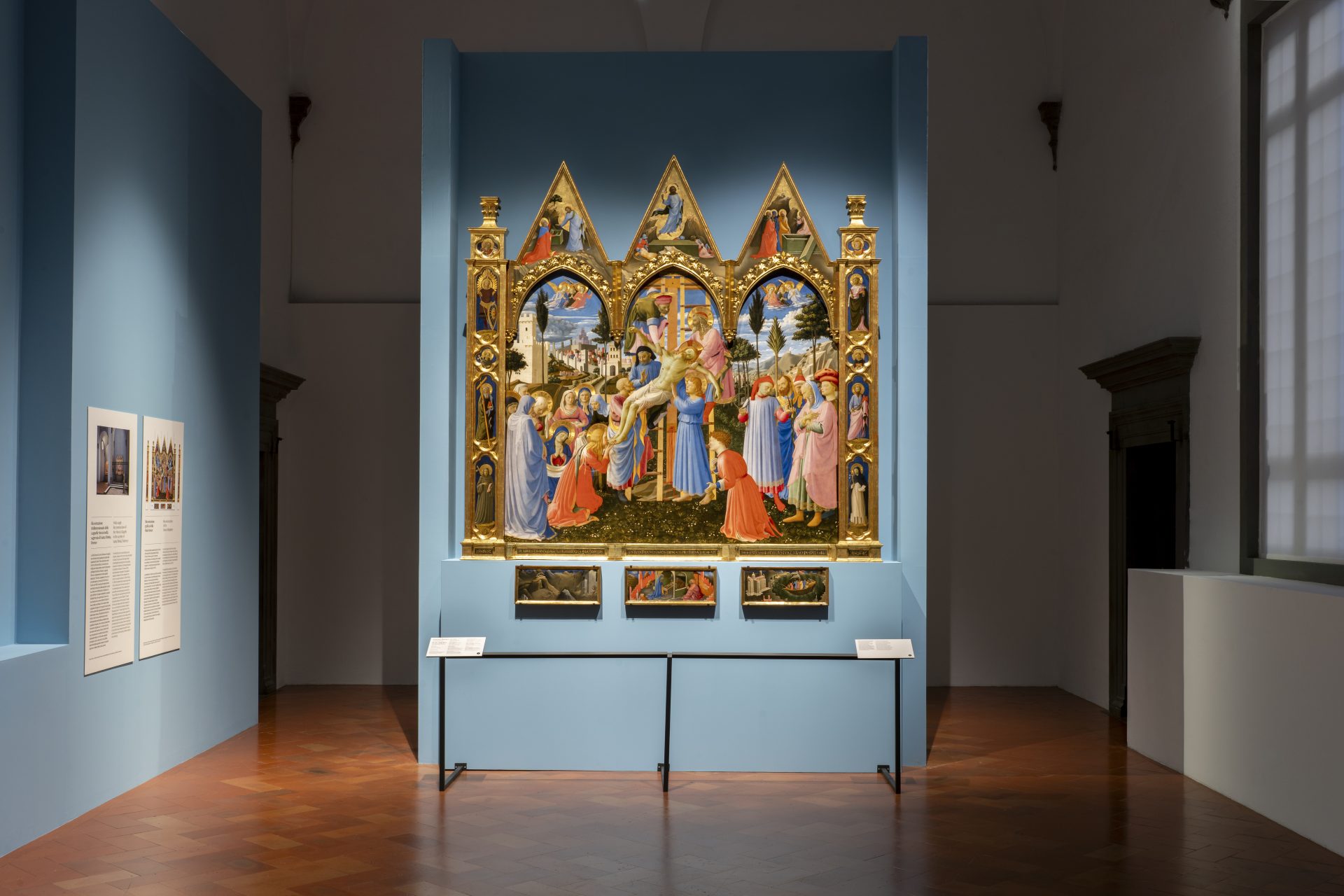
By Rebecca Ceccatelli. Cover image: Beato Angelico, exhibition view, Museo di San Marco, Firenze, 2025. Photo: Ela Bialkowska, OKNO Studio.
Three years after its landmark show on Donatello, the Florentine institution now turns its attention to one of the city’s most emblematic figures: Beato Angelico. Few artists embodied Florence so completely, walking its streets, working within the Convent of San Marco—today a museum—and leaving their mark on churches and institutions across the territory.
From 26 September 2025 to 25 January 2026, the Fondazione Palazzo Strozzi and the Museo di San Marco present Beato Angelico, an extraordinary and unprecedented exhibition dedicated to the painter-friar, a symbol of fifteenth-century art and one of the undisputed masters of the Italian Renaissance. Conceived in close collaboration with the Italian Ministry of Culture and the Museo di San Marco, the exhibition spans two venues, reflecting a vital dialogue between cultural institutions and the city itself, and stands as one of the highlights of the 2025 cultural season.
Beato Angelico in Florence: 140 Masterpieces on View for the First Time in 70 Years
Curated by Carl Brandon Strehlke, Curator Emeritus of the Philadelphia Museum of Art, together with Angelo Tartuferi and Stefano Casciu for the Museo di San Marco, this is the first major Florentine monographic exhibition on Beato Angelico in seventy years. It places his luminous works in dialogue with contemporaries such as Lorenzo Monaco, Masaccio, and Filippo Lippi, as well as sculptors like Ghiberti, Michelozzo, and Luca della Robbia, offering a sweeping narrative of Angelico’s influence across Renaissance Florence.
Renowned for his delicate balance between the legacy of late Gothic tradition and the emerging principles of Renaissance naturalism, Beato Angelico (born Guido di Piero, later Fra Giovanni da Fiesole; Vicchio di Mugello, c.1395 – Rome, 1455) mastered perspective, light, and the harmonious integration of figures within space. This exhibition gives visitors a rare chance to encounter his profound artistic vision—one where the sacred and the human meet in radiant balance.
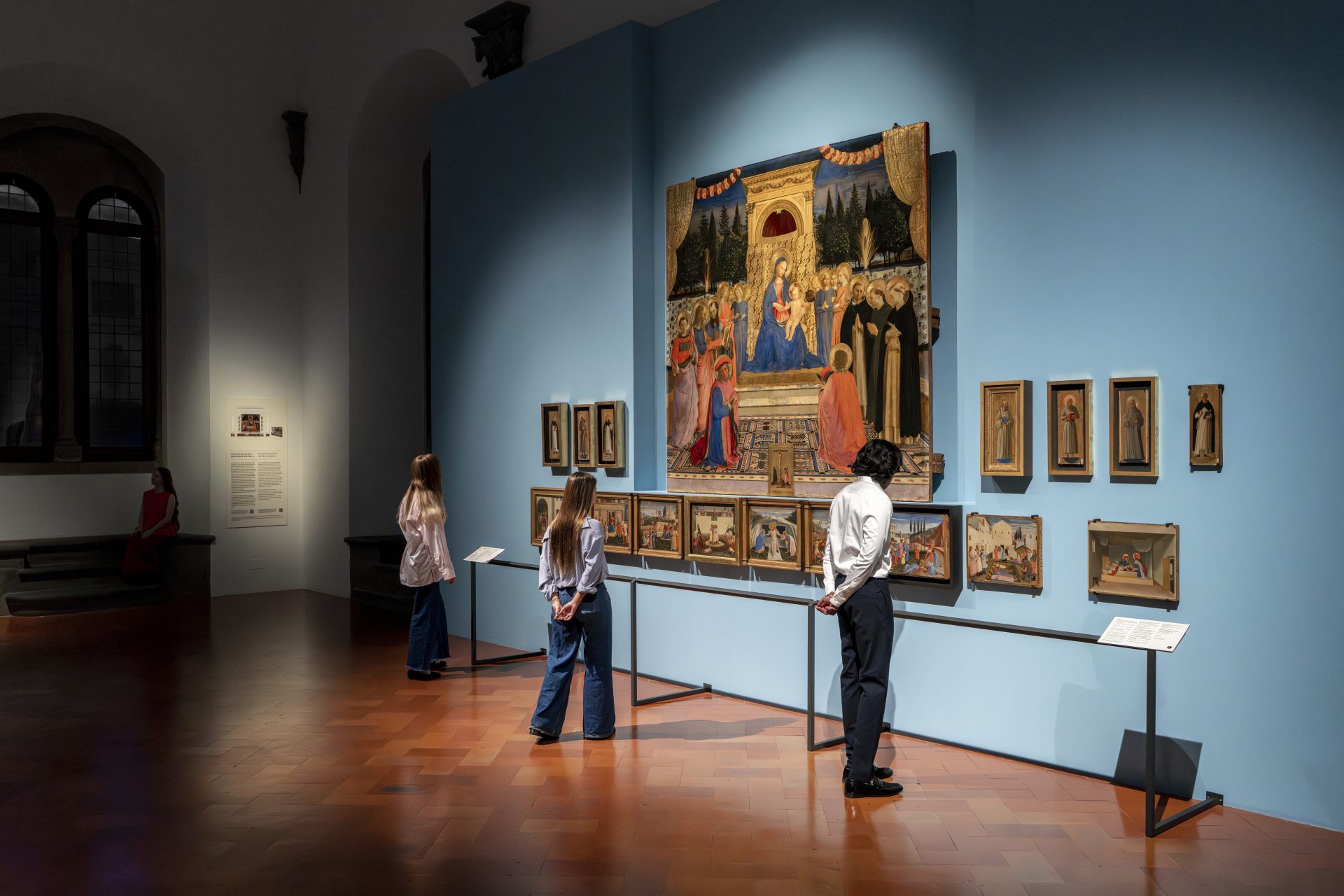
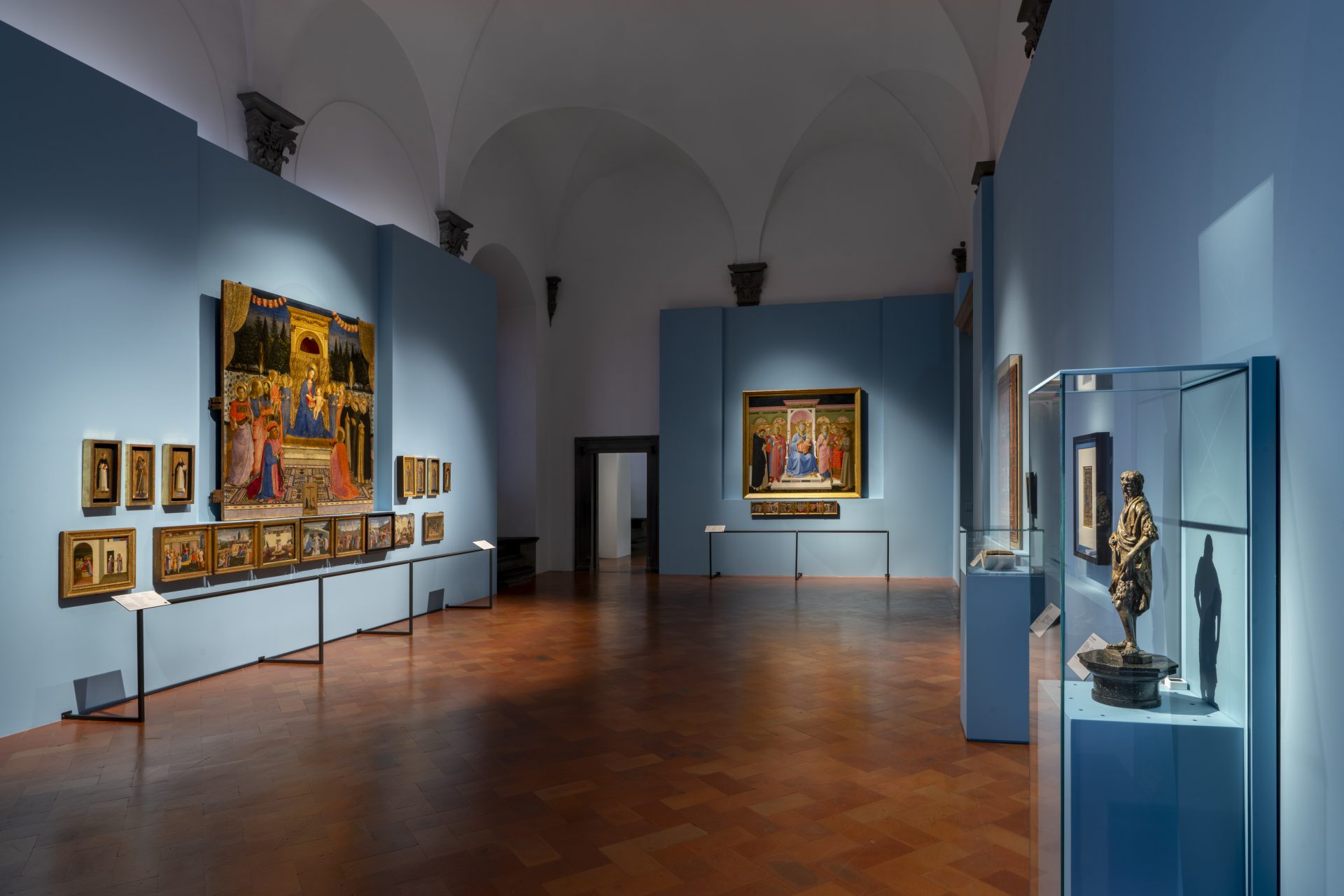
Over 140 works—paintings, drawings, sculptures, and illuminated manuscripts—have been assembled from the world’s greatest museums, including the Louvre, Gemäldegalerie in Berlin, the Metropolitan Museum of Art in New York, the National Gallery in Washington, the Vatican Museums, the Alte Pinakothek in Munich, and the Rijksmuseum in Amsterdam, as well as from Italian churches, libraries, and collections. The exhibition is the result of more than four years of preparation, including an ambitious restoration campaign and the reunification of altarpieces dispersed for over two centuries. It is not only a scientific achievement of extraordinary scope, but also a cultural event reconnecting Florence with one of its most luminous artistic voices.
Early Works and Artistic Research at Museo di San Marco
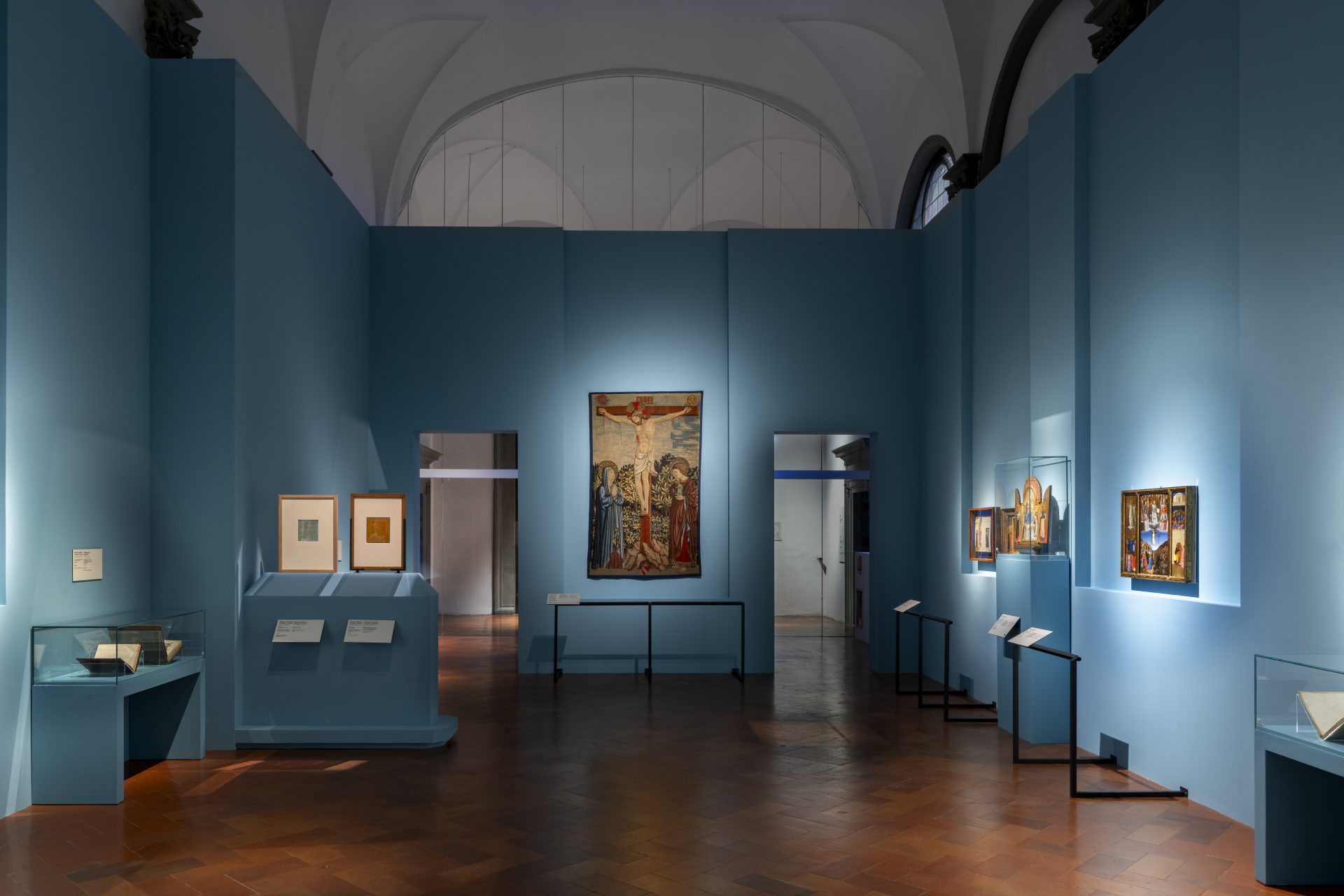
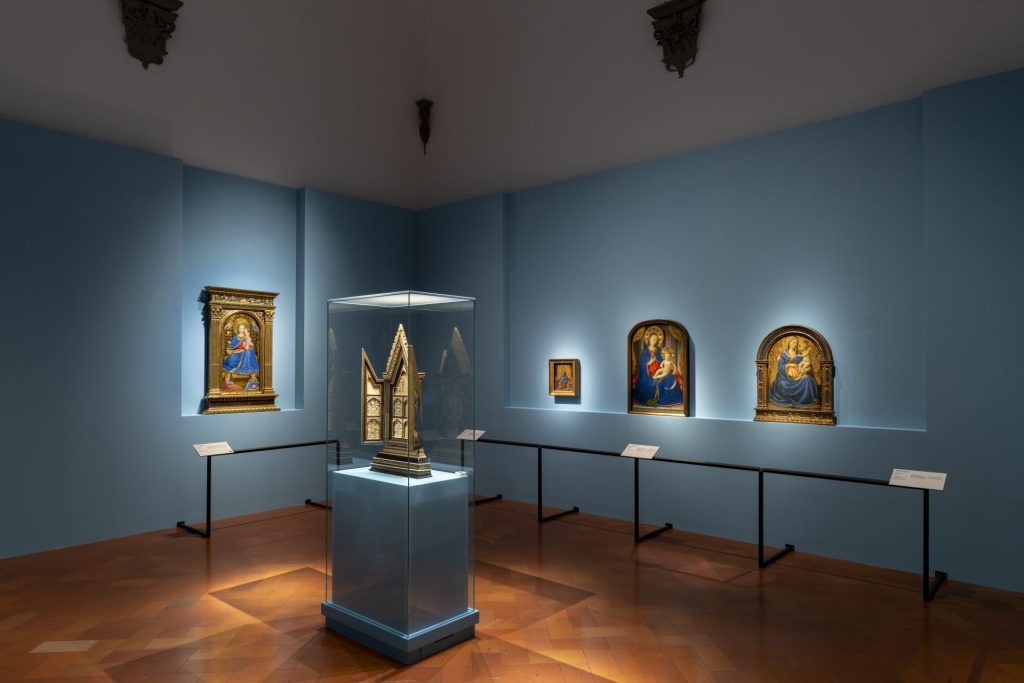
The first section, located at the Museo di San Marco, explores the early years of the friar-painter. Works usually displayed here have been relocated to Palazzo Strozzi to make room for delicate blue tones recurring in both venues, reminiscent of the sky in the altarpieces rising before visitors in the exhibition halls. The opening room is dedicated to Angelico’s formative years and the artistic context in which he trained.
It begins with the Pala di Fiesole, painted as a triptych around 1420–1423, marking Angelico’s entry as a Dominican friar at the Convent of San Domenico. Already in his mid-twenties, the work demonstrates his extraordinary technical skill. Chronologically arranged early works follow, illustrating his transformation from a master of late Gothic painting to a co-founder of Renaissance painting alongside Masaccio. The comparison between the Pala di San Pietro Martire and Masaccio’s Trittico di San Giovenale exemplifies this evolution.
To provide context, the exhibition includes works by artists exploring perspective and color alongside Angelico: Starnina, the Master of the Straus Madonna, Lorenzo Ghiberti, Lorenzo Monaco, and Masolino da Panicale. Shared details—preparatory drawings, gold backgrounds, anatomy, chiaroscuro, and icon composition—reveal a rich network of artistic dialogue. At the end of the room stands the imposing Tabernacolo dei Linaioli, executed by Lorenzo Ghiberti and Angelico between 1432 and 1436.
On the second floor, works normally off the tourist trail in Florence are brought to the forefront. Visitors move through corridors and cells adorned with frescoes such as Cristo Deriso, the Annunciazione, and the Crocifissione, where veiled windows filter sunlight, creating a contemplative interplay of light and shadow.
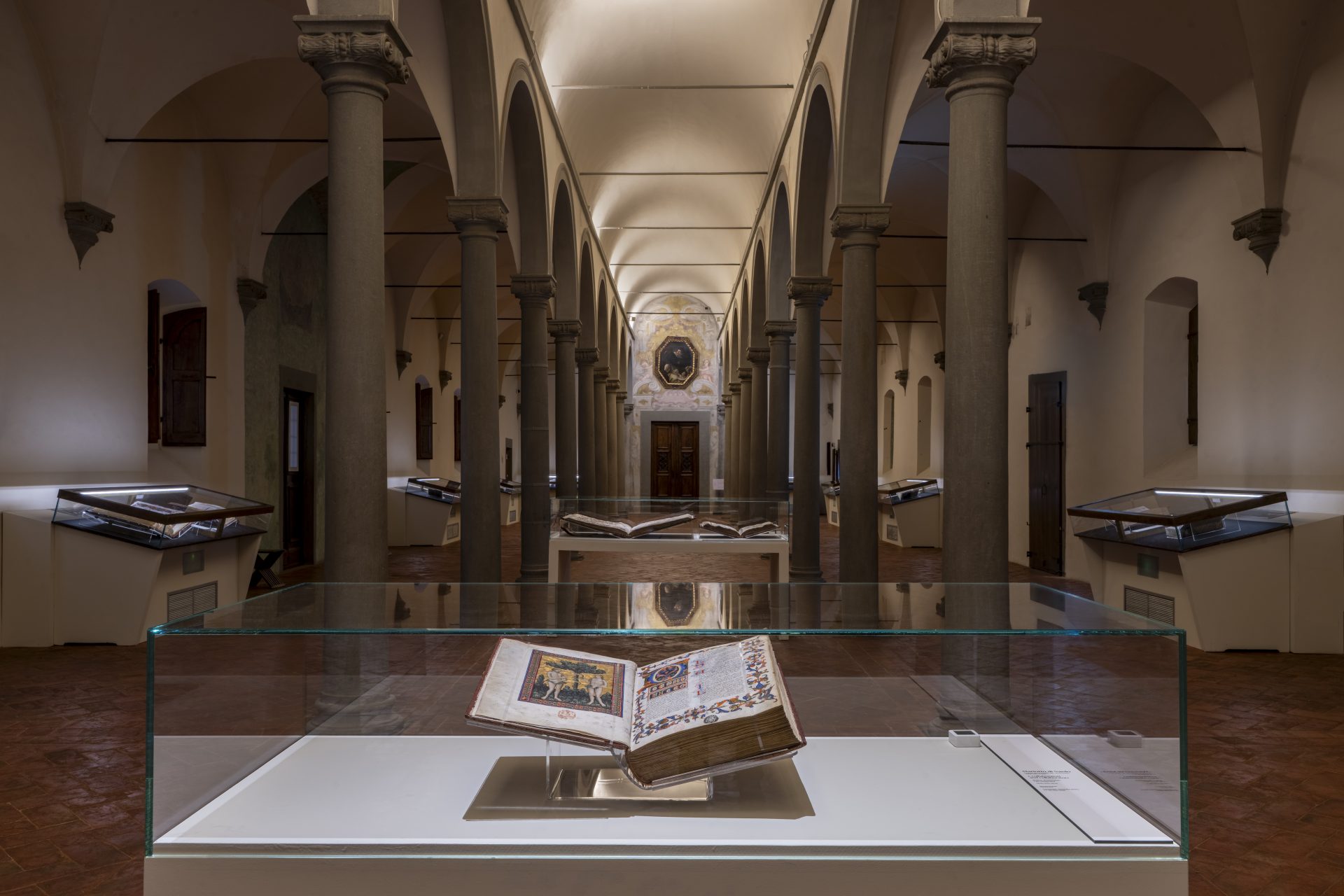
Photo: Ela Bialkowska, OKNO Studio
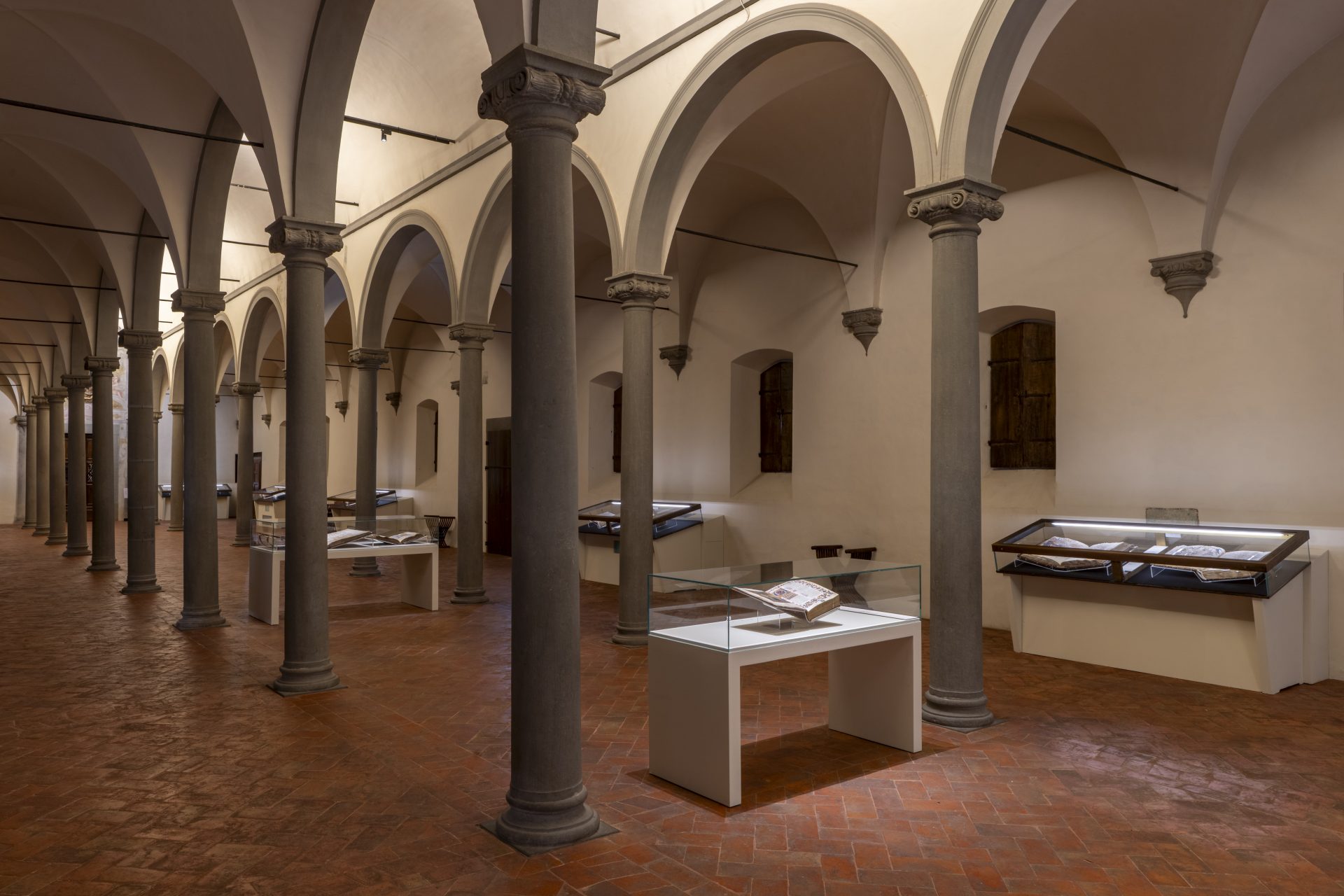
Photo: Ela Bialkowska, OKNO Studio
A dedicated wing showcases numerous manuscripts with Angelico’s miniatures. Among the most significant is the Missal of Beato Angelico (Missale Angelici, c.1425–1430). This manuscript, housing texts for Mass chants on saints’ feast days, features miniatures by Angelico and eleven by his pupil Zanobi Strozzi. Lavish in detail, color, and composition, these works demonstrate Angelico’s mastery of illumination and his contribution to Renaissance art beyond fresco painting.
From Family Commissions to Renaissance Innovations: Palazzo Strozzi’s Beato Angelico
At Palazzo Strozzi, the exhibition is rooted in the very history of the palace. In 1489, the Strozzi family commissioned its construction, carving a grand residence amid crowded streets and marketplaces. The first altarpiece visitors encounter, dedicated to the family, is the Pala di Santa Trinita, a luminous work that exemplifies Angelico’s mastery of composition, light, and serene spiritual atmosphere.
The following room presents the San Marco altarpiece, displayed after three centuries in its complete form, exactly as Angelico conceived it. Here, the exhibition emphasizes not only monumental works but also the details and preparatory sketches behind them: faces, flowers, predella scenes, and embellishments. Several altarpieces, long dismantled and scattered worldwide, were painstakingly reconstructed for the exhibition, with fragments reunited alongside graphic reconstructions revealing their original composition.
The room in fact focuses on the renewal of the Convent of San Marco in Florence, promoted by Cosimo de’ Medici, who entrusted it to the Observant Dominicans of Fiesole, transforming it into one of the city’s spiritual and cultural hubs. Angelico emerges as a pivotal figure of this period, merging the Gothic legacy with Renaissance innovations: vivid colors, careful spatial planning, and architectural precision redefine early Florentine religious painting.
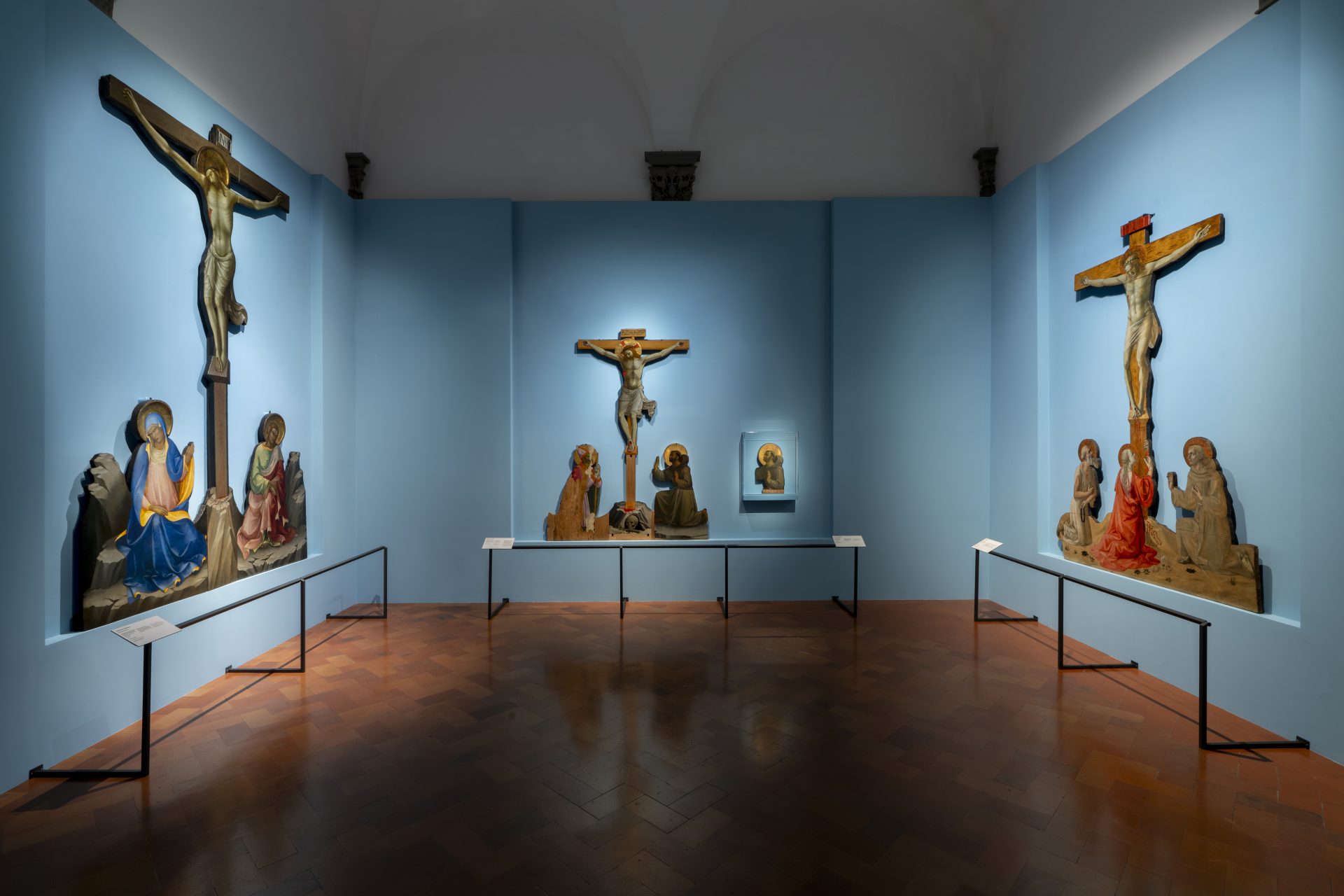

Another room features then shaped crucifixes and altarpieces, whose dynamic silhouettes break away from conventional rectangular formats. Between the late Trecento and early Quattrocento, these works—combining painting and sculpture—played a central role in devotional practice. Angelico’s lessons resonate in pieces such as the Crucifixion of Ceppo, where form, color, and expressive intensity engage the viewer both spiritually and visually.
Beato Angelico’s Final Years in Rome: A Look at His Mature Style
Between 1445 and 1455, Angelico alternated long stays in Rome with periods in Florence, navigating the most productive years of his career. Summoned by Pope Eugene IV, who admired his San Marco frescoes, Angelico was commissioned to decorate the Chapel of the Sacrament in the Vatican (1446), followed by the Niccolina Chapel (1448) for Pope Nicholas V. He also worked for Cardinal Juan de Torquemada at Santa Maria sopra Minerva, painting panels of the Crucifixion and predella scenes illustrating Christ’s life.
Upon his death on 18 February 1455, Angelico was buried at Santa Maria sopra Minerva, celebrated as the “second Apelles” and “glory of painters,” affirming his eternal legacy. This section of the exhibition allows visitors to trace his mature style, revealing his synthesis of humanist ideals, architectural clarity, and spiritual vision—hallmarks of one of the early Renaissance’s most influential figures.
How to Explore Beato Angelico’s Masterpieces: Take Your Time
Ultimately, this exhibition is for those who love to take their time—to wander slowly through rooms, to lose themselves in reading, in the delicate details, in subtle gestures of hands, or the gentle play of light across a panel. It is for those who wish to admire, to study, and to immerse themselves fully in Angelico’s world. Each work—whether a grand altarpiece, a tiny miniature, or a preparatory sketch—offers a moment of reflection, a chance to connect with both the human and the divine, and a reminder that true appreciation of art unfolds in patience, contemplation, and attentive looking.


