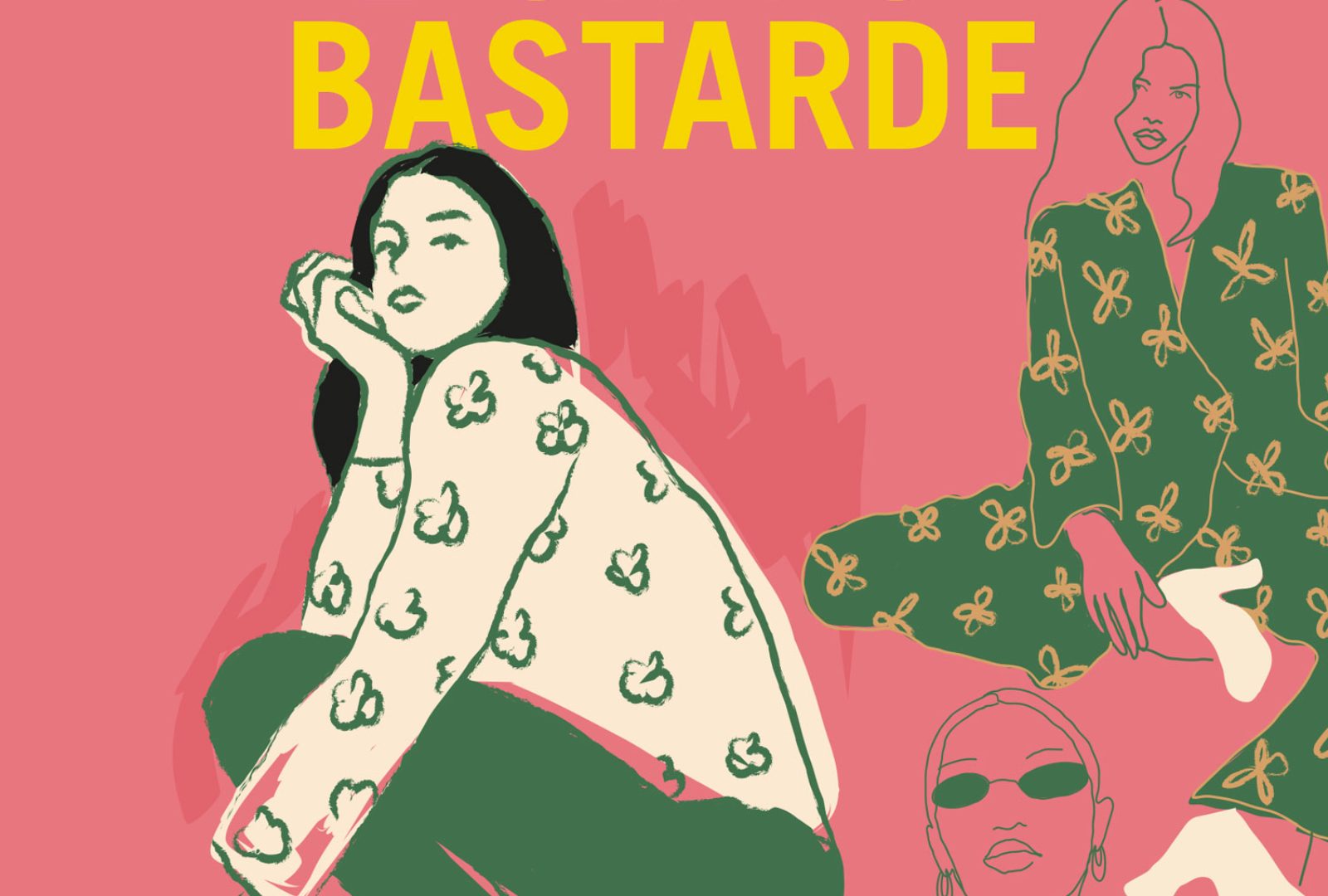
By Camilla Sarra. Cover image: detail from Libere e un po’ Bastarde book cover, Bompiani (2025).
Rossana Campo: A Fierce Authentic Voice in Italian Women’s Literature
For more than thirty years, the author has embodied a unique and penetrating voice in the landscape of contemporary Italian literature—a voice that reveals with strength and delicacy the inner worlds of women. It is a voice that can be sharp and biting, raw yet profoundly intimate, capable of traversing the hidden and complex terrains of the female soul with passion. Since her stunning debut in 1992 with In principio erano le mutande (In the Beginning Were the Panties), which quickly became a cult classic, the author has distinguished herself by narrating freedom, desire, love, and resistance with rare and unwavering emotional clarity.
Rossana Campo’s narrative style vividly captures the way women speak to each other: with whispers and shouts, with the tenderness and urgency of those who know that words can be both a refuge and a weapon. She proved this in her acclaimed novels—from L’Attore americano (The American Actor) to the award-winning Dove troverete un padre come il mio (Where Will You Find a Father Like Mine)—and now in her latest masterpiece, Libere e un po’ bastarde (Free and a Little Bit Wicked, Bompiani), arguably her most political, disarming, and deeply human work to date.
Inside the Book: Fierce Women & Radical Rebellion
At the beating heart of this novel is Betti, a screenwriter living in Paris, a woman both sharp and deeply self-aware, embodying the emotional complexity and ambiguity of contemporary life. Through her eyes, we meet an intertwined circle of women, friends and companions, all in middle age—women who share wine and late-night talks, who confess their vulnerabilities yet fiercely protect one another.
Among them are vivid figures: Alice, fragile and searching for a self that slips away; Gloria, a fading actress trapped in an oppressive marriage with a controlling director; Federica, a scholar on the brink of an ill-fitted union; and Sylvie and Lorenza, a long-term couple whose intimacy is beginning to crack. These are not mythic heroines but living, breathing contradictions—capable of rage, tenderness, and everything in between. Betti navigates her emotional world balanced between two destabilizing loves: one with Leila, a married woman who might offer stability, and the other with Justine, a younger, elusive woman embodying pure, wild, uncontrollable desire. Through these relationships, the italian writer courageously and sensitively explores queer love, refusing to simplify or explain, allowing mystery and complexity to speak for themselves.
A Novel That Redefines Female Identity and Desire
Libere e un po’ bastarde tells of a fluid femininity, constantly evolving, never confined by social roles or expectations. The women in this novel are not defined by motherhood, marriage, or traditional roles—they define themselves through pleasure, grief, intuition, and rebellion. Their bodies—alive and pulsating—stand at the narrative’s center, not as mere symbols, but as tangible realities that age, desire, and reveal themselves unfiltered. Female sexuality, often queer, is portrayed with a delicacy and realism that offer a rare, honest, and innovative view of intimacy between women in contemporary literature. The author grants her characters—and her readers—the freedom to be many things at once, without apology or justification.
The Author’s World: Female Freedom as Conscious Imperfection
In the author’s world, freedom is not a static goal but an ongoing, imperfect journey. Her protagonists are not free despite their flaws, but precisely because of them. Their agency emerges from uncertainty, from the conscious choice to be heard, from the decision to choose themselves, always. The author rejects the stereotypical ideal of the “strong woman” in favor of a more authentic truth: women who make mistakes, change their minds, fall and rise again, and refuse to be erased or marginalized. It is a quiet revolution, made of daily resistance, emotional survival, and courageous imperfection.
The Book Redefining Women’s Power
In an era dominated by the race for efficiency, productivity, and aesthetic perfection, Rossana Campo’s Libere e un po’ bastarde powerfully reclaims slowness, nuance, and the beauty of imperfection and disorder. It is a novel that reads quickly but lingers long after the last page—because it speaks of women we know, who we are, or who we wish to become. The title itself is a manifesto: suggesting that freedom may come at a cost or with an uncomfortable label—but it is worth it. The author’s writing reminds us that living fully and loving deeply are already acts of resistance. At a time when women’s literature risks being tamed or commodified, the author stands firm and graceful, showing that storytelling can still be a gentle form of rebellion—and a lasting act of love.


