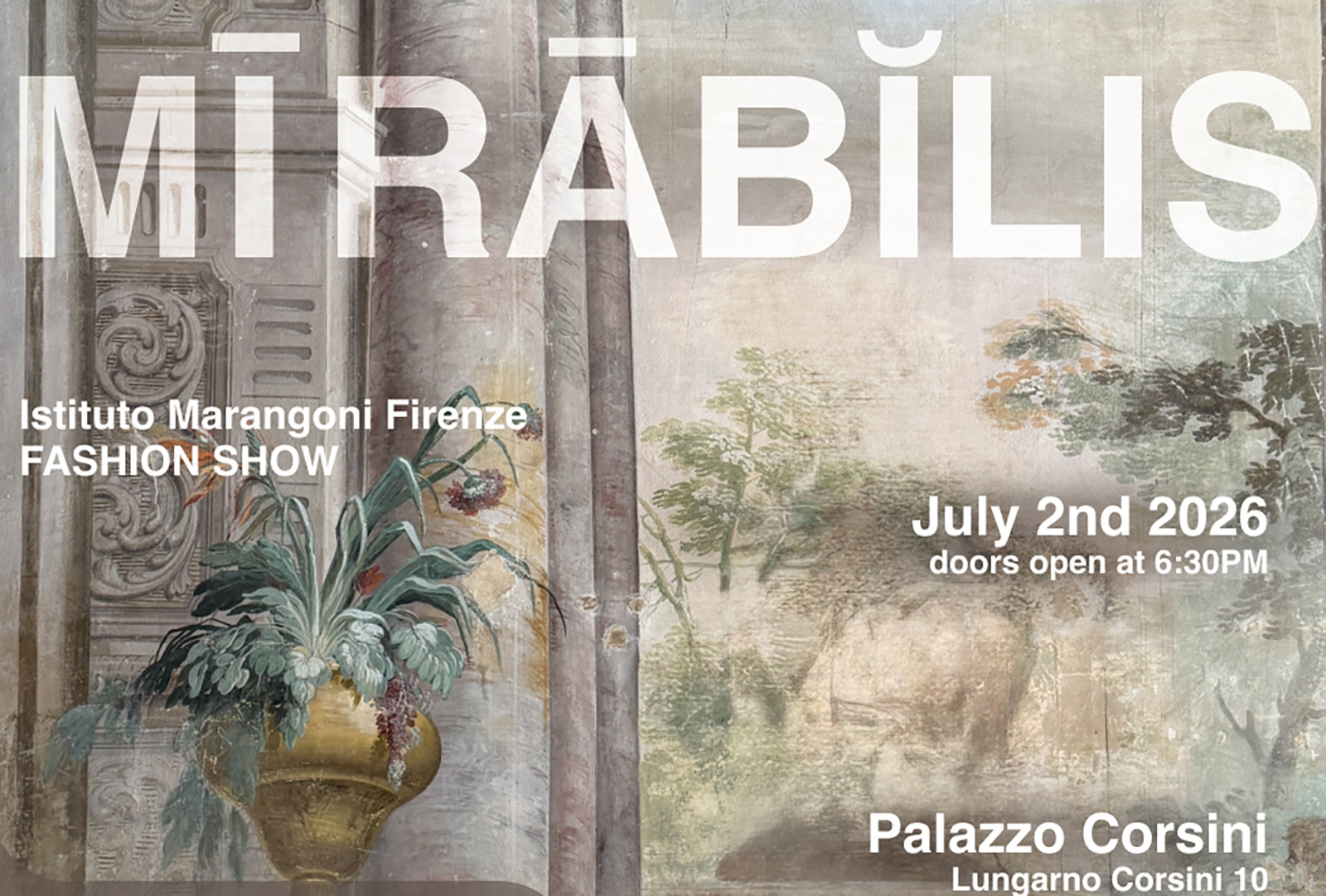
MĪRĀBĬLIS is the power of the eye to see and be captivated by what it beholds. It is the eye that willingly surrenders to illusion and is carried away by wonder into an enchanted and marvelous world, where sound, atmosphere, and performance reveal beauty, elegance, and magic.
INDEX
1 – THE CONCEPT
2 – THE LOCATION
3 – THE SOUNDTRACK
4 – THE RUNWAY
5 – THE RUNNING ORDER
6 – CREDITS
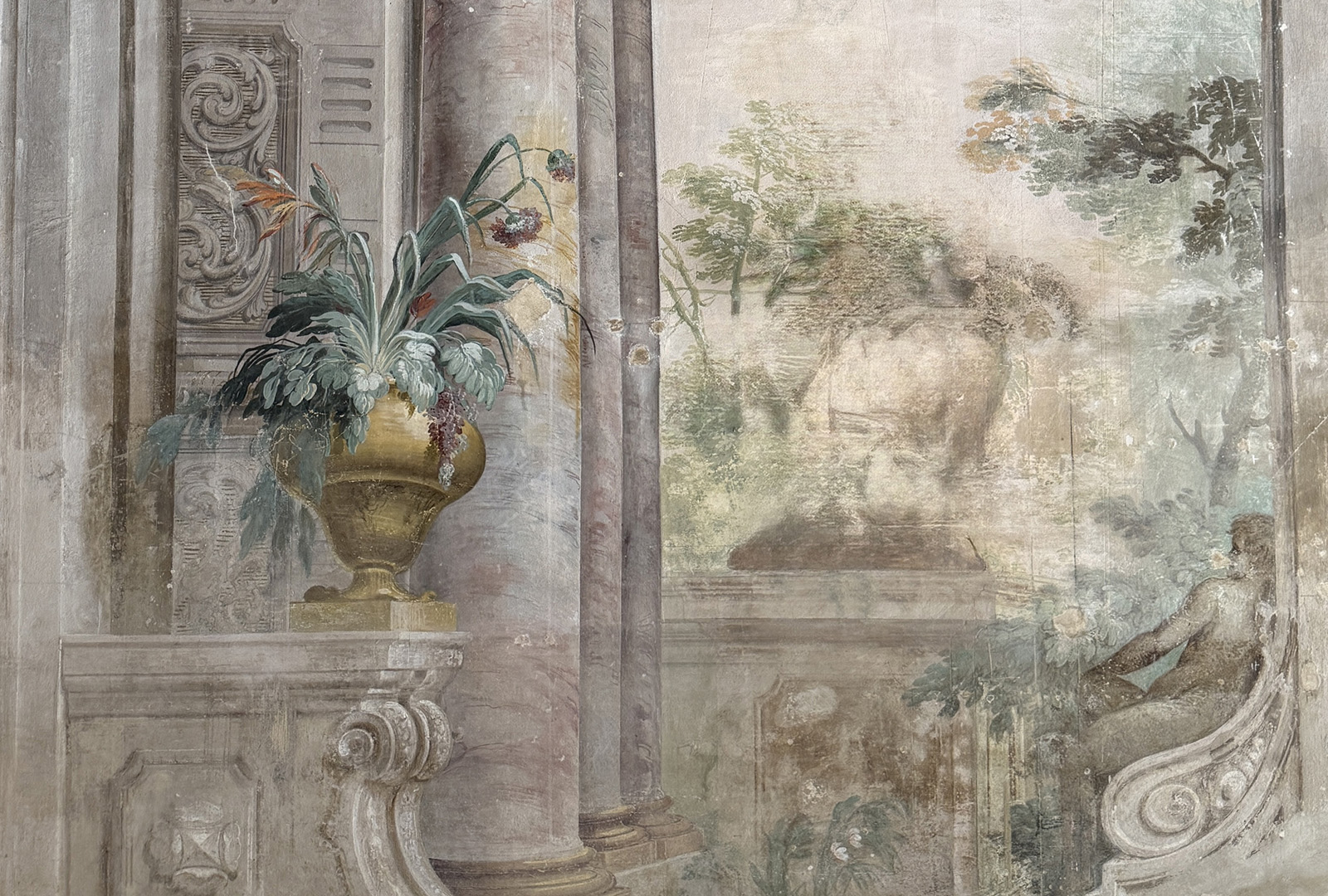
INTRODUCTION TO MAGIC
The concept behind the fashion show is the continuation of a three-year journey, the first two stages of which centred on the themes The Witness and Textures. This year, Istituto Marangoni Florence focuses on the theme of the Sensible, drawing inspiration from Emanuele Coccia and his essay La vita sensibile.
But what is the “sensible”? Coccia approaches this question not through a strictly analytical philosophical framework, but through a fluid, speculative, and often poetic reflection. His writing privileges images and their invisible dimension, drawing on pre-modern philosophical traditions, including thinkers such as Averroes. While rich in suggestion, this approach deliberately distances itself from the scientific and logical rigour that characterises much of contemporary philosophy.
At the core of his thought lies a striking statement: “the sensible is the essence of the image.” Coccia constructs a constellation of intuitions around it. In this sense, the sensible can be understood as something that exists between the subject and the surrounding world — not the image itself, nor purely perception, but the condition that allows images to emerge, circulate, and affect us.
The concept of wonder — that which we gaze upon with amazement — becomes the central focus of the fashion show. The sensible generates wonder because it produces a form of attraction — a glamour that, in its original sense, operates as a form of enchantment.
LOCUS INCANTATUS
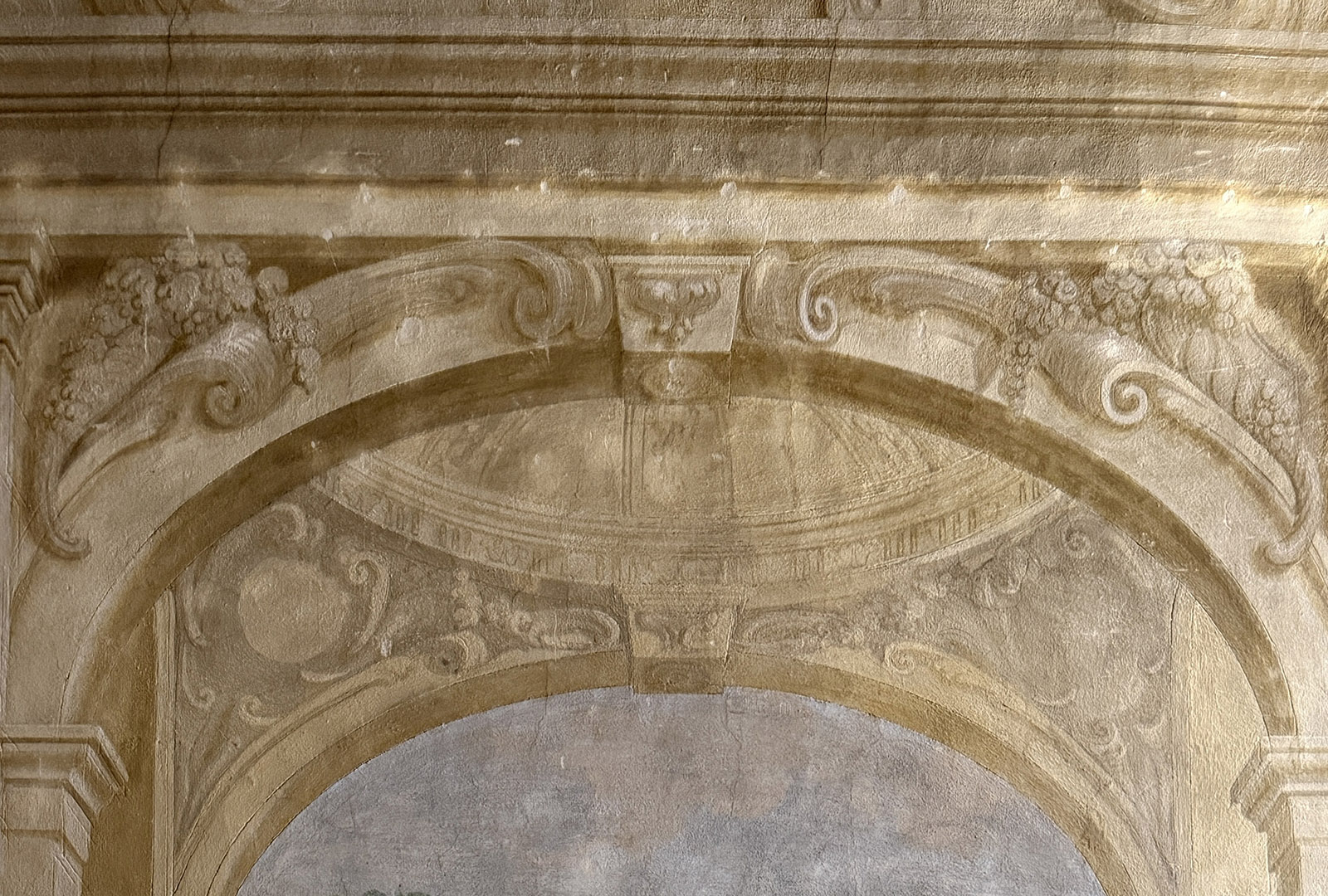
In medieval literature, the enchanted place par excellence is the forest — a space where one encounters fairies, spirits, or demons, often near springs or sources of water, as in the myth of Melusina. While it was not possible to stage the fashion show in an actual forest, an equally evocative location was chosen: the Sale del Ninfeo of Palazzo Corsini, in the heart of Florence.
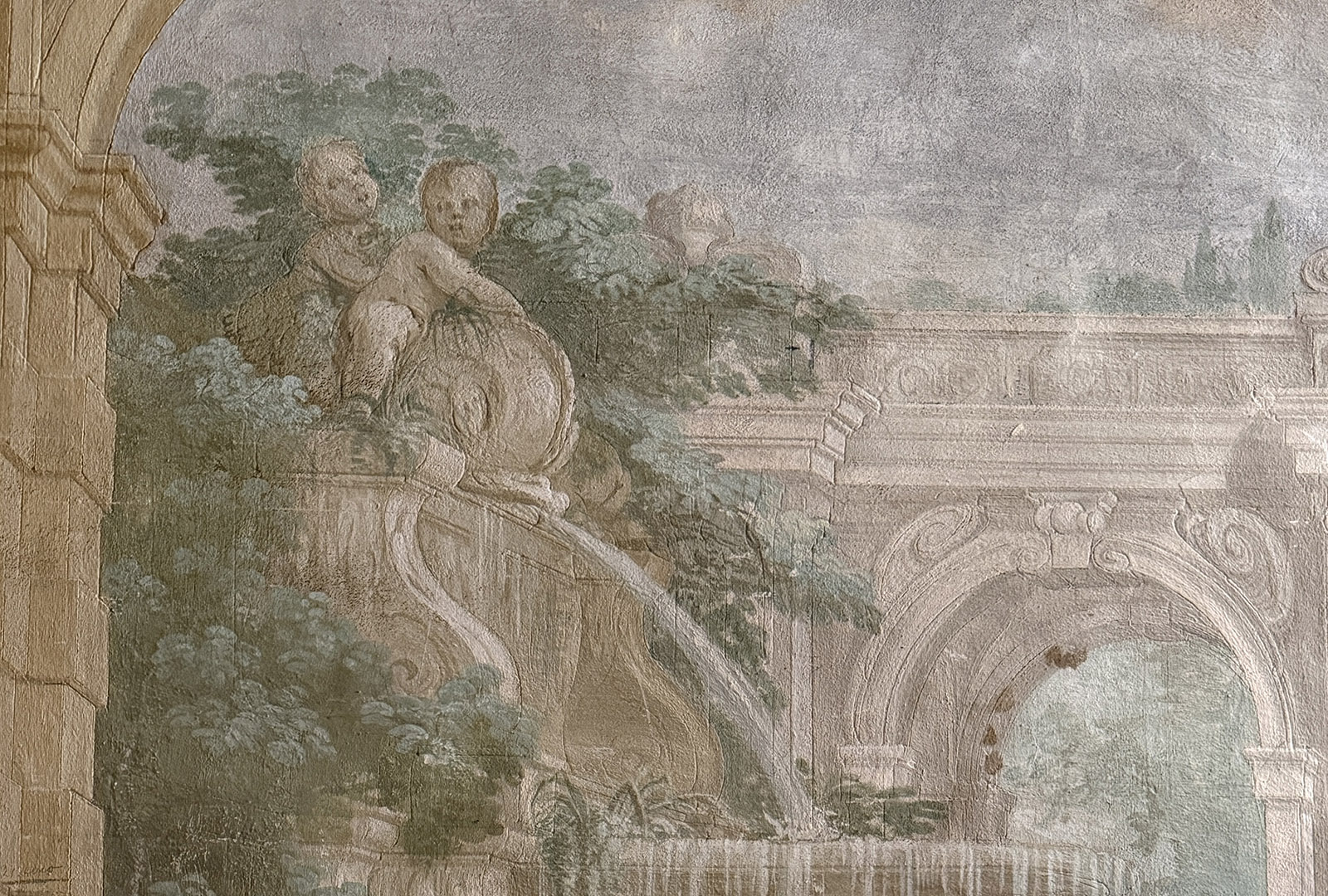
Its magic lies in the trompe l’oeil that depicts trees and lush vegetation, creating the illusion of an open, natural landscape, while inside, a grotto with flowing water introduces a second layer of enchantment — a spell within a spell.
Following Coccia’s perspective, the “sensible” detaches itself from the original object and takes on an autonomous form. What we encounter here is not nature itself, but its sensible manifestation — a mediated, yet powerful presence that exists precisely in the space between reality and perception.
The word ninfeo itself transports us to ancient Rome: a nymphaeum was a sacred space dedicated to nymphs, minor deities associated primarily with water. From mythology to magic, the transition is gradual yet continuous. Cultural transformations redefined these figures over centuries: nymphs became enchanted beings, later associated with what we now call fairies.
In this sense, the classical locus amoenus evolves into a locus incantatus — no longer simply a place of harmony and beauty, but a space charged with mystery and transformation. Although the Ninfeo was built in the seventeenth century, it retains this ancient energy of a marvellous and enchanted place.
THE SONG OF THE SIRENS
The soundtrack of the Runway was produced by Istituto Marangoni Firenze tutor in Sound Design Emiliano Zelada specifically to enhance the experience of MĪRĀBĬLIS collections. If the image alone generates enchantment, sound gives depth to the experience. Like the song of the sirens, it seduces and immerses, guiding the audience into a suspended dimension where perception becomes unstable and heightened.
MĪRĀBĬLIS – THE MAGIC RUNAWAY
Within this conceptual framework, the Fashion Show presents eight collections — four for men and four for women, each comprising five looks. Developed through a shared academic approach, they are characterised by a strong focus on material research, sartorial construction, and a renewed sensibility towards the relationship between body, identity, and nature.
The eight designers were selected by a jury comprising Sara Sozzani Maino, Giuseppe Angiolini, Corinna Chiassai, Luca Lin, Giorgia Cantarini, and Niccolò Pasqualetti.
The collections presented are EWE by Kendall Lea Spitz, La Forma del Sentire by Matilde Bonechi, Mater by Arianna Corrias, I:N by Kangsan Lee, The Performed Self by Sara Peng, Opasana by Karla Musladin, Oltre il Filo by Matilde Gori, and Unexpected Armor by Monica Beduzzi.
THE RUNNING ORDER
Provided directly by the designers and retain their original voice, the following statements will introduce the running order.
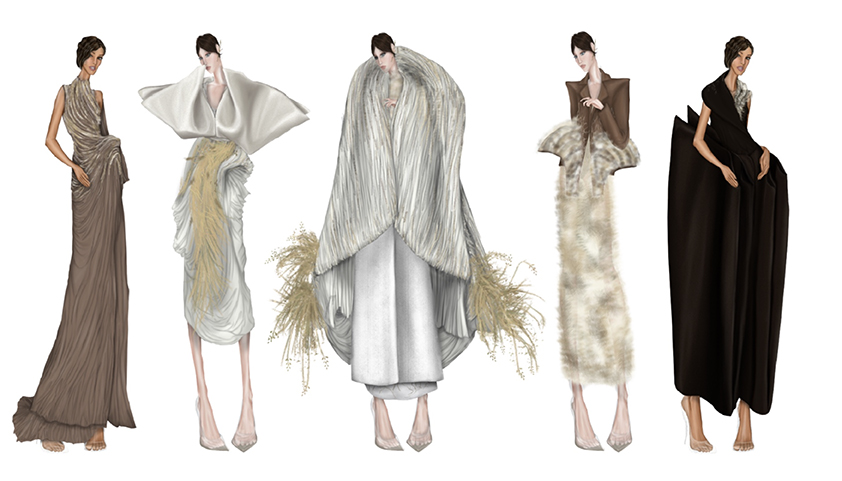
KENDAL SPITZ – EWE
My collection takes inspiration from a fiber that we use every single day without taking recognition from it: wool. Using the wool from my rescued sheep, I highlight the importance of honoring these animals in an industry that profits on their extraction. I took inspiration from traditional shepherds’ garments from around the world, highlighting the structure and protection that was used to keep these animals safe in more of a care rather than a use of these animals. By using traditional techniques of needle felting and wool felting, I honored these animals as non-human workers rather than extracting and taking from them.
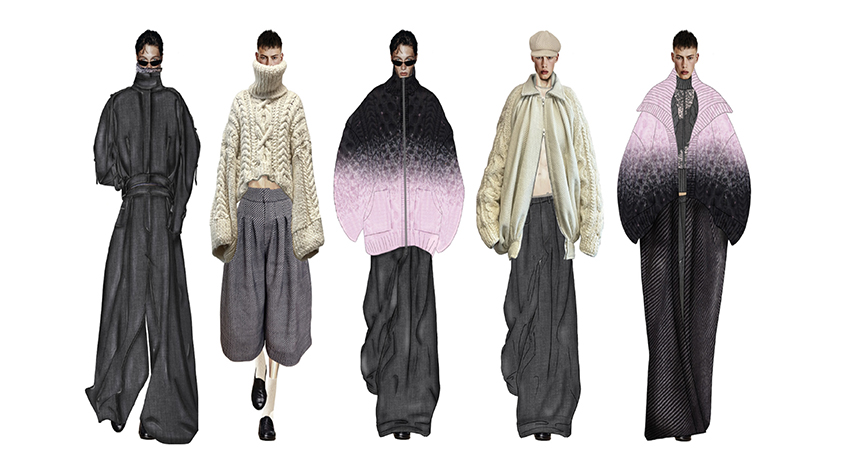
MATILDE BONECHI – LA FORMA DEL SENTIRE
My first inspiration was an essay by Umberto Eco, Pensiero Lombare. Subsequently, I was inspired by menswear silhouettes from the late 19th and early 20th century, focusing in particular on denim, a fabric used in everyday life and one that evolves over time. Afterwards, I studied the clothing of the fishermen of the Aran Islands, from which I drew inspiration for the knitwear section of the collection. Finally, I decided to use the loom to create a hybrid textile that blends denim and knitwear, recreating the same texture of denim through wool yarns.
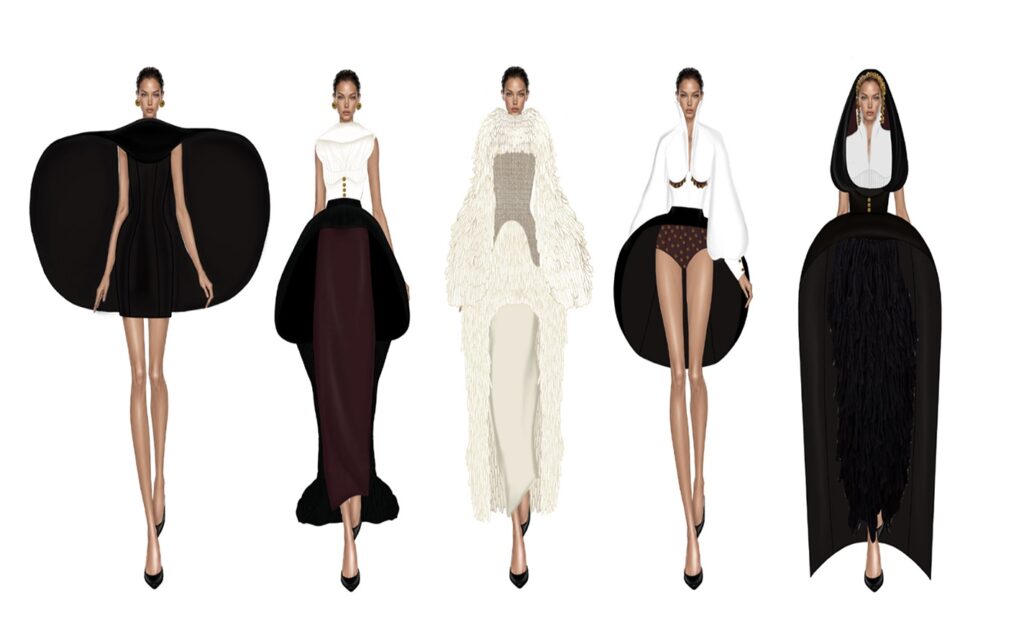
ARIANNA CORRIAS – MATER
My collection is inspired by the Sardinian mother — a strong woman, a pillar of our society — and by a Sardinian artist called Costantino Nivola. I drew inspiration from his works, especially the Mediterranean Mothers. Within my collection, you can find key materials linked to Sardinian folklore, such as velvet, as well as hardware elements like Sardinian filigree, which is a fundamental part of my cultural heritage.
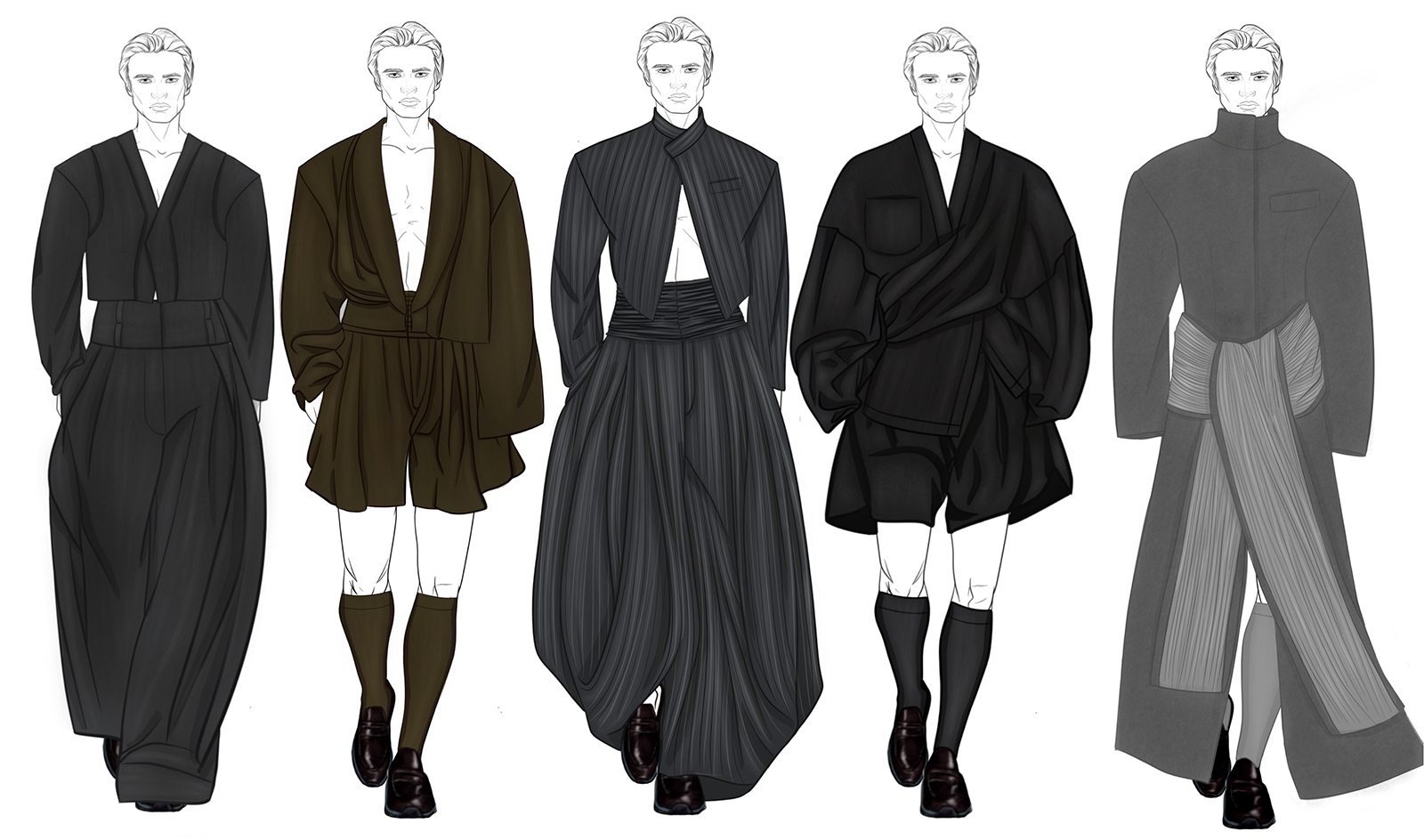
KARLA MUSLADIN – OPASANA
The concept is inspired by Dubrovnik Republic, where clothing was more than a visual appearance, it was part of social system. Rather than approaching Dubrovnik as an image, I approached it as a system. Opasana is menswear collection and it comes from the idea of wrapping and enclosing the body. It refers to traditional belt worn around the waist but also symbolizes protection, structure and control.
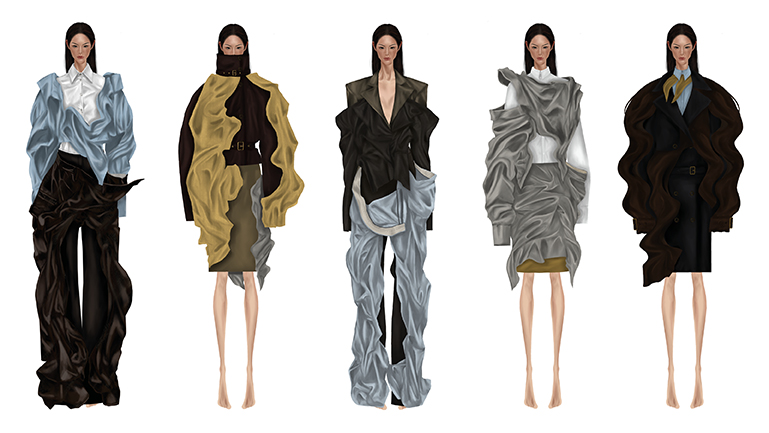
SARA PENG – THE PERFORMED SELF
My collection explores a very widespread psychological condition in contemporary society: the people-pleasing personality, that is a tendency to please others while rejecting one’s own thoughts. I was inspired by the British artist Philippe Soussan, especially his chair series, where he creates an optical illusion by combining crumpled paper with chairs. All my garments are made of two layers: the first is a smooth, uniform dress that represents the mask we want to show to others, meaning the accommodating and pleasant person, while the second layer, which is on the outside, has the same structure but is enlarged and distorted, and this represents what is actually repressed and deformed. The fabrics I used are everyday materials such as cotton, wool, and poplin, but by using wire I tried to create a sense of three-dimensionality.
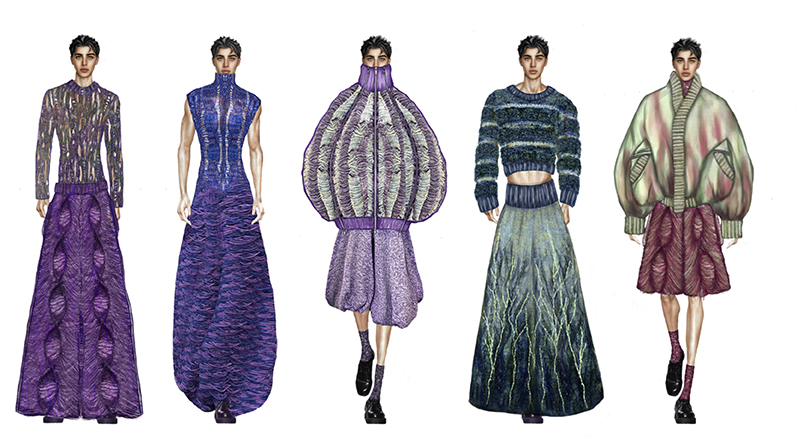
MATILDE GORI – OLTRE IL FILO
Oltre il Filo is a menswear collection entirely made in knitwear, inspired by the history of textile regeneration in Prato and by the memory of my grandfather, who was a cenciaiolo. Through a regenerated cashmere yarn, I explored the theme of evolution. What would normally be discarded here takes on a new form and a new meaning, just as the cenciaioli used to do. Soft textures, colors, and volumes redefine the idea of masculinity, making it vulnerable, sensitive, and contemporary.
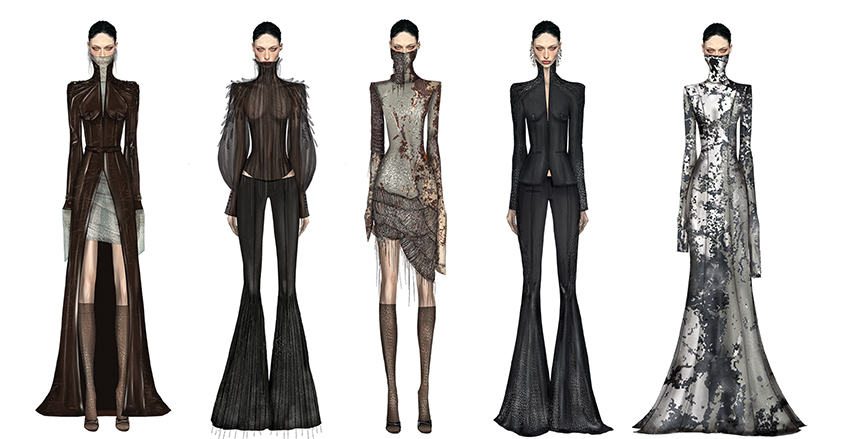
MONICA BEDUZZI – UNEXPECTED ARMOR
The collection is inspired by the concept of time as an uncontrollable force that acts upon everything, both objects and people. My garments translate the metamorphosis of things, specifically the decay of fruit. This is expressed in my collection through textures, fabric manipulations, and the materials used. Crystallization is the technique I used to simulate mold settling on a tired piece of fruit, becoming, in effect, an unexpected armor.
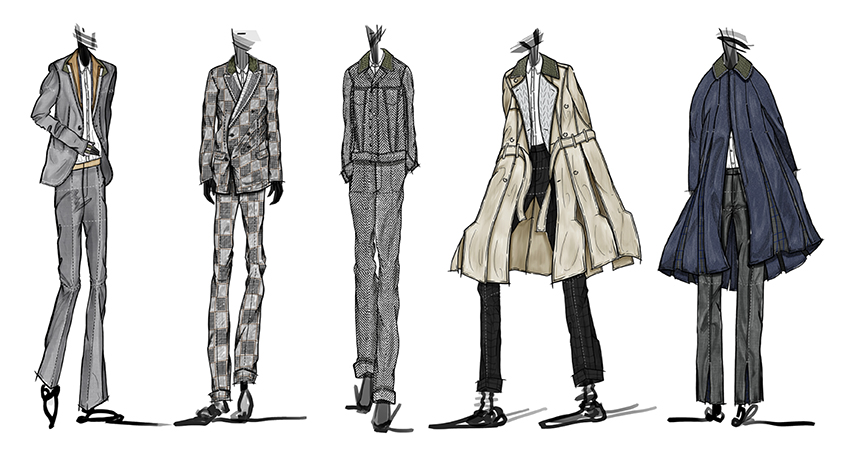
KANGSAN LEE – I:N
This collection is inspired by Carl Gustav Jung’s persona, which I see as a garment. And through tailoring, I present three different stages: tension, adjustment, and release. Materials such as horsehair canvas are very important to my collection because they gradually mold to the body through heat, movement, and posture. And through tailoring fabrics such as wool, cashmere, or cotton gabardine, I was able to express my aesthetic more.
ABRACADABRA
MĪRĀBĬLIS opens a threshold to another world, where the urban fades and nature hosts enchanted presences. Dressed by our young designers, they guide us into a suspended temporality — a time outside of time, where the sensible is not defined, but lived.
CREDITS
Istituto Marangoni Firenze
School Director: Lorenzo Tellini
Director of Education: Francesca Giulia Tavanti
Fashion Design Area
Programme Leader: Miguel García Abad
Tutors: Nora Bagdasaroglu, Jacopo Battisti, Brenda Cecchi, Bianca Hodselle, Valeria Lasalvia, Marco Puccini, Stefano Peloso
Fashion Design and Accessories Alumni: Matilde Tasselli
Fashion Design and Accessories 3 students: Monica Beduzzi, Matilde Bonechi, Arianna Corrias, Matilde Gori, Kangsan Lee, Karla Musladin, Sara Peng, Kendall Lea Spitz
Fashion Styling Area
Programme Leader: Odile Orsi
Tutors: Jacopo Battisti, Martina Lucchesi
Fashion Styling and Creative Direction Alumni: Rebecca Sclavo
Fashion Styling and Creative Direction 3 students: Maria Emilia Alavarado Balcazar, Asia Banchelli, Maria Francesca D’Alì, Clara Ekroth, Giada Pacini, Pamela Robalino, Mia Steinhart
MĪRĀBĬLIS External Jurors
Giuseppe Angiolini, Giorgia Cantarini, Corinna Chiassai, Luca Lin, Niccolò Pasqualetti and Sara Sozzani Maino
Communication PMO
Stefania Facciorusso – Communication Manager
Communication, PR & Event Organization
Lucrezia Mangani – Digital, Social Media & Events Strategist
Production and Casting
Monogrid
Soundtrack
Emiliano Zelada
Sponsors
Hair & Make-up
Monacelli Italy
The House of Hair
Event beverage
Santoni L’Aperitivo


