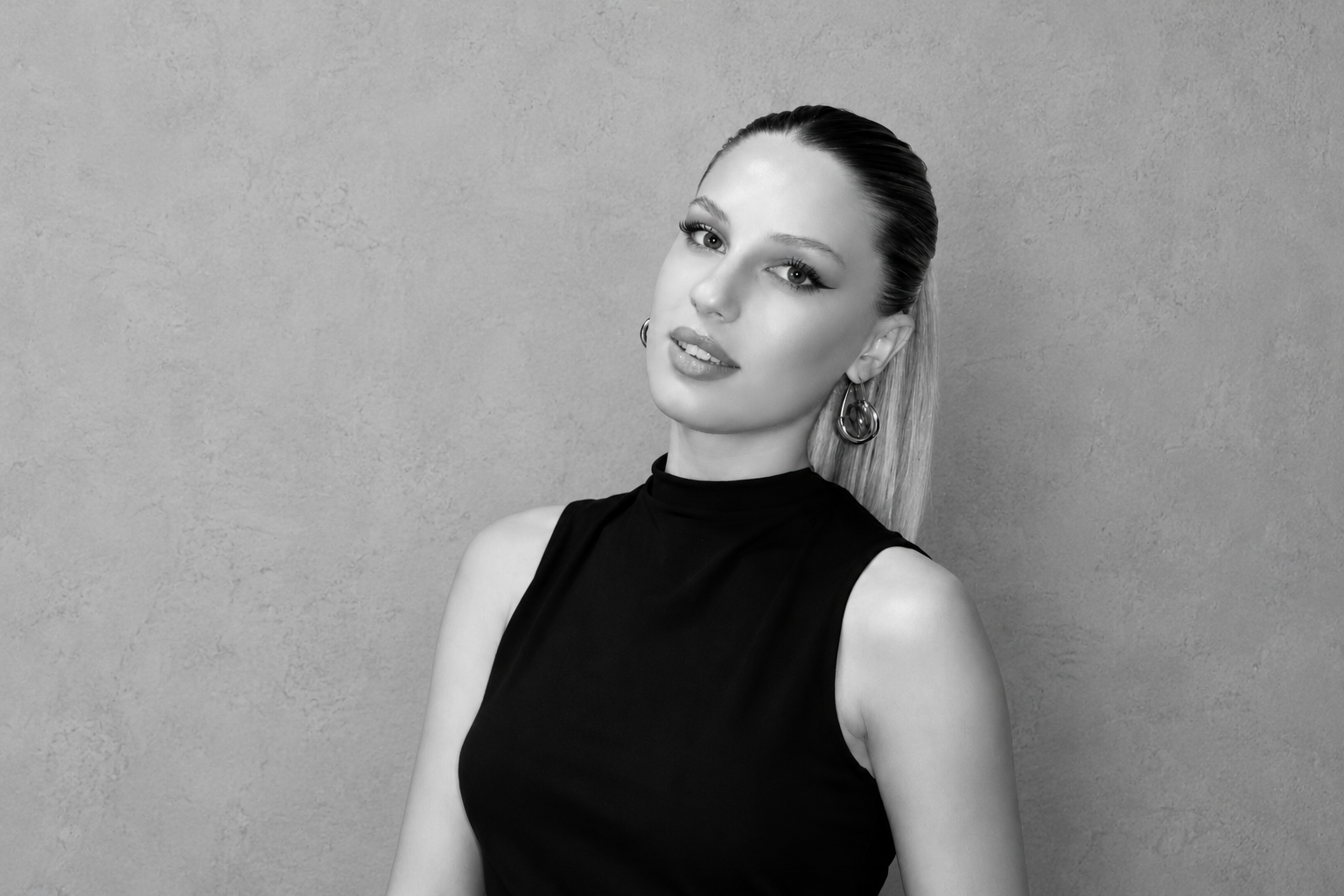
By Gherardo Ulivi.
Born in Florence in 2004, Matilde Bonechi has been passionate about drawing and fashion since childhood, a fascination that led her, after attending a sports-focused secondary school, to study Fashion Design at Istituto Marangoni Firenze, where she developed a distinctive approach to menswear rooted in craftsmanship and material experimentation. Her dedication recently earned her the Fashion Design Award at Milano Moda Graduate 2026, marking an important milestone for a young designer determined to challenge established conventions and develop her own creative identity.
Her collection draws on Umberto Eco’s idea of clothing as an extension of the body, reinterpreting late 19th- and early 20th-century menswear through exaggerated proportions and oversized silhouettes that transform traditional symbols of authority into forms of protection. Inspired by the cable-knit sweaters worn by Aran fishermen, Bonechi combines chunky wool with denim, experimenting with handwoven fabrics that bring together contrasting textures, while pink and gradient shades soften a palette rooted in traditional menswear. The result is a contemporary vision of masculinity in which strength and vulnerability coexist, with clothing becoming a way to express identity and challenge conventional ideas of gender. We spoke to her about winning the award, the importance of craftsmanship and the challenges facing a new generation of designers, from finding their place in the fashion industry to developing an authentic creative voice in the age of artificial intelligence.
From Florence to Milano Moda Graduate 2026
GU: When did your passion for fashion begin, and why did you choose Istituto Marangoni Firenze?
MB: My passion started when I was a child, through drawing. I’ve always loved imagining clothes and experimenting with shapes and colours. As I grew older, I realised that fashion could become a language through which to express ideas and explore identity. I chose Istituto Marangoni Firenze because I wanted to turn that passion into a profession, develop my technical skills and find my own creative direction. Florence is also my hometown, and it has deeply influenced my journey. Art and traditional craftsmanship are part of everyday life here, and they continue to inspire my work.
GU: You won the Fashion Design Award at Milano Moda Graduate 2026. What was that moment like?
MB: It was incredible, almost impossible to put into words. Behind that win were months of research and hard work, along with plenty of doubts and the determination to overcome them. Seeing my collection on such an important runway was emotional, especially because I felt the project had managed to communicate something beyond my own personal vision. It was an enormous achievement and a real motivation to keep experimenting.
GU: You’re ambitious and determined. Which part of your personality helped you the most?
MB: My stubbornness, in the best possible sense. When I believe in an idea, I find it difficult to let go, even when bringing it to life becomes complicated. I’m very demanding of myself, and while developing the collection I had to rethink certain techniques, adjust proportions and find alternative technical solutions. I also learnt how important it is to listen to others and recognise when something can be improved. For me, determination means finding new ways to make the things you believe in possible.
Rethinking Menswear Through Craftsmanship and Identity
GU: Your collection draws on Umberto Eco’s idea of clothing as an extension of the body. How did you develop this concept?
MB: La Forma del Sentire began with a reflection on the relationship between clothing and identity. One of my references was Umberto Eco’s Pensiero lombare, in which clothing is described as a kind of prosthesis for the body, capable of changing its boundaries and the way it occupies space. I translated this idea into exaggerated volumes and constructions that move away from the body’s natural silhouette. Clothing becomes a protective structure, almost like a shield, that can also embrace fragility. I wanted to explore how such powerful shapes could express sensitivity and vulnerability.
GU: Why did you choose to reinterpret 19th- and early 20th-century menswear through oversized silhouettes?
MB: I’m fascinated by the idea of using fashion history to create something contemporary. I studied men’s outerwear from the late 19th and early 20th centuries, with its rigid structures and precise proportions, and looked for ways to reinterpret those codes. Oversized volumes create a different relationship with the body, wrapping around it and transforming its silhouette. I wanted to use the past as a starting point for imagining a new language of menswear.
GU: You combined denim and chunky wool, while experimenting with traditional weaving techniques. What were you hoping to achieve?
MB: Material experimentation is central to my work. I wanted to create a dialogue between denim, associated with everyday wear and durability, and wool, which suggests something softer and more protective. I drew inspiration from traditional Aran knitwear, reinterpreting its cable patterns through three-dimensional techniques. I also experimented with loom weaving, creating a wool fabric that visually resembles denim and establishes a connection between weaving and knitwear. For me, craftsmanship is an essential part of the creative process. I enjoy working directly with materials, understanding their possibilities and exploring how they can shape the construction of a garment.
GU: Pink introduces a softer dimension to the collection. What does this choice represent?
MB: I wanted to bring a sense of delicacy into a wardrobe defined by strong volumes and structured constructions. Pink allowed me to question traditional associations between colour and gender. Combined with denim and wool, it takes on a different kind of strength, while visually softening the oversized silhouettes. I wanted to show that sensitivity and strength can exist within the same identity.
GU: Your collection brings strength and vulnerability together. How do you see contemporary masculinity?
MB: I imagine a masculinity free from the stereotypes that have shaped menswear for so long. A man can be strong and sensitive, and he can seek protection without that being seen as a weakness. With La Forma del Sentire, I wanted to express this vision. The structured outerwear conveys strength, while the softer textures and pink tones introduce a more intimate dimension. I’d like menswear to allow every man to express his personality freely.
GU: What was the boldest decision you made while developing the collection?
MB: Taking on a technically complex project while staying true to my vision. From the beginning, I wanted to create exaggerated volumes and highly structured knitwear, combining different materials. Turning those ideas into wearable garments required countless tests and adjustments. At times, it would have been easier to choose less demanding solutions, but I would have lost an essential part of the collection’s identity. The real courage was accepting the risks of experimentation without knowing exactly how things would turn out.
The Future of Fashion: Young Designers and Creative Freedom
GU: What’s the biggest challenge facing young designers today, and what needs to change in the fashion industry?
MB: One of the biggest challenges is turning creativity into something that can actually be produced, especially from a financial perspective. I’ve realised how much work and how many resources go into creating a collection, particularly when you’re working with quality materials and traditional techniques. It’s also difficult to stand out while maintaining your own identity in an industry that constantly demands something new. I’d like to see the fashion system invest more in young talent by encouraging collaborations with companies and providing access to artisanal expertise. Young designers need real opportunities to grow and develop professional projects, with enough freedom to make mistakes and experiment.
GU: With social media and artificial intelligence everywhere, how do you protect your creative identity?
MB: I see social media and artificial intelligence as interesting tools that offer new possibilities for research and communication. At the same time, I believe it’s essential to stay connected to the physical creative process. Much of my work begins with drawing and experimenting directly with materials, observing how they behave and adjusting them until I achieve the result I’m looking for. Those experiences are fundamental to developing my identity as a designer. Technology can be a valuable resource when used consciously, as long as it leaves room for personal exploration. A designer develops a recognisable language through individual choices and sensitivity.
GU: What matters more today: talent or the ability to promote yourself?
MB: I think finding a balance is essential. Talent and technical skills form the foundation of a designer’s work, while the ability to communicate a creative vision has become increasingly important. Social media gives young creatives a level of visibility that would have been difficult to achieve in the past, but an interesting image needs to be backed by a strong project and a genuine understanding of the product. Above all, I want my work to speak for itself. Every garment should have its own identity and be able to communicate something without needing too much explanation.
GU: Has any designer changed the way you see fashion, and which rule would you like to break?
MB: I admire designers who develop a distinctive creative language, especially those who turn garment construction into a form of research. I’m interested in the relationship between pattern cutting and the body, as well as the possibility of creating unexpected silhouettes while maintaining a strong focus on quality. I prefer to explore different influences, including those outside fashion, to develop my own perspective. The rule I’d most like to break concerns the traditional codes of menswear. I’d love to contribute to a world where colours and proportions can be explored freely, without being tied to predefined gender expectations.
GU: What are your favourite places in Florence to study, go for an aperitivo or visit a museum?
MB: Having been born in Florence, I feel a very strong connection to the city. I find inspiration simply by walking through its streets, looking at the architecture and noticing details we often take for granted. I love having access to museums and historic places that constantly offer new creative inspiration. One of my favourite neighbourhoods is Santo Spirito, because of its authentic and lively atmosphere. I love the relationship between the city’s historical character and the everyday lives of the people who live there. Florence maintains an incredibly strong connection to its past while continuing to offer new perspectives to those working in creative fields.
GU: After this win, where do you see yourself in five years, and who would you dream of dressing?
MB: I’d like to look back and see how much I’ve grown, both professionally and personally. Right now, I want to keep learning, gain experience with leading companies in the industry and develop the skills I need to become a well-rounded designer. I’d love to work for brands with a strong identity and a tradition of craftsmanship that are also open to innovation. Eventually, my dream is to develop my own project with a distinctive creative language. As for who I’d like to dress, I’m thinking more about people who connect with my vision than a particular celebrity. I’d love my clothes to be worn by people who see fashion as a way of expressing who they are.


