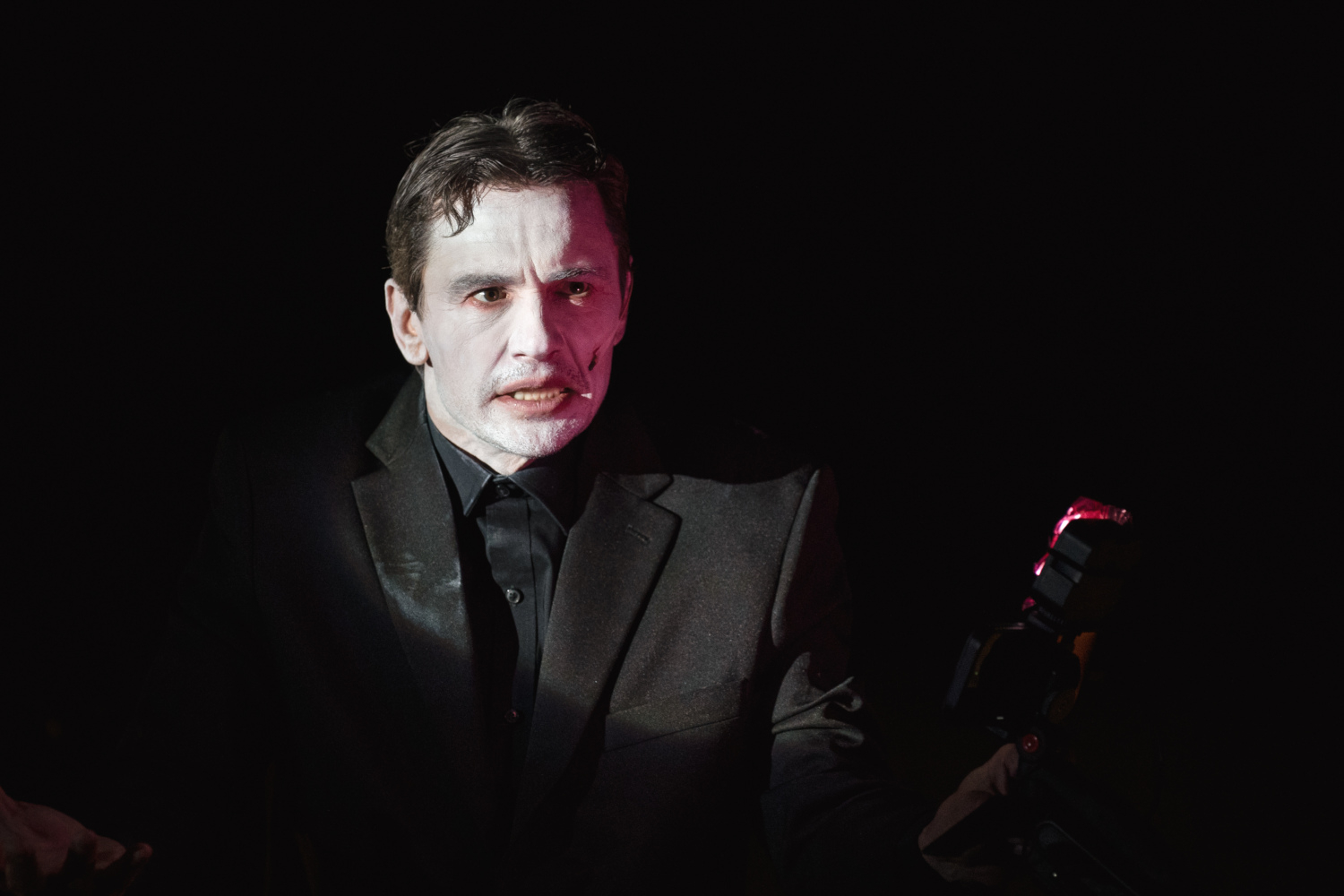
By Gherardo Ulivi. Cover image by Flavia Tartaglia.
What happens when success becomes the thing you need to feel alive? James Franco knows that obsession from the inside. Looking back at his younger years, he describes a time when success and making good art seemed capable of bringing happiness and meaning, only to discover that no achievement was ever enough. That same hunger for recognition is at the heart of Desert Films, the performance written by Franco and directed with Peter Gold, which was staged at Florence’s Teatro della Pergola on 6 and 7 October. Moving between theatre and cinema, reality and fiction, the piece draws on the troubled story of actor Robert Blake and the Mystery Man he played in David Lynch’s Lost Highway, turning Hollywood into the “desert” of the title: a place where fame can become an addiction and material success an attempt to fill an inner void. With him, we talked about Robert Blake, his fascination with David Lynch, his own experience of fame and success, and why live performance still holds a unique power for him.
Back to the Stage
James Franco, why, after so many films, did you decide to take on a theatrical performance?
I love the theater. I go to see as many shows as possible, wherever I am: in New York, London, Paris, Amsterdam, or Los Angeles. Desert Films is a play I wrote myself, so it is a particularly exciting project for me. I started out writing plays in small theaters in Los Angeles; in 2014, I made it to Broadway with Of Mice and Men, and now here I am. I deeply love the art and craft of cinema, but I am also very interested in stories about Hollywood as a kind of addiction: tales of people who love that environment so much that they burn themselves by getting too close to its “heat.”
The Mystery Man
The performance is a tribute to Robert Blake and his portrayal of the Mystery Man in David Lynch’s film Lost Highway. What fascinates you about this character?
Robert Blake is a complex and tragic figure. Having started acting as a child—he was in the cast of Our Gang (The Little Rascals) for 40 episodes—being in front of the camera was as natural as breathing to him, but he also had a visceral need for it to feed his self-esteem. When his career took a severe hit following the accusation that he had murdered his wife, Bonnie Lee Bakley (the actor was later acquitted in criminal court but found liable in civil court, ed.), he completely lost himself. The Mystery Man in Lost Highway represents the mystical and the subconscious. With this show, I wanted to investigate exactly what happens to a person when the thing that gives their life meaning above all else is taken away from them—in this case, cinema.
Hollywood as an Addiction
So you are not interested in the true-crime aspect?
I’m not interested in finding out who the culprit is, but rather in the obsession that drove Blake, a man who seemed to need Hollywood to feel alive: if he wasn’t acting, he felt like a nobody. I am fascinated by that toxic hunger for attention and recognition that we also witness today through social media. The “desert” in the title is Hollywood itself: a place where you try to fill the emptiness of your soul with material success, which becomes your sole reason for living. This is what happened to Blake and his wife, turning them into two tragic figures.
Fact or Fantasy?
Desert Films is therefore a reconstruction of the events?
It is inspired by that true story, but it is not a factual account: it is a “fantasy,” in a way. What interested me was how both Robert Blake and his wife were addicted to fame and everything Hollywood represents, almost as if it were a drug. Drawn by this force, they became the opposite of Romeo and Juliet: instead of star-crossed lovers, they became like two terrible comets that ended up crashing into each other.
When Success Is Never Enough
Does this addiction to Hollywood resonate with you personally?
Certainly, I had it too. When I was younger, up until about ten years ago, I lived with the same obsession. In my subconscious, I thought: if I am successful enough, if I make enough good art, then I will be saved, or I will be happy, and this will give meaning to my life. I have completed projects that I am very proud of and have been part of films I love, but I discovered that it didn’t truly make me happy. I always wanted more, endlessly. Because of this, I can recognize what Robert Blake felt, with the difference that he never woke up from that cycle: even after his acquittal, no longer able to make films, he started shooting videos on his own in his apartment and posting them on YouTube.
Inside David Lynch’s World
The show is also a tribute to David Lynch. What does Lynch mean to you?
I love the way almost every piece of David Lynch’s work—whether it’s cinema, television, painting, music, or acting—operates simultaneously on multiple levels. There is a surface level concerning material reality and the people in the world, but at the same time, there are levels that read as mystical, cosmic, or tied to the subconscious. His beauty lies in the fact that all these levels can be true at the same time.
Cinema Meets Live Theatre
Desert Films is a live performance. There’s cinema, there’s theater. But what exactly happens on stage?
It’s a hybrid between cinematic language and live theater: it involves actors performing on stage who, at the same time, relive and evoke episodes from the past. I deeply love the live dimension and the centrality of theatrical writing; I remember that, since elementary school, even without fully understanding them, I was magnetically drawn to Shakespeare’s works. Going back to Walter Benjamin, a reproduced work of art loses its “aura,” while a live performance retains it: the energy created in the shared space with the audience is unique; it has something almost religious about it.
Escaping the Fame Trap
The show discusses the nature of fame and its consequences. How do you avoid getting swept away by it?
Fame and power give you a deceptive euphoria and make you believe you constantly need them. Many people chase them their whole lives without ever learning how to manage them. It is incredibly difficult to stay sane in the whirlwind of success. Having experienced that slavery firsthand when I was young, I realized I had to find a different way to define myself: I learned to detach myself from the results of my efforts and focus solely on the creative process.


