By Francesca Trovato. Cover image by Alessandro Destro.
Fashion usually reaches us at the end of a very long process. We see the finished garment, the image, the collection. patron/ise, currently on view at Lottozero in Prato, asks us to look earlier, at everything that happens before a surface appears finished. Created at the end of the first six-month residency of Textile Art Factory, the exhibition brings together four young artists — Lorena Bucur, Carmen Buonanno, Linda Ann Cipriani and Nikola Filipović — with curator Ester Maria d’Avossa, all selected within a programme designed for creatives under 36. Their work developed inside one of Europe’s most important textile districts, with direct access to laboratories, archives and companies. For anyone studying fashion today, that context matters: textile is approached as a material you can manipulate and as a system shaped by labour, memory and the conditions under which things are produced.
The exhibition takes place at Lottozero, an international centre for textile culture in Prato’s Macrolotto Zero, a neighbourhood closely connected to industrial production and ready-to-wear manufacturing. Its multicultural history and the forms of labour that often remain invisible also enter the exhibition. The central idea is simple and particularly relevant to fashion: the final object hides almost everything that made it possible. Behind a textile there are experiments that fail, technical decisions, physical effort and people whose work may disappear once the finished surface reaches us.
So what does textile research actually look like?
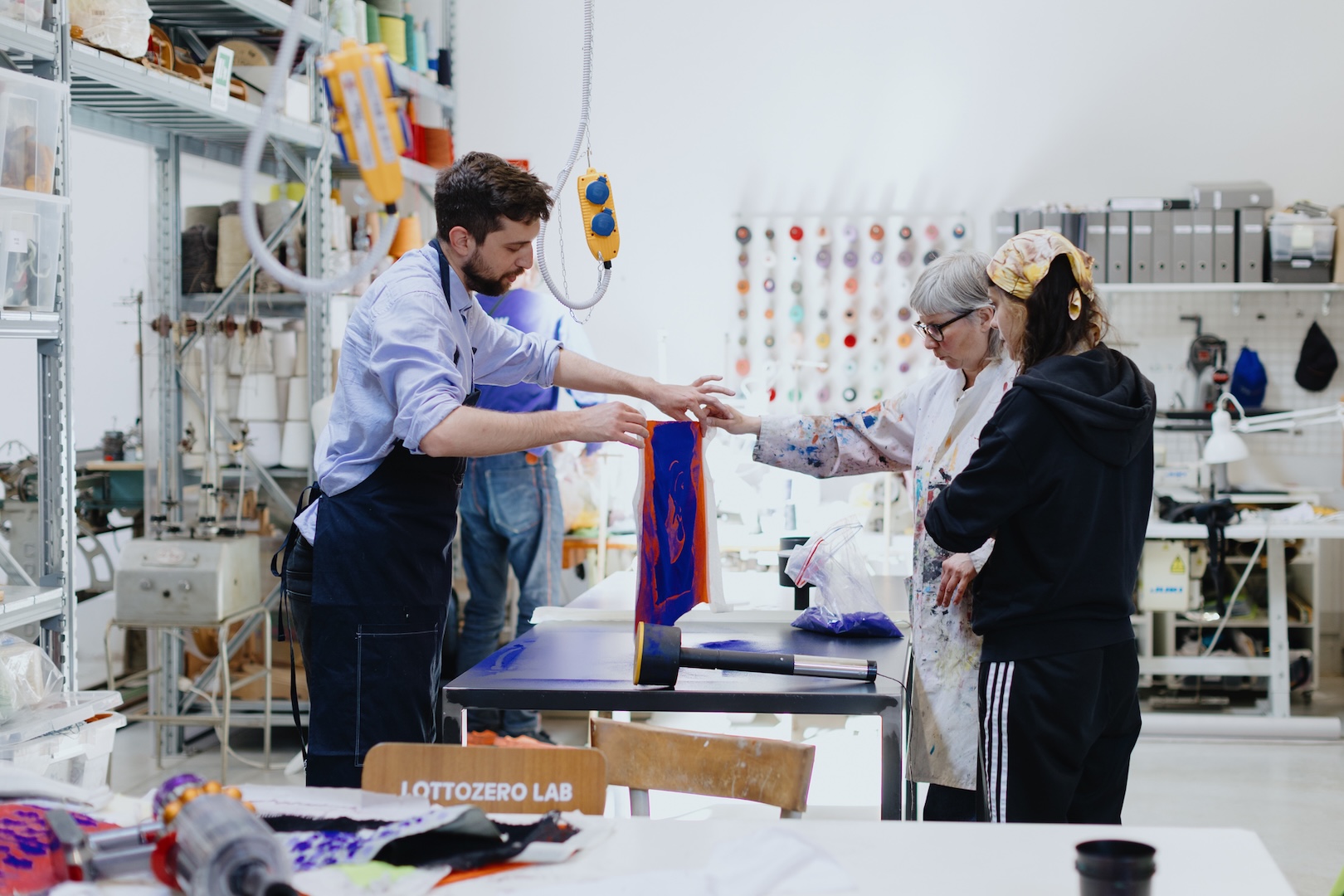
Textile Art Factory gives a fairly concrete answer. During the residency, participants received technical training and worked with practitioners from the international textile scene. The programme included yarn winding and weaving with Astrid Skibsted, haute couture embroidery with Elisabeth Gasbarre, felt with Studio Claudy Jongstra, surface and flock-printing research with Eugène van Veldhoven and Annika Syrjämäki, and natural-pigment printing with Florence Hawkins. For young people entering fashion, this is perhaps one of the most useful aspects of the project. Material research happens through direct experimentation. You understand a textile differently once you have seen how tension changes a surface or how an error can generate a new visual effect. The residency placed that experimentation inside Prato, connecting contemporary creative practice with the technical knowledge of a district where textiles are part of everyday economic life.
Linda Ann Cipriani: when fabric starts behaving like a screen
Linda Ann Cipriani, born in 1995, moves naturally between physical material and digital processes. In Overprocessing the Net, textile becomes a kind of network where fabric structure meets the digital grid. The word net refers to the construction of the cloth as well as the systems through which images and labour circulate.
Cipriani works with scanning, enlargement and stitching, allowing effects such as moiré to become part of the work instead of treating them as defects to erase. Textile scraps and industrial materials found during the Prato residency enter the installation alongside components from textile machinery. The result makes the production process visible on the surface. For fashion students accustomed to designing through screens, this connection feels especially current. Digital imagery is constantly translated into print or fabric, and the imperfections created during that movement can become part of the design language itself. Cipriani’s work suggests that the most interesting moment may happen when the digital image stops behaving perfectly.
Lorena Bucur: a fabric can hold a family history
With White n.1, Lorena Bucur, born in 1996, starts from a photograph taken by her father inside her grandmother’s home in Romania. Textiles were already everywhere in that image, appearing as rugs and domestic fabrics decorated with traditional motifs. Bucur takes that inherited visual memory and transforms it through flock printing on viscose, creating an almost invisible white-on-white surface. Inside the patterns, references to Eastern European popular culture also appear, including the Adidas logo and the histories of counterfeiting associated with it. The textile is then draped over scaffolding, a structure connected with physical work and migration. What initially appears fragile is supported by something associated with construction. It is an interesting way to think about textile design because pattern here carries history. A motif can travel through generations and absorb new meanings along the way. Fashion frequently borrows from visual heritage; Bucur’s work asks what happens when we look more closely at where those images came from and who carried them forward.
Nikola Filipović turns childhood objects into textile sculpture
Nikola Filipović, born in 1994, works primarily with embroidery and felt and considers textile a sensitive archive capable of holding traces of human experience. His installation First Time Being Alive begins with a personal discovery: he had reached the age his parents were when he and his sister were born in the years immediately following the wars in former Yugoslavia. From there, childhood toys become enlarged textile sculptures. The forms resemble plush toys while carrying memories shaped by the economic instability of the period. Their decorative surfaces draw on Slavic domestic textiles and family linen traditions, including the symbolic form of the tree of life.
Scale changes everything. Something familiar becomes strange once it grows beyond the dimensions we associate with childhood. Felt also becomes more than a soft surface: it carries questions about what families transmit and how materials can store experiences that are difficult to articulate directly.
Carmen Buonanno asks how much pressure a material can take
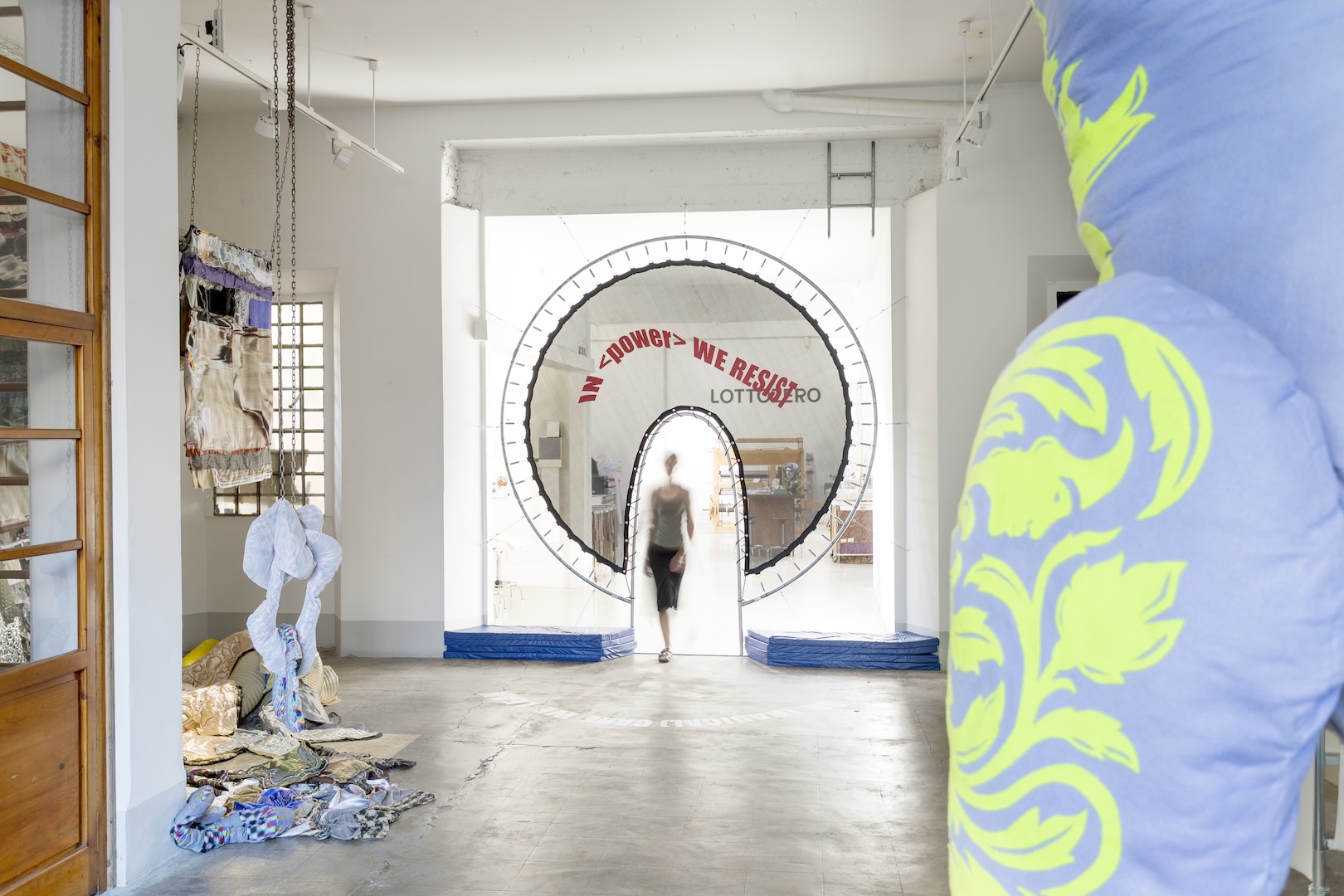
Born in 2001, Carmen Buonanno is the youngest artist in the exhibition. Her practice investigates how bodies experience space and how environments can produce different forms of access or exclusion. In Radical Power, she transforms the threshold between Lottozero’s exhibition area and the surrounding spaces using a trampoline positioned vertically and held under tension. Its elastic surface becomes a structure that physically suggests pressure and resistance. The phrases “In <power> we resist” and “On {radical} care we lean” connect the installation to workers’ protests and labour struggles within Prato’s textile district, including those involving migrant workers. The work was also activated through a performance with electroacoustic composer Muiredach O’Riain on July 23.
For fashion, the question behind the work is difficult to ignore. Materials have physical limits, and production systems place pressure on people too. The textile industry becomes a useful framework for considering both.
Why should someone studying fashion care about all this?
Because fashion begins much earlier than styling. Understanding textiles means understanding how a material behaves and what kind of knowledge is required to transform it. It also means seeing the systems behind the finished product. That is where patron/ise becomes particularly interesting for younger creatives. Its artists move freely between hand processes and technology while working directly with the industrial reality surrounding them. The exhibition makes space for failed experiments and residues from production, treating these elements as part of creative research instead of hiding them.That approach feels increasingly relevant for a generation entering fashion at a moment when questions about production are impossible to separate from design. Learning how something is made changes the way you design it.
Why Prato’s Textile District Matters for Fashion Education
Textile Art Factory was created by Lottozero in partnership with the Museo del Tessuto di Prato and Studio Corte 17, with support from the Tuscany Regional Programme FSE+ 2021–2027. The programme consists of two six-month residency cycles and gives participants the chance to live and work in Prato while entering into contact with local archives, companies and cultural institutions.That geographic connection is crucial. Prato provides something that cannot easily be reproduced inside a classroom: proximity to an active manufacturing ecosystem. Techniques can be learnt in the laboratory and then understood in relation to the larger network that produces textiles every day.
For a young designer, visiting patron/ise therefore means looking at fabric from the opposite direction. Instead of beginning with the finished fashion image, you begin with the material and follow everything that sits behind it.
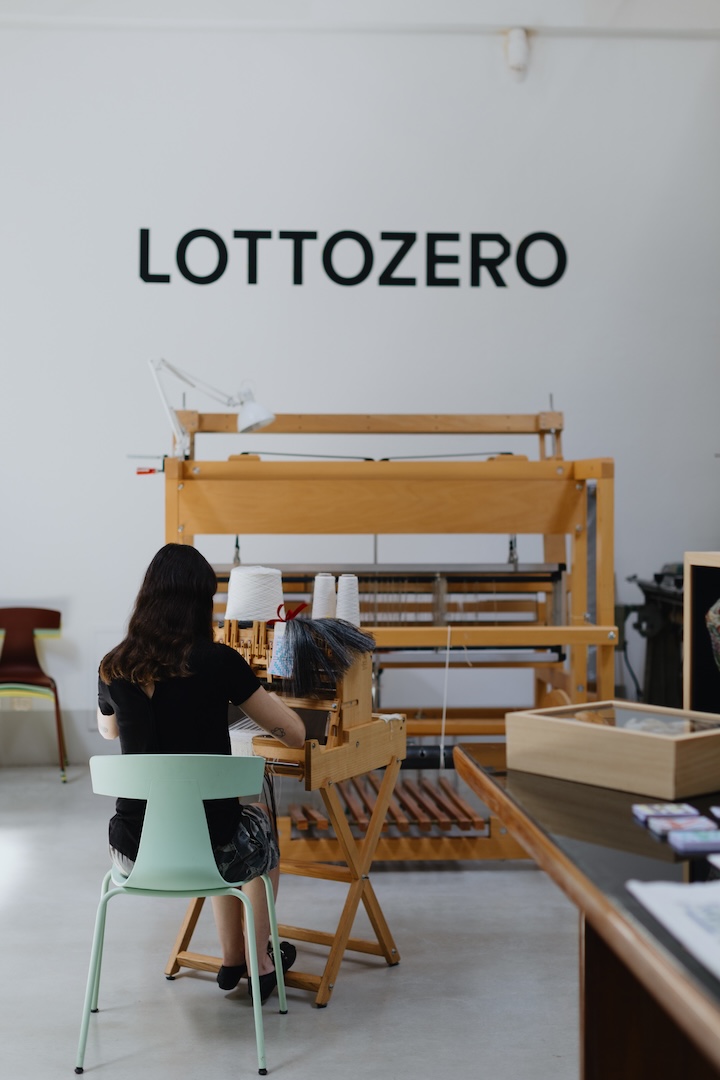
Photo by Toast Studio
Need to know
patron/ise is on view at Lottozero Kunsthalle, Via Arno 10, Prato. The exhibition is curated by Ester Maria d’Avossa and features works by Lorena Bucur, Carmen Buonanno, Linda Ann Cipriani and Nikola Filipović. It is open Monday to Thursday from 10am to 6pm, Friday from 10am to 4pm, and on weekends by appointment.


