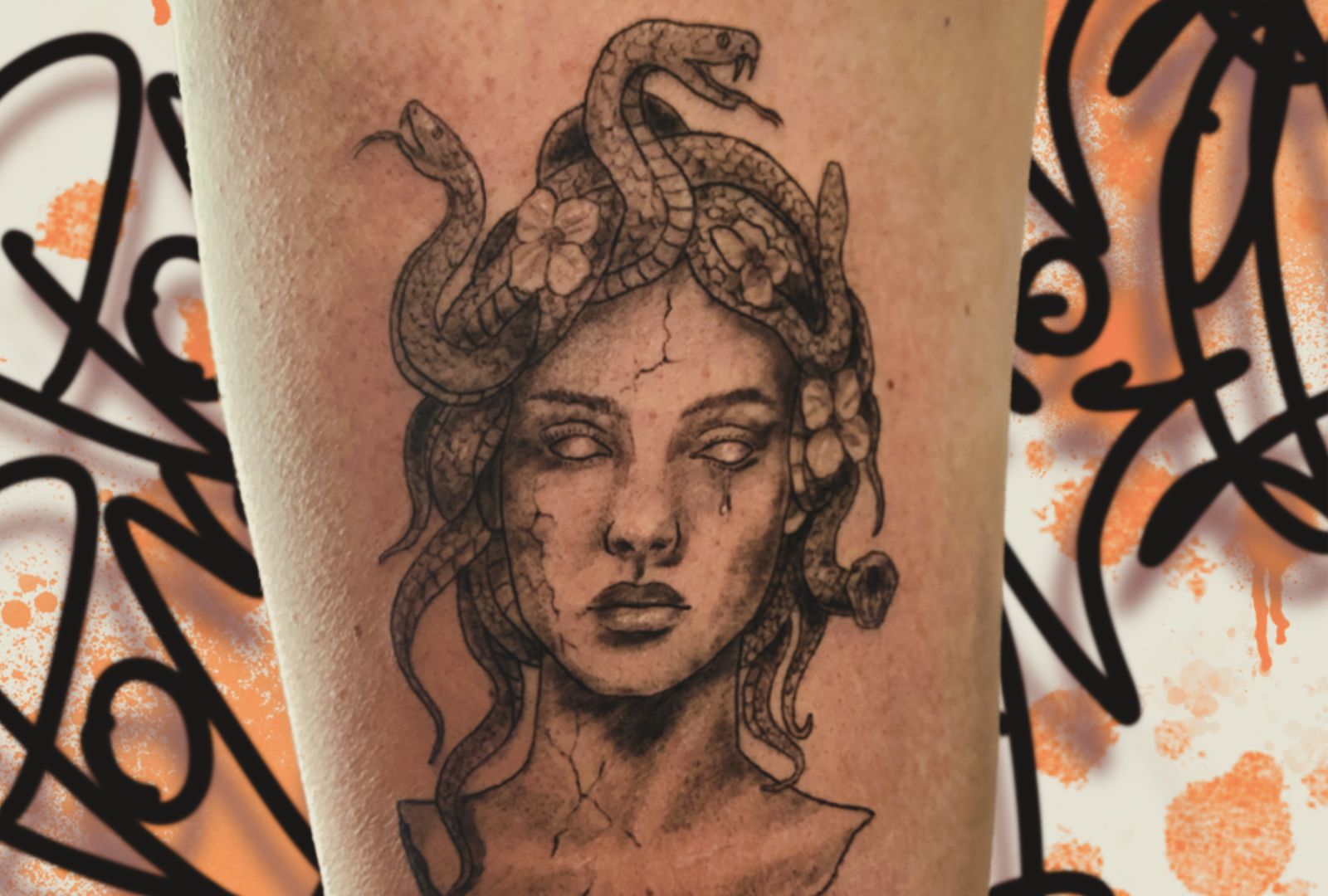
By Azzurra Rinaldi. Cover image tattoo artwork by Falco Luca Poggioni
Never before have we had access to so many images. And yet, never before have we chosen from such a limited visual vocabulary.
Tattoos are often described as the ultimate form of self-expression. They tell a story, mark an experience, celebrate an identity. At least, that is the theory.
In practice, however, a quick scroll through social media reveals an unexpected phenomenon: thousands of people expressing their individuality through remarkably similar tattoo designs. Minimalist flowers, flying dandelions, tiny hearts, inspirational quotes, celestial symbols, and geometric animals appear again and again, replicated across feeds and bodies. The question is: what happens when uniqueness becomes a trend?
Your Tattoo Isn’t as Original as You Think: The Myth of the Unique Tattoo
Most people who get tattoos believe that their tattoo design is unique and special. But even the most original idea rarely exists in isolation. The images we use to represent love, freedom, rebirth or identity are part of a shared visual vocabulary that circulates across cultures and generations. We think through recurring symbols and archetypes.
In a world of eight billion people, complete originality is almost impossible. Every tattoo, no matter how personal, belongs to a wider visual and cultural repertoire. My own tattoos are no exception. A Finnish phrase on the back of my neck, Hullus ja Vapaus (“Craziness and Freedom”), may be less familiar than a reproduction of Canova’s Eros and Psyche, yet neither exists outside a shared symbolic universe. What makes a tattoo personal is often not the image itself, but the story attached to it.
How Instagram and Pinterest Shape What We Get Inked
The real question, then, is not why tattoo symbols are repeated, but why certain images have become overwhelmingly dominant.
Think about the concept of freedom. What image comes to mind? A bird in flight? A butterfly? Or perhaps a dandelion transforming into a flock of birds? And what about resilience? How many times have you seen the word inked in elegant cursive lettering?
Pinterest and Instagram are filled with images that connect specific concepts with equally specific visual formulas. Freedom becomes a flying dandelion. Rebirth becomes a phoenix. Eternal love becomes an infinity symbol. Emotional connection becomes two hands linked by their little fingers. These tattoo designs are repeated endlessly, often in different sizes and on different parts of the body, but with remarkably little variation. Symbols have always been repeated. The difference is that today repetition is increasingly shaped by algorithms rather than by tradition. Social media platforms have reduced an almost infinite symbolic repertoire to a limited catalogue of highly recognizable, endlessly recommended solutions.
The Great Tattoo Catalogue: Why We Keep Choosing the Same Tattoo Designs
Some tattoos carry deep personal meanings; others are primarily aesthetic choices. There is nothing wrong with either approach. A flower, butterfly, mandala, or decorative pattern does not need to tell a life-changing story in order to be meaningful.
The more interesting aspect is not what these tattoo designs mean, but why we keep seeing the same ones everywhere. Imagine wanting a large mandala tattoo on your back. You open Pinterest, browse hundreds of images, and eventually stop on one design. “I like that one.” The choice feels personal, yet thousands of other people may have arrived at exactly the same conclusion.
In the process, we sometimes forget that tattoo artists are artists. Rather than creating something new from a conversation, many are asked to reproduce an image that already exists online.
The result is predictable: copies of copies of copies.
Certain tattoo designs have become the Times New Roman of skin art, instantly recognisable, widely available, and endlessly reproduced.
Original Tattoo or Viral Trend? The Question to Ask Before Getting Inked
I don’t think tattoos need to be original. In fact, originality itself may be an illusion. Our imagination is often shaped by images and narratives that already exist around us. Perhaps, instead of searching for the perfect image online, we could start with an idea, a memory, a feeling, or a story, and allow the tattoo artist the freedom to interpret it. If you ask an artist to represent freedom, they might create something very different from a flying dandelion, an infinity symbol, or the word “resilience”.


