By Azzurra Rinaldi. Cover by Giovan Battista Dall’Arno.
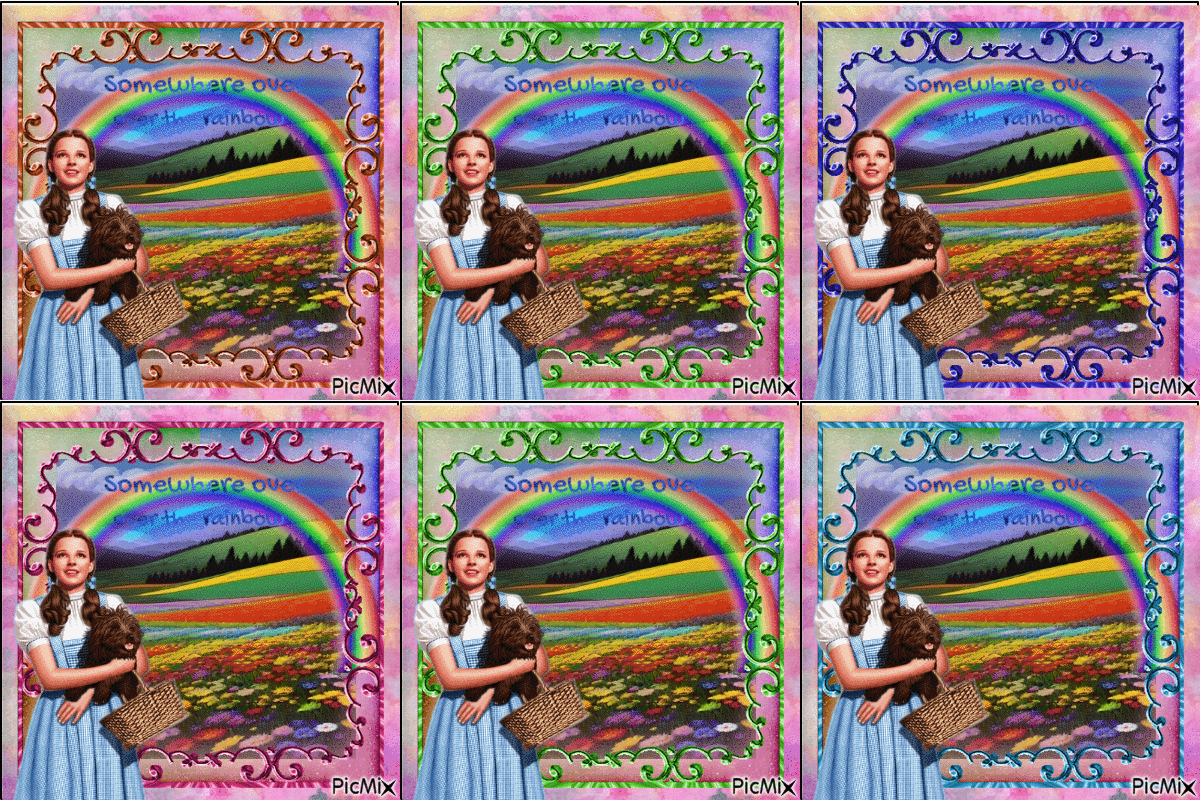
“Somewhere over the rainbow,” sings the protagonist of The Wizard of Oz, and indeed, she eventually flies over the rainbow into another world.
Rainbows are, in a way, magical, which is why they appear in countless symbols and contemporary icons. We find them in Nordic mythology as the rainbow bridge that connects the world of the gods to the human one, and in contemporary culture they are also imagined as the bridge that animals cross into the afterlife.
The cover of Pink Floyd’s The Dark Side of the Moon, where a rainbow emerges from a prism, is iconic. Is the dark side really so dark? Or is it colourful like a rainbow? The rainbow is created when a ray of light splits; we usually see light, but not the rainbow contained within it.
What Makes the Rainbow So Fascinating
We could think of light as Doctor Who’s Police Box (perhaps a bit too millennial…): bigger on the inside. Rainbows have seven colours, but from light we usually perceive just one. In fact, we often say that white is not a single colour, but the sum of all colours, while black is the absence of both colour and light.
Just seven colours can generate all the colours in the world, just like seven musical notes can create every composition, from classical to metal, pop to techno.
Why We Turn to the Rainbow After the Storm
The rainbow has become a symbol of hope, as it appears after the rain. Seeing it after a storm is comforting; it brings a sense of calm.
For this reason, it has also been used as a symbol of peace, sometimes even replacing the traditional white dove. It feels universal, not tied to any specific religion or political ideology. It simply exists in the collective imagination, and for that very reason it has become a shared symbol. During the Covid period, the rainbow also became a symbol of hope, encapsulated in the phrase “everything will be alright.” In that context, it came to represent resilience in a time of uncertainty: the idea of holding on with patience and care, and trusting in a sense of collective strength.
How the Rainbow Became a Symbol of Pride and Identity
The rainbow has also become one of the most recognizable symbols associated with Pride and LGBTQ+ visibility. During Pride season, the rainbow moves beyond its role as a spectrum of colours and becomes a language of visibility, used to claim space, affirm identity and express belonging in the public sphere.
The earlier meanings remain, simply layered rather than replaced. The rainbow stays what it has always been – light, transition, multiplicity – while gradually taking on another role, becoming a presence that occupies space, speaks, and makes itself visible.
Over time, the rainbow has expanded. New colours have been added – pink, white, black – enriching its visual and symbolic language. The Pride flag evolves as identity itself evolves: fluid, expressive, and free from fixed definitions. And we like it. Because the rainbow does not follow rigid rules: so why should it stay limited to seven colours, when it can be many more?


