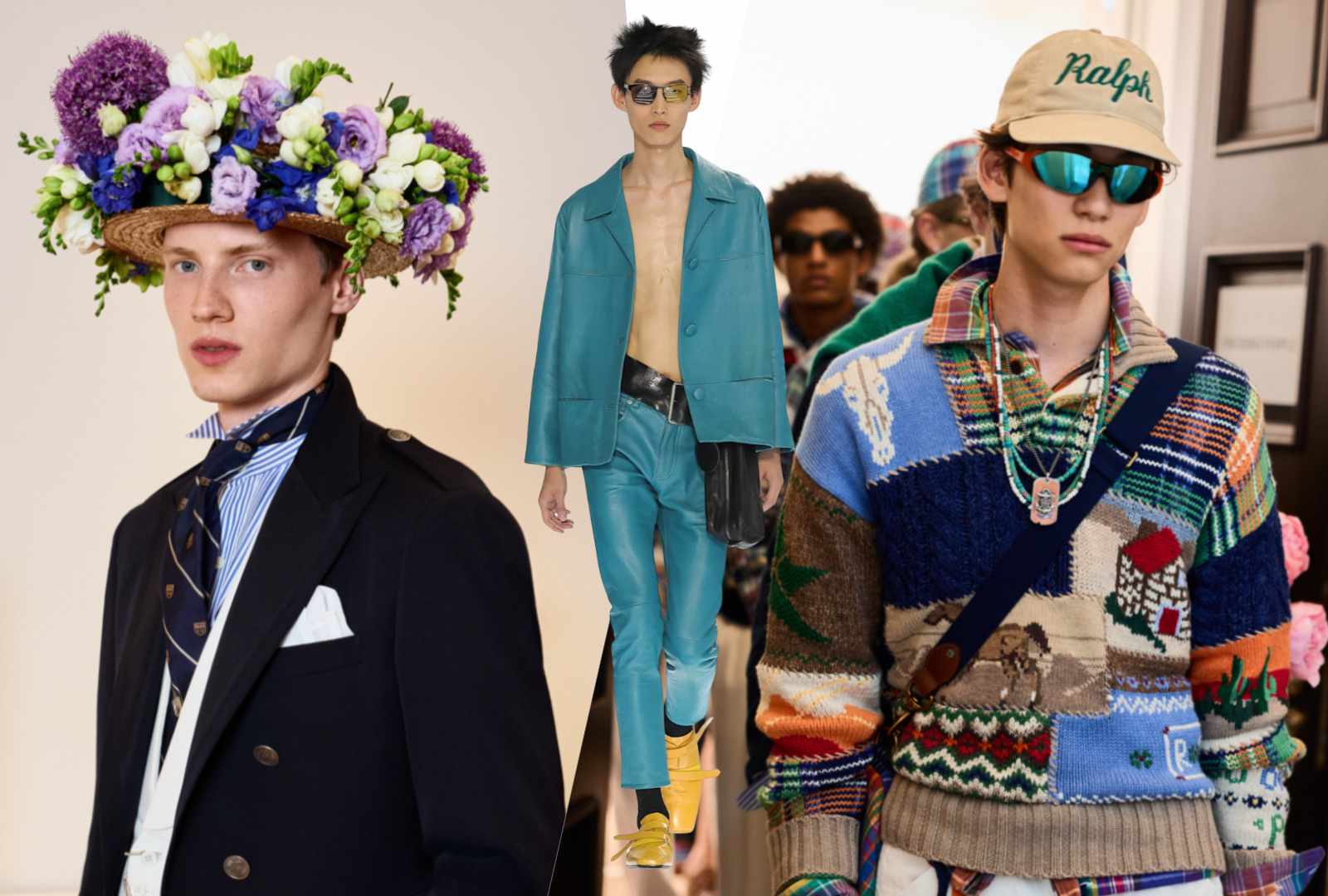
By Giulia Piceni.Cover image I’M FIRENZE DIGEST Prada and Ralph Lauren courtesy.
Arriving in Milan at the Wrong Time, Or Exactly the Right One
I finally moved to Milan thinking I would arrive inside a system at full intensity. Fashion Week, at least in its mythology, is supposed to feel like a city briefly overclocked: editors running between shows, buyers making decisions that will define seasons, and a general sense that something culturally significant might happen at any moment if you just stay alert enough. Instead, Milan Men’s Fashion Week SS27 arrived with a strange kind of calm. Everything functioned, everything was scheduled, everything was photographed, and yet very little of it felt urgent. People attended shows, documented them, moved on to the next appointment, and repeated the cycle with impressive efficiency. But the emotional charge that is supposed to sit underneath all of this seemed diluted, as if the machinery of Fashion Week had remained intact while the voltage had been quietly lowered.
Milan Men’s Fashion Week SS27: Why Everything Feels Slower
A few days before the shows began, I was having a drink with a friend who had just joined as a model one of those impeccably established Italian luxury houses, the kind defined by a quiet confidence along with excellent tailoring, precise fabrics, and a sense of refinement that does not require justification. And to be fair, Italian tailoring like Savile Row still represents one of the highest expressions of garment construction in the world. But that is also where something interesting begins to happen, because craftsmanship, on its own, no longer guarantees tension. It guarantees quality, yes, but not necessarily desire. Our conversation drifted into the broader state of fashion, and into a shared observation that so many collections now feel visually aligned as if clothes had to play it safe.
As in the calendar the striking majority of the menswear brands present were characterized by the just described tailored allure, the silhouettes from each runway show didn’t present much of a stir to the system. Even a quick look through all of them unlocks similar proportions. Even the supposed attempts at differentiation often sit within the same aesthetic vocabulary. Across menswear SS27, what once felt like distinct positions now feels more like variations on a single, increasingly polished language of luxury minimalism. And perhaps that is the quiet paradox: the more technically perfect fashion becomes, the more emotionally interchangeable it risks feeling.
Why Fashion Speaks Innovation More Than It Shows It
What complicates this further is the way fashion now speaks about itself. Every brand wants to appear contemporary, every presentation needs to signal innovation, and every season is accompanied by a growing list of technological references that sound increasingly detached from the clothes they are meant to describe. Artificial intelligence, digital ecosystems, immersive experiences, virtual identities. These terms circulate easily through press releases and presentations, creating the impression of movement even when the garments remain firmly within familiar territory. My friend mentioned, almost casually, that he had been scanned in full body because his digital avatar would be used in a fashion installation. It was not presented as extraordinary, simply as part of the evolving interface between fashion and technology. But it raised a question that is difficult to ignore: if innovation is increasingly expressed through systems surrounding the garment rather than through the garment itself, then where exactly is fashion evolving? There is a growing distance between the language of progress and the physical reality of what is being shown.
Milan Men’s Fashion Week SS27: When Attendance Becomes Performance
Outside the shows, Milan Men’s Fashion Week SS27 operates with its own recognisable rhythm. There is a choreography to it that has become increasingly refined over the years. People move efficiently between venues, photographs are taken with intention, attendance is documented as proof of relevance, and presence itself becomes a form of currency. Attend. Photograph. Post. Move on. Repeat. Even social interactions begin to follow this structure. Invitations are exchanged, plans are suggested, and meetings are postponed with an optimism that everyone knows will not survive the week. Eventually, most paths lead to the same outcome: a bar somewhere in Milan where the prices are still marginally tolerable and where the conversations revolve around deadlines, casting decisions and the general exhaustion of trying to stay visible. It was in one of these moments that I found myself saying to a friend that fashion had become too corporate. Because while the industry has never been more financially successful or more globally systematised, there is a growing sense that creative risk has shifted away from the object and into the infrastructure surrounding it. What is being produced is increasingly safe, while what is being communicated is increasingly ambitious.
Prada Menswear SS27 at Milan Fashion Week: Why It Still Feels Different
There are exceptions, and in Milan they are difficult to ignore. Prada Menswear SS27 at Milan Fashion Week remains one of the few houses that still seems interested in producing something closer to a proposition than a product. Perhaps my reading of it is inevitably shaped by an enduring interest in Raf Simons’ work, but what feels distinctive is not simply the aesthetic outcome, but the presence of tension within it. Prada collections do not always resolve cleanly. They do not always aim to. They leave space for interpretation, contradiction and disagreement. And in a season where so much feels pre-aligned before it even reaches the runway, disagreement itself starts to feel like a form of value. Elsewhere, the system continues to adjust. Creative directors rotate, brands reposition, and cities quietly compete for cultural relevance. Even designers who once felt inseparable from Milan, such as Magliano, now show in Paris, suggesting that the geography of creative urgency is no longer fixed.
From FOMO to FONO: What Milan Fashion Week SS27 Reveals About Fashion Today
Fashion Week has always been structured around a very specific emotional logic: the fear of missing out. Missing the show, missing the moment, missing the conversation that would define the season before it disappeared. But after experiencing Milan from within, another feeling begins to surface, one that is harder to articulate but increasingly difficult to ignore. It is not the fear of missing out anymore. It is the suspicion that nothing particularly decisive is happening at all. Milan Fashion Week SS27 still produces movement. It still produces content. It still produces visibility. What it seems less certain about, at least in this moment, is whether it still produces ideas. And perhaps that is where FOMO quietly transforms into something else entirely. FONO: Fear of Nothing Occurring. For a city built on spectacle, it might be the most revealing feeling of all.


