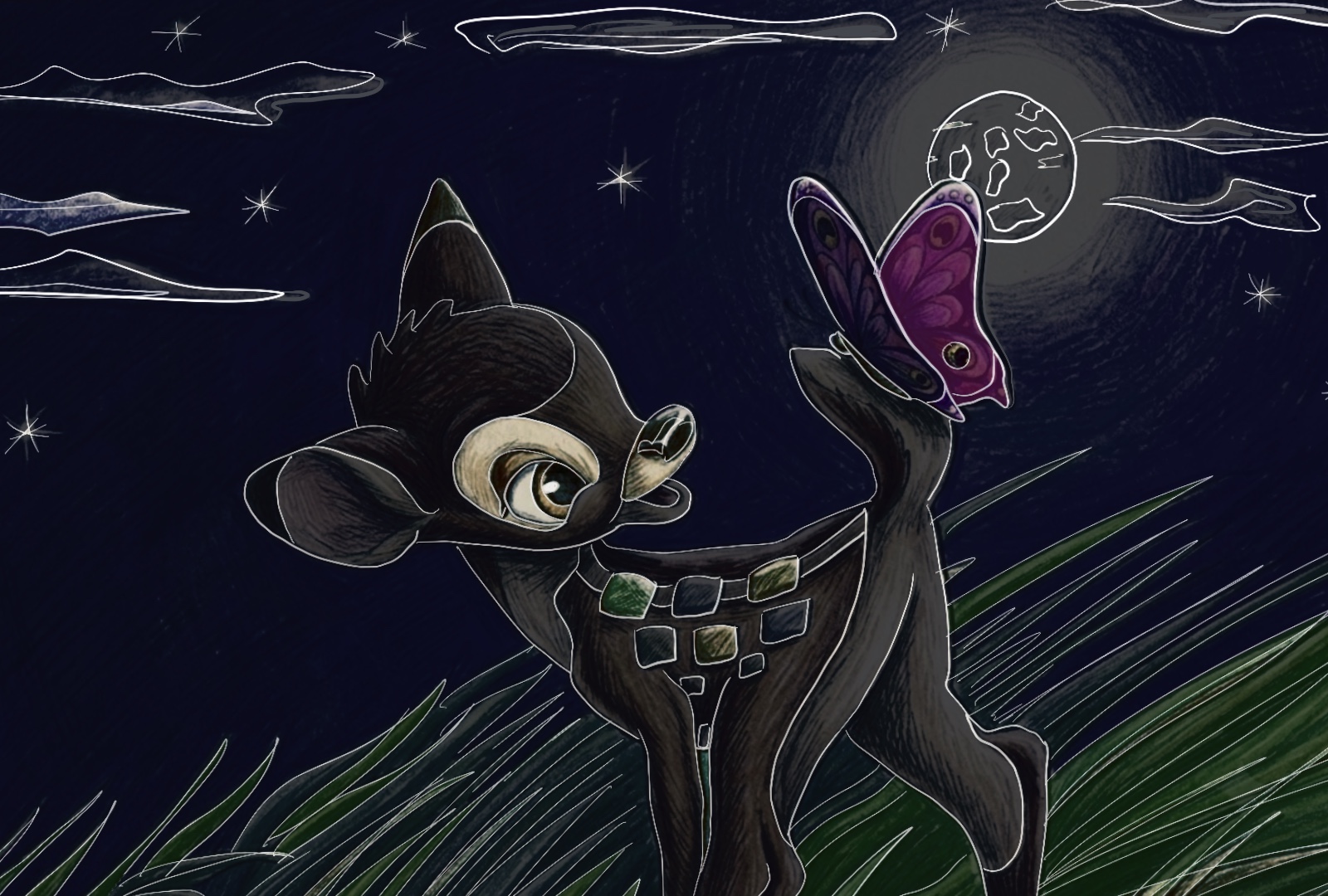
By Camilla Sarra. Cover by Isabella Medrado
What Bambi’s Forest Really Teaches Us in 2026
A young creature is born in spring, in a hidden hollow deep inside the forest, sheltered from view and surrounded by the reassuring presence of its mother. At first, the newborn knows only the warmth of that refuge, but little by little begins to observe the world, distinguish its sounds, encounter other animals and understand that the woods can be welcoming and merciless, filled with wonder and crossed by danger. It is precisely this gradual discovery of reality that makes Felix Salten’s Bambi, a Life in the Woods far more than a story for children. Behind the journey of the young roe deer lies a universal coming-of-age tale about fear, loss, solitude, emotional bonds and the need to become an adult without losing the ability to marvel.
A Contemporary Stage Reimagines a Classic Fable
«Reading the novel moved me deeply from the very beginning. I felt the joy of recognising myself in a character whose life and experiences seemed so close to my own», says Ilaria Maria d’Urbano, who transformed this personal connection into the theatre experience Bambi, the Life of a Doe, freely inspired by Salten’s book. Conceived, written, directed and performed by d’Urbano, the production has been staged in June 2026 at The Square, in Via Domenico Cirillo 1/r, Florence. The famous woodland character was given a female voice and became a doe moving through the seasons of existence, facing obstacles, joy, loss and achievement until she becomes a woman and a mother in the broadest sense of the word.
The Lost Art of Paying Attention
The journey begins in a small, protected space, where a mother’s presence keeps danger at a distance and makes everything seem manageable and safe. It is the first experience shared by every living being: feeling sheltered within a familiar place while slowly beginning to observe what lies beyond it. Growing up, however, sooner or later means leaving that refuge, crossing a threshold and accepting that reality can never be entirely predicted. The forest welcomes the fawn with light, wind, scents, encounters with other animals and the freedom of running across an open meadow, but it soon reveals fear, violence and the possibility of loss.
«The story crosses both wonderful and ruthless thresholds: the discovery of the world, violence against the vulnerable, the beauty of running across an open meadow, loneliness, abandonment and grief», the author explains. Growth does not follow an orderly sequence of achievements; it also passes through falls, uncertainty and experiences that force us to change direction.
What Bambi Teaches Us About Learning Through Observation
One of Bambi’s earliest achievements is learning to recognise what is happening nearby, distinguishing animals by their sounds and reading the information hidden in the air, just as the mother does. In the forest, this attention is essential for survival. In human life, it becomes a way of truly understanding others.
Bambi learns through observation and slowly tries to become as capable as its parent. Knowledge passes from one generation to the next through presence, example and shared experience, without the need for abstract explanations. The fawn watches, listens, imitates and turns what it receives into an ability of its own. This lesson feels especially relevant in a society filled with a constant flow of messages, images and notifications, where we hear countless voices and yet risk listening to none of them. Salten’s story suggests the opposite movement: slowing down, making space for silence and paying attention once again to nature, to other people and to what is happening within us.
Wonder as a Way of Understanding the World
For the young roe deer, every encounter is a discovery, every sound opens a new question and every transformation in the landscape inspires wonder. Wonder becomes the first way of knowing reality and is not merely an emotion linked to childhood: being amazed means recognising that what lies before us should never be taken for granted.
The woodland setting also reveals that nothing remains still: the seasons change, animals grow and every form of life passes through birth, transformation and disappearance. Nature is a living presence that shows how change is not an exception, but the fundamental rule of existence. Becoming an adult should therefore not coincide with losing our sense of wonder. Continuing to be amazed can help us remain sensitive, curious and open to what we do not yet know, even after encountering the most painful side of life.
Seeing Nature Through Bambi’s Eyes: A Shift in Perspective
Salten’s fable forces us to shift our perspective. The natural world is not observed through human eyes, but through those of a vulnerable being for whom every sound may announce either an encounter or a threat. «In an absolute love of life and all living beings, the boundary between human and animal seems to dissolve», observes Ilaria Maria d’Urbano. Respect for the environment grows out of this sense of closeness. Protecting nature means preserving a landscape and recognising the value of the lives within it, accepting that animals too can feel fear, form bonds and suffer loss.
Why Vulnerability Changes the Way We See Violence
Danger enters the story suddenly, breaking the calm and showing how fragile existence can be for those who lack the means to protect themselves. Telling violence through the experience of an animal allows us to observe it from the perspective of the victim, unable to resist or fully understand its reasons. The reflection concerns our relationship with animals, but inevitably extends to human beings as well, speaking of those who are excluded, those who struggle to make their voices heard and those who depend on the protection of others. Vulnerability must never become a fault, and greater strength always brings responsibility. The degree of civilisation of a community can also be measured by the way it treats its most fragile members and by its ability to protect those who cannot protect themselves.
Bambi’s Mother as the First Form of Care
At the beginning of the tale, the mother represents safety, knowledge and the first connection with reality. She teaches the newborn to distinguish a safe place from a dangerous one, to recognise the signals of the forest and to move carefully through a world that is still unknown. «I wanted to write a monologue performed by a doe who tells the story of her own life, her obstacles, her joys, her achievements and all the effort required to reach them. A female Bambi who becomes a woman and a mother in the broadest possible sense», d’Urbano explains. Motherhood therefore becomes the ability to create, protect and accompany the growth of another being. Those who have received care learn to offer it, while those who have been guided can eventually become a point of reference for someone else. Independence does not arise from an absence of relationships, because it is precisely the experience of a secure bond that gives us the courage to move away and explore.
When Loss Changes the Landscape We Thought We Knew
The young animal soon discovers that loving someone also means exposing oneself to the possibility of losing them. Grief interrupts the protected time of childhood and introduces an irreversible awareness: no presence can be held onto forever, and every bond carries within it the risk of absence.
The fable shows how pain can be crossed and gradually integrated into one’s personal story. In a society that often urges people to recover quickly and move on, this narrative gives grief its own space and time, reminding us that fragility should neither be hidden nor judged. Suffering is part of existence and may, in time, become a new form of awareness.
Solitude as a Passage Toward Maturity
As the protagonist grows, solitude becomes another unavoidable stage of the journey, because after being protected comes the moment when no one else can decide on our behalf. It is when the woodland creature is alone that personal abilities are tested, danger is faced and the possibility of continuing independently becomes real. The story therefore distinguishes isolation, which breaks relationships and causes suffering, from the ability to be alone, which can encourage independence and self-awareness.
No one can live entirely alone, but not even the strongest relationship can cross every threshold on our behalf. Some passages require a personal decision and force us to find within ourselves a strength that remained hidden while we were still protected. Maturity grows precisely from the balance between these two dimensions: the willingness to build deep relationships and the ability not to depend entirely on the presence of others.
Meeting a Guide Who Does Not Choose for Us, but Teaches Us How to See
During the journey, a figure appears who is able to pass on knowledge, helping the young doe understand what she has experienced and prepare for maturity. «Bambi meets a guide who will hand down all her knowledge», the author explains. This presence recalls teachers, educators, parents and all those capable of accompanying someone without taking their place. Guidance also means preparing for separation, because knowledge is passed on so that the other may one day continue alone. It becomes both a transfer of responsibility and an inheritance to be used, transformed and eventually handed down again. Having a human or spiritual point of reference means receiving the tools needed to build a personal path. Someone may indicate a direction, but the journey always belongs to the person who must walk it.
Discovering That Courage Begins Only After Fear Has Entered the Story
The central character fears danger because she is alive and knows she can be hurt. Fear is presented as a signal that warns, protects and encourages attention. Adulthood does not arrive when fragility disappears, but when one learns to live with vulnerability without allowing it to become paralysing. Hope also takes on a deeper meaning, because it does not come from innocence, but arises after an encounter with suffering. Continuing to believe in life, while knowing that nothing can be guaranteed, becomes a conscious choice and one of the most authentic forms of courage.
A Somersault That Changes Our Perspective and Helps Us Find Our Balance Again
The Italian word capriola, chosen to describe the protagonist of the monologue, carries a double meaning: it refers to a female roe deer, but also evokes a childhood movement, a sudden reversal and the effort to land back on one’s feet. «The word capriola suggests movement and overcoming obstacles. It evokes childhood, its games and its sense of freedom», explains Ilaria Maria d’Urbano.
It is an image that captures the nature of growth, which rarely follows a straight line. As in a somersault, we sometimes need to lose our orientation for a moment in order to recover it in a different form. Difficulties do not disappear, but they can teach us to see the world from another angle and discover possibilities we would never have encountered by remaining still.
Bambi: A Fable That Still Speaks About What It Means to Be Human
Salten’s heroine does not simply want to survive. She needs to understand what is happening, interpret the signals of the forest and search for meaning within fear, loss and change. «Bambi is thirsty for truth, the truth I feel such care and desire to convey through my monologue», says the author.
Her search echoes some of the deepest questions of existence: why pain is part of life, how change can be accepted, what remains of those we have loved and when we can truly consider ourselves adults. The spiritual dimension of the monologue also grows out of the need to recognise that every individual life belongs to a wider cycle of birth, development, death and renewal.
When the Forest Becomes Theatre, Sound and Scent
In the theatre experience, Ilaria Maria d’Urbano’s voice is accompanied by the sand art of Giulia Rubenni, known as Ghibli, who shapes the sand live, giving visual form to the emotions and different stages of the tale. The original music is composed by sound designer Giovanni Dario Manzini and brings together piano, electronic sounds and objects played live, with Lorenzo Maiani as sound engineer. Scent also becomes part of the narrative through the olfactory identity created by the Florence-based company Ephèmera. The woodland world takes shape through images, sounds and fragrances, creating an immersive experience that engages the audience on several levels.
Why This Woodland Fable Still Speaks to Every Generation
The story continues to move us because it explores existence without separating beauty from harshness. This timeless fable encourages us to listen, to avoid taking the lives of other beings for granted and to look at the world from the perspective of the most vulnerable. It reminds us that fear can coexist with courage and that adulthood does not mean giving up sensitivity, but learning to protect it even after encountering pain.


