By Azzurra Rinaldi. Cover image Dior courtesy
From Disney characters to invented ones, from newspaper prints to maps, print is something fashion has always sought to reinterpret in different forms: through clothes and accessories of all kinds. Here are some examples of paper-inspired fashion from some of the most important luxury brands.
Comics, Logos and Pop Language in Fashion
We can start with comics. One of the most pop approaches is Moschino, which uses graphic typography taken from comic strips, like the word WOW.
In a more sophisticated but still related style, the French designer Jean-Charles de Castelbajac does not only use lettering, but also the images from comic strips, featuring characters such as Pluto, completely covered in sequins.
The pop language of comics creates a strong contrast with luxury, which has traditionally been associated with elegance and, almost automatically, with the absence of kitsch. These garments, instead, embrace excess: bold colors, exaggerated graphics, and a deliberate visual noise. In this sense, Moschino’s approach becomes almost a statement: “If you can’t be elegant, at least be extravagant.” And, as a devoted lover of fluo, I can only agree.
Why Newspapers Became a Style Obsession
Moschino is also known for its newspaper dress, a garment entirely made of newspaper-print textile, and what about the newspaper bag from SS26?
However, he is not the only one to use newspaper in fashion. We can also find Jean-Charles de Castelbajac, with a pair of trousers worn by the pop star Rihanna, and John Galliano for Dior, who created dresses and trousers in FW2001. Even earlier, in the 1960s, Elsa Schiaparelli and later Chanel explored similar ideas.
Nowadays, the newspaper style has become very common and can also be found in fast fashion shops. If the newspaper is something meant to be read and then discarded, in fashion it is transformed into something made to last. What is normally ephemeral—linked to a specific day, a specific moment—becomes permanent, almost frozen in time.
Not because these garments contain real news, but because the printed “paper” itself generates curiosity in the viewer, inviting them to read line after line what designers have imagined as their own fashion newspaper.
Are the cuts always the same, or do they change from one piece to another?
From Cartography to Sheet Music in Clothing
Geographical map prints have become the signature of Alviero Martini Prima Classe. The light brown tones recall ancient maps used by early navigators, although new color palettes have now emerged, including blue, pink, violet, and white. Here, the “paper” is adapted to enhance the design of the accessory.
Valentino has seamlessly integrated sheet music into his dresses: the paper itself may disappear, but the stave—with musical notes and lyrics—remains, as seen in the dress worn by Katy Perry at the 2014 Grammys.
And speaking of music, what about the custom-made Vivienne Westwood dress for Taylor Swift, where the lyrics of her song can be read directly on the fabric? Printed paper goes beyond words and can tell stories through different languages, such as maps or music.
Unlike paper used for maps or sheet music—where meaning must be understood rationally—in fashion, language does not necessarily need to be decoded through reason, but rather experienced aesthetically.
When Literature Becomes a Fashion Symbol
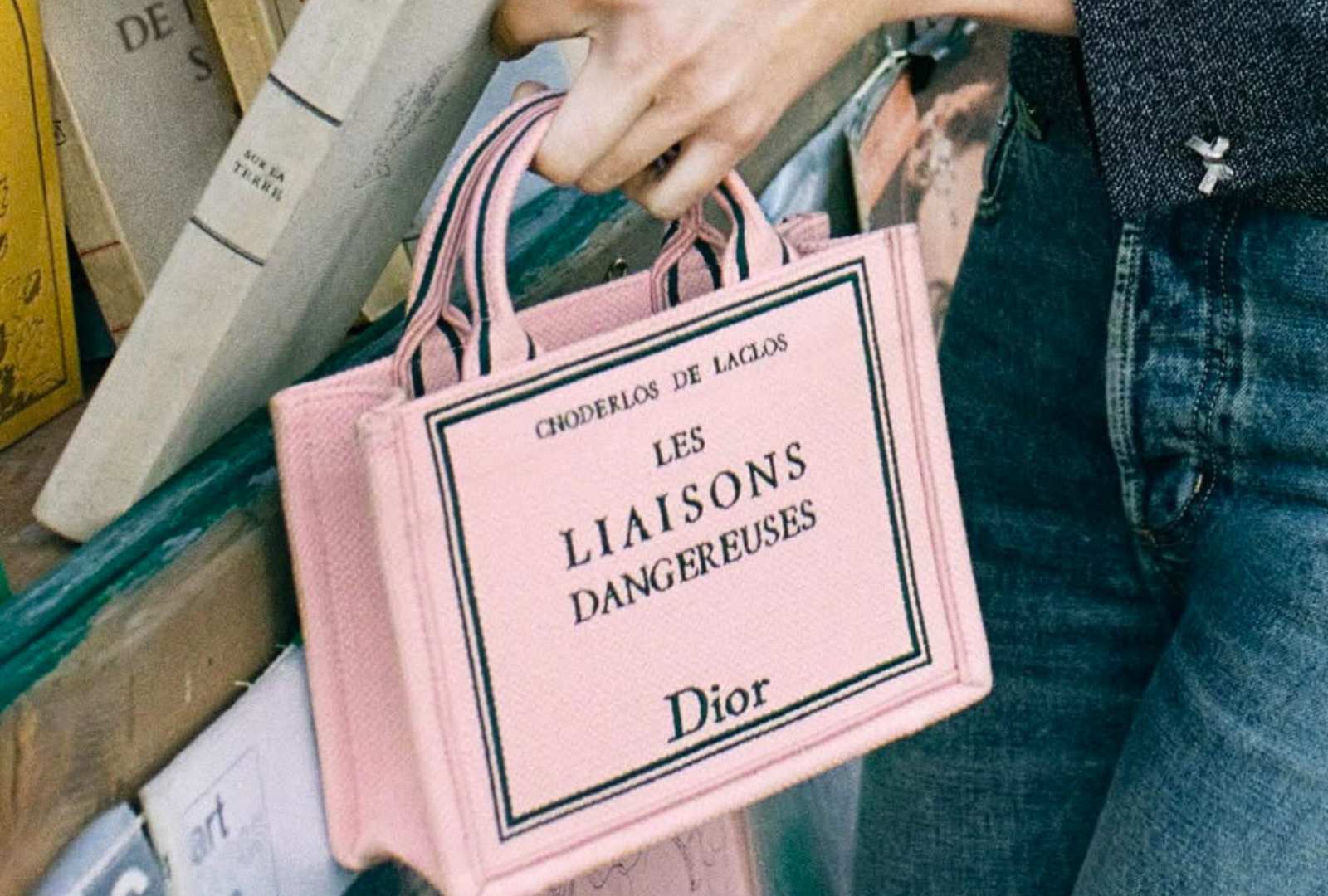
Books are also used in fashion, but not to show their interior pages—instead, the focus is on the cover. Dior has created a collection of bags featuring titles from classical literature, from Dracula by Bram Stoker to Baudelaire’s Les Fleurs du mal, and even the children’s book The Very Hungry Caterpillar by Eric Carle.
In my opinion, the most remarkable “book-inspired” dresses are those by French designer Sylvie Facon. She may be outside the major fashion houses, but her handcrafted work is truly spectacular. She recreates the covers of ancient books and transforms their delicate pages into voile: a dream for librarians like me and book lovers alike!
Why Some Forms of Paper Resist Fashion
But why is the book not used in fashion in the same way as the newspaper?
Is there a sense of reverence surrounding the book? Does it appear less ironic, less open to manipulation?
Why do Dior’s bags feature titles from classical literature, rather than invented ones, as is often the case with magazines?
When it comes to the book, fashion seems to encounter a kind of “bug”—something that prevents its full transformation into a garment. The few existing examples remain outside the luxury system, often handcrafted, rarely using text, with covers that tend to remain untitled. What is the weight of culture if fashion hesitates to appropriate it or turn it into play?
Perhaps the book, unlike the newspaper, resists fashion—not simply as a surface, but as a symbol—and for this reason, it can never be fully worn.


