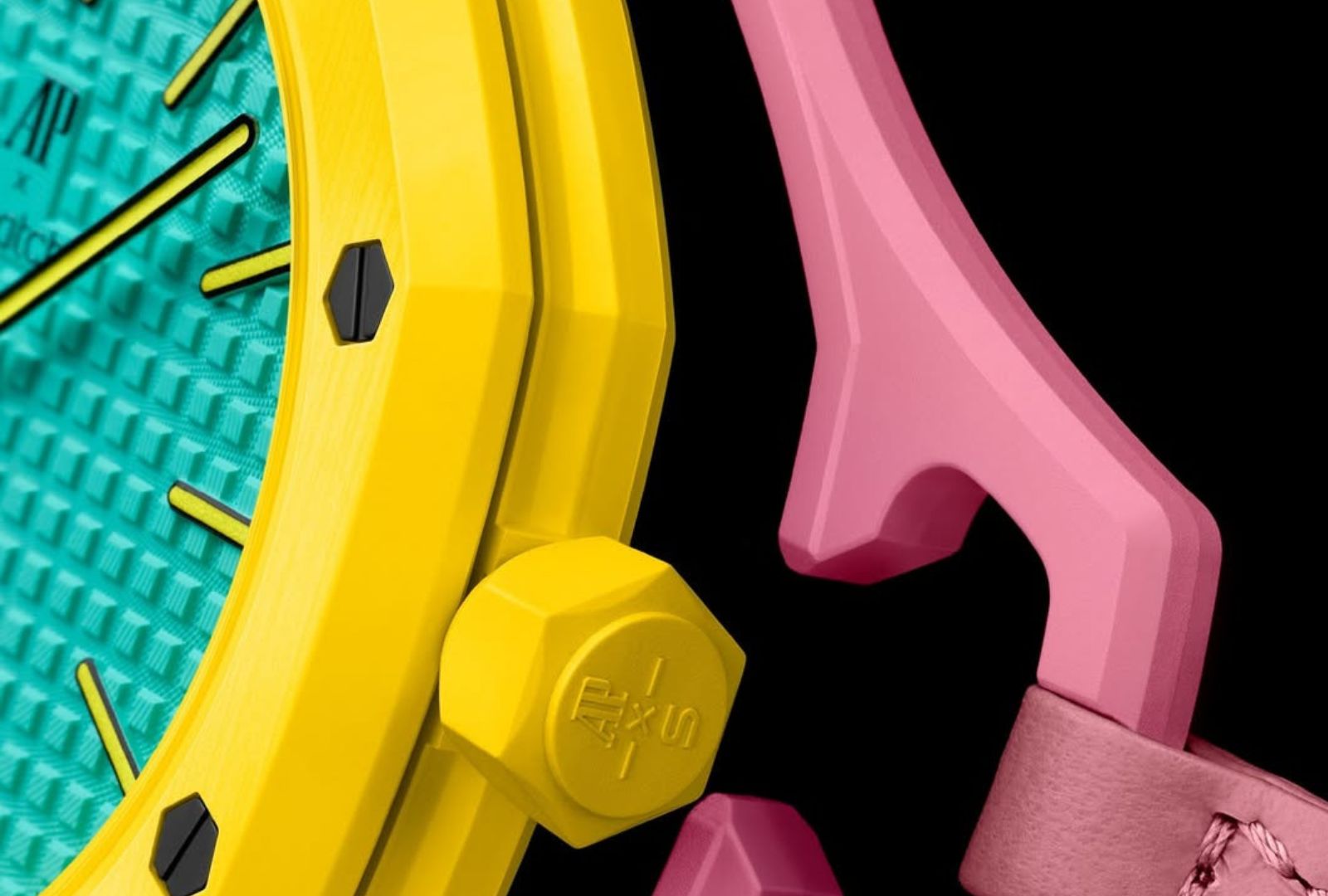
By Kashvi Bhandari. Cover image Audemars Piguet x Swatch courtesy
Just when watch connoisseurs thought they had finally decoded the collaboration playbook, especially after the 2022 MoonSwatch phenomenon, the tectonic plates of the industry shifted overnight once again. Enter the Audemars Piguet x Swatch “Royal Pop” collection. Yes, that sentence is real. And honestly, if someone had told me three weeks ago that this would happen, I would have laughed them out of the room.
For those unfamiliar with the watch industry, the scale of this collaboration only makes sense once you understand what these two brands represent, because they operate through completely opposite philosophies and business models.
How the Royal Oak Turned Audemars Piguet Into a Luxury Watch Obsession
Founded in 1875 in the Swiss village of Le Brassus, Audemars Piguet is quite literally the AP-ex of luxury- and no, the pun is absolutely intentional. What makes the brand so exceptional is the fact that it remains one of the very few major watchmakers still family-owned and independent since its founding. It is famously considered part of the “Big Four” of privately owned watch brands alongside Rolex, Patek Philippe and Richard Mille.
AP only produces around 50,000 to 57,000 watches annually in order to maintain exclusivity and extremely high demand. The majority of that demand revolves around the Royal Oak, first introduced in 1972 and designed by Gérald Genta. The model quickly became, and still remains, the defining face of the brand. Ironically, the Royal Oak was also Audemars Piguet’s mechanical response to the Quartz Crisis, helping save the company from financial collapse through what it understood best: radical design innovation rather than an immediate shift toward electronic technology.
To this day, AP remains fiercely loyal to its traditional mechanical philosophy, while continuously pushing that heritage forward through cutting-edge materials, experimental craftsmanship and revolutionary design -balancing both sides of the “modern tradition” coin.
The Swatch Revolution That Made Plastic Watches a Global Fashion Statement
Flip the dial and you get Swatch, essentially the complete opposite of Audemars Piguet’s universe. As the cornerstone of The Swatch Group, the largest watchmaking conglomerate in the world, Swatch completely rewrote the rules of the industry after launching in 1983. While Audemars Piguet built its identity through exclusivity and top-down luxury, Swatch championed a radically different strategy: turning the affordable quartz watch into an accessible, mass-market fashion phenomenon.
The brand is widely credited with modernising the entire “Swiss-made” industry by introducing colourful plastic watches with rubber straps and lightweight designs that felt playful, youthful and culturally disruptive at the time.
Today, Swatch produces several million watches every year and targets a vastly broader demographic than AP ever intended to reach, which is exactly why this collaboration feels so culturally explosive.
Audemars Piguet x Swatch “Royal Pop” Collection: What It Looks Like and Key Design Details
In the least shocking news ever, watch heads lined up outside boutiques for more than 6 days without knowing what was going to be unveiled. The one-off collection consists of eight unique pocket watches in two case styles: Lépine (open-face) and Savonnette (hunter case with hinged cover). The design also merges the creativity of Swatch’s vibrant POP line from the 80s, resulting in eight different colourways, as well as distinctive elements from AP’s Royal Oak such as the very distinguishing octagon (eight-sided) shape and the bezel with eight screws (by this time you’ve probably realised that the eight theme keeps “popping” up). While many were disappointed that it isn’t a wristwatch, the collaboration presents it as “a completely new way to wear time”. So get ready to see people wearing it around their neck, in their pocket, as an accessory or even as a charm on their bag.
Despite all this information, you might still be curious about the real intention behind this collaboration. And while there may be many motives, this partnership has sparked widespread discussion among watch aficionados. Among these discussions, new theories have also emerged, which you might be seeing all over social media.
Why the Royal Oak Debate Is Now About Control, Not Just Design
For years, Audemars Piguet has been trying to protect its iconic Royal Oak design under intellectual property law. However, AP lost both cases in two major markets: Japan (in 2024) and the United States (in 2025). The courts ruled that the features AP wanted to trademark were “nondistinctive”, “highly common in the watch industry”, and that “without the words Audemars Piguet, no ordinary consumer would identify the iconic shape and would rather think of it as a wristwatch”.
Following these rulings, it became legally much easier for competitors to produce watches inspired by the Royal Oak’s geometric design. So now the one watch that generates over 90% of Audemars Piguet’s revenue has virtually no legal protection. What happens next?
This is where Swatch enters the picture, or so the theory suggests. One of the reasons enthusiasts find this narrative compelling is that, shortly after the court battles, Swatch reportedly filed an international trademark with the World Intellectual Property Organization (WIPO) in June 2024 for the name “Royal Pop”. This move, according to the theory, would address two problems at once: the legal protection gap and the issue of counterfeits. For the first time, Audemars Piguet could potentially demonstrate that a large audience directly associates the octagonal design with the brand, rather than with “watches in general”.
And then comes the final question: if the brand itself offers a legitimate, accessible alternative, why would consumers choose a fake? So, if the theory is in fact true, what better way to shut down lawsuits and counterfeits than with a fellow Swiss watchmaker (and circling back to what I said before) with what AP knows best: innovative design.


