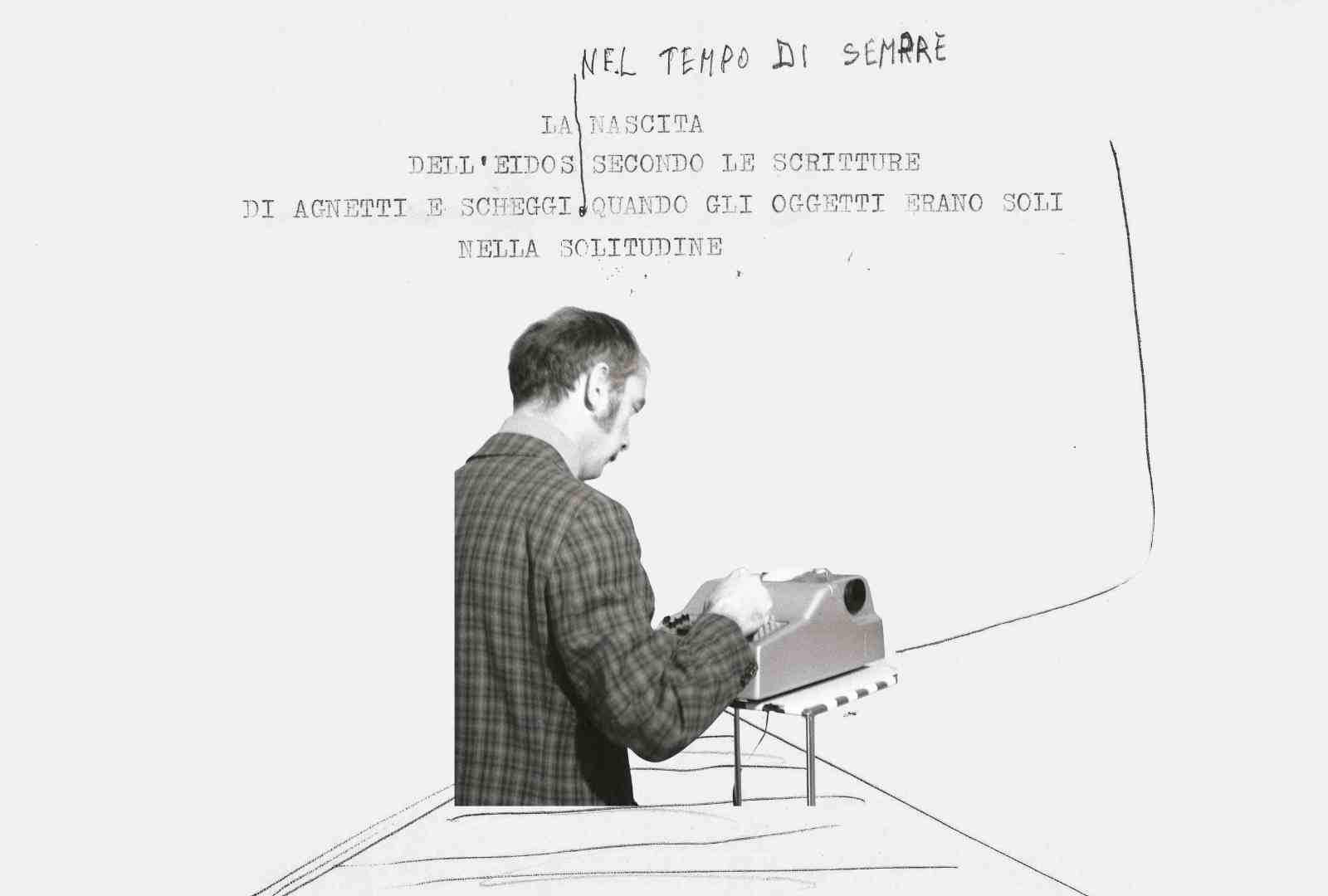
By Ginevra Barbetti. Cover image Vincenzo Agnetti e Paolo Scheggi, sketches for Il Tempio. La nascita dell’Eidos.
Any attempt to tell the story of Vincenzo Agnetti (1926–1981) inevitably faces a paradox. Agnetti was an Italian painter, writer, poet, and a leading figure of conceptual art, yet the more one tries to define him, the more his work eludes fixed form. His trajectory moves through discontinuities and absences, resisting the logic of conventional biography.
On the centenary of the artist’s birth, Forma Edizioni presents Vincenzo Agnetti. Lavorare insieme è atto politico (Working Together Is a Political Act)at Rifugio Digitale in Florence (on view until March 4, 2026). Organized in partnership with Rifugio Digitale and the Teatro Nazionale di Firenze, and in collaboration with the Vincenzo Agnetti Archive, the initiative combines a book edited by Bruno Corà, an exhibition, a virtual environment and a public talk, reflecting the work and thought of one of the most radical artists of the late 20th century. These elements form a shared platform grounded in cooperation as a method of transmission. As Corà emphasizes, the project reflects the need to confront the complexity of Agnetti’s practice while activating new perspectives for contemporary audiences.
At the heart of this project is the very tension that defines Agnetti’s work. This is best captured in his self-portrait Quando mi vidi non c’ero (When I Saw Myself, I Was Not There). As Germana Agnetti, president of the Vincenzo Agnetti Archive, explains: “It is his self-portrait. It suggests the paradoxical relationship we maintain with ourselves: we see ourselves, we capture the fleeting instant like a glance in the mirror, yet we are already something else.” In this sense, the work becomes the archetype of consciousness in motion, a point where perception and transformation coincide.
The same title became the foundation of the biography Germana later wrote. As she recalls, “It seemed to me that this title allowed the reader to enter the spirit of the artist.” Rather than following chronology, she reconstructed his trajectory through what he called his “rammentatori”: writings, works, and statements that preserve the intellectual trace of experience. As Agnetti wrote, “Everything I have thought, said, and done, I have forgotten by heart. This is the first authentic document.” Forgetting, in this sense, becomes a structural condition through which experience enters form.
Want to know more about Rifugio Digitale? Read more here.
Who Was Vincenzo Agnetti? The Hidden World Behind His Conceptual Art
Born in Milan on September 14, 1926, Agnetti studied at the Brera Academy and later attended the Piccolo Teatro school. There he met Bruna Soletti, who would remain his lifelong partner and collaborator. His early work unfolded between informal painting and poetry, yet most of this production disappeared, leaving fragments and memory. These early experiences formed a hidden foundation, an internal phase that prepared the emergence of his mature work. The concept of dimenticato a memoria—forgotten by heart—defines this formative period. As Germana Agnetti explains, “Culture exists when it has been assimilated, when it becomes part of us and we can forget it by heart.” Culture operates as assimilation. Experience becomes internal structure rather than external record. This logic shaped his intellectual development during the late 1950s and early 1960s, when he moved in proximity to figures such as Piero Manzoni and Enrico Castellani. His departure for Argentina in 1962 intensified this process of withdrawal and reflection. During these years, he filled notebooks later titled Assenza (Absence). These pages contain ideas and conceptual structures that formed the foundation of his later production.
Vincenzo Agnetti and the Art of Language as Structure
Agnetti’s return to Italy in 1967 marked a decisive shift. Internal elaboration entered material form. From this point forward, writing, image, and object became components of a unified practice. He described this condition as the emergence of the “man-artist,” a figure in whom existence and production converge. Works such as Principia, Obsoleto, and La macchina drogata (The Drugged Machine) define this transition. Principia exposes the instability of linguistic meaning through permutation. Obsoleto establishes a circular structure in which language becomes subject and medium. La macchina drogata transforms calculation into linguistic output, exposing the instability of systems. The machine produces sequences that oscillate between sense and collapse. The viewer enters the work as an active participant, generating material that becomes part of the artwork itself. These works establish the core of Agnetti’s practice: language as structure, translation as method, art as cognitive operation.
When Performance, Photos, and Words Turn Into Conceptual Art
From the late 1960s onward, Agnetti’s research expanded across media while maintaining conceptual continuity. His work explored equivalences between word and image, presence and absence, event and trace. Archiving itself became part of his artistic method. As he wrote, “The mental tear is the tear from the rule. Every described or represented thing is a tear from reality.” Archiving produces a rupture that transforms lived experience into transmissible form. As Germana Agnetti explains, “We have various tools to collect the performative dimension of works—video, recordings, photographs, transcriptions—but there is also a multiple form of archiving that only the artist can produce.” A paradigmatic example is La lettera perduta (The Lost Letter). In 1979, Agnetti had the performance photographed in New York, transforming it into a work. That same year, he presented a lecture-performance version at the Venice Biennale. He later translated four photographic moments into four iron sculptures, forming the exhibition Quattro titoli Surplace. Each transformation extended the life of the original action.
His later works, including the Photo-Graffi, introduce a more introspective register. Language and image converge into a unified field where perception becomes structure.
The Living Archive: Preserving Art Without Freezing It
The Vincenzo Agnetti Archive continues this process of transmission. As Germana Agnetti, President of the Archive, explains, “The work of the Archive requires keeping hands and feet firmly anchored in the past, while directing one’s gaze toward the future.” This responsibility involves preserving documents while activating new interpretations. The Archive functions as a site of continuity, connecting historical material with present inquiry. Agnetti died suddenly in Milan on September 1, 1981. His work remains open, defined by transformation and displacement. His “rammentatori” persist as active structures, generating meaning across time. His self-portrait continues to define his position with clarity: a moment of recognition in which presence shifts into another state.


