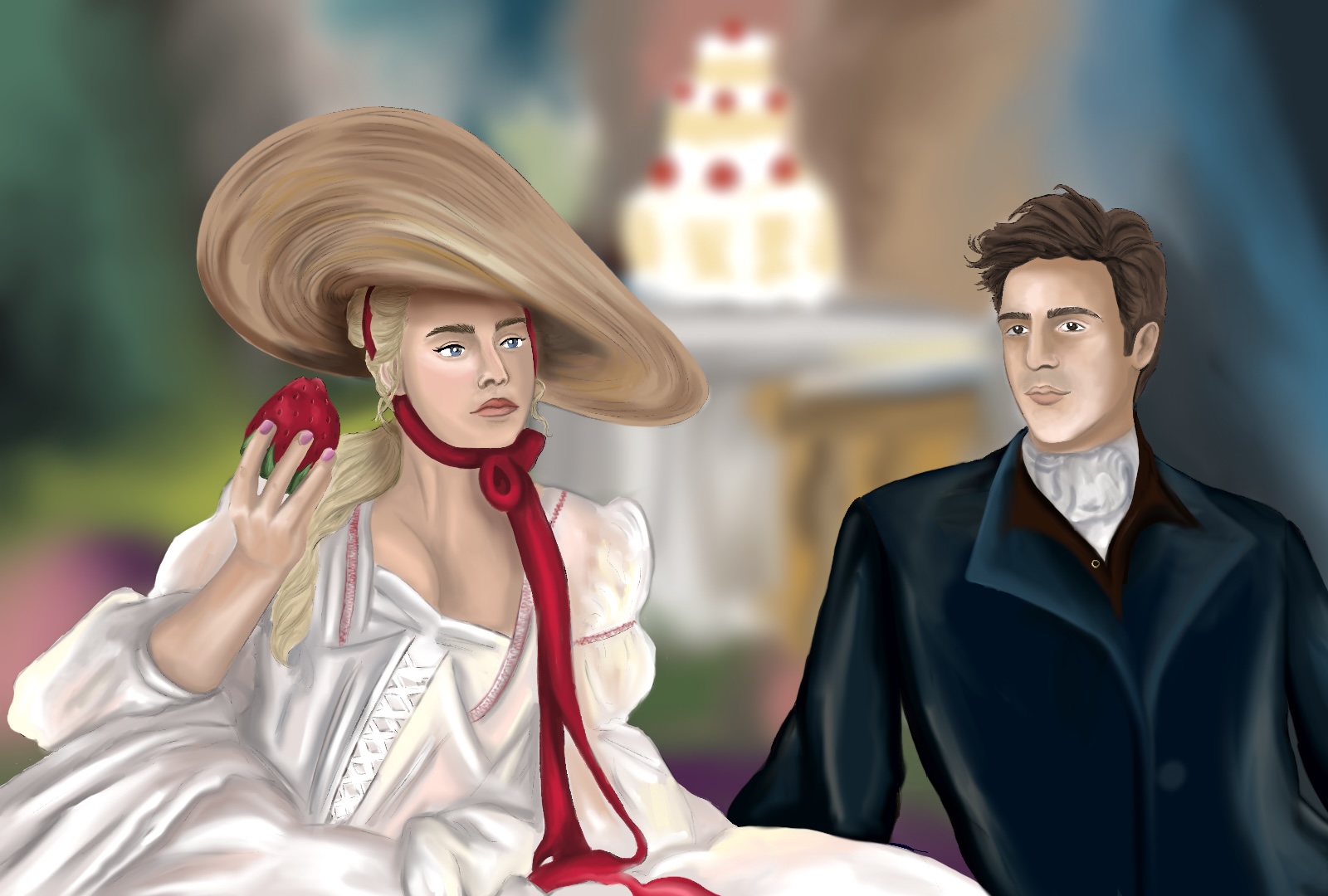
By Rebecca Ceccatelli. Cover image by Taline Raed Eid Nesheiwat.
From Casting to Soundtrack: Why Everyone’s Talking About Wuthering Heights
That a storm was coming, we already knew when news of the film’s production first broke. Although it was released in theaters on February 12, backlash against Emerald Fennell’s much-anticipated adaptation of Wuthering Heights had already begun brewing during its premiere screenings, days before it reached the wider public. After the provocative success of Saltburn and the Oscar-winning Promising Young Woman, audiences expected another bold, divisive, visually arresting work from the director. And bold it certainly is.
Yet as viewers left theaters, reactions proved sharply divided. Some were genuinely surprised by how much they disliked it, describing it as “a fourteen-year-old’s first read of the novel for English class.” Others went as far as calling it a masterpiece of our time — while, somewhere in the background, someone might have added with subtle irony: “It looks incredible — almost too perfect, like it was made for fan edits.”
What remains undeniable is the film’s visual power. With gorgeous cinematography and meticulously composed frames, Fennell delivers a punk-infused, hyper-sexual reinterpretation of Wuthering Heights by Emily Brontë. Yet for many, beauty has not been enough. Certain creative choices have proven difficult to forgive — or even ignore. The debate has fractured audiences into distinct camps: devoted readers who reject the director’s vision outright; newcomers who appreciate the film despite recognizing its evident flaws; and those familiar with the novel who can separate faithful adaptation from personal cinematic interpretation.
Here are the most recurrent critiques the film has received so far. Are you ready to (dis)agree?
Wuthering Heights Lost in Translation: Heathcliff’s Dark Edge Is Missing
The most frequent criticism — and the one topping the podium — concerns the film’s departure from the novel’s central themes. In Wuthering Heights, the barrier between Catherine and Heathcliff is not merely romantic misunderstanding or unfortunate timing. It is fundamentally rooted in social and racial otherness.
Heathcliff’s outsider status, emphasized throughout the novel — where he is described as “a dark-skinned gypsy in aspect” — is not a marginal detail but central to the story’s violence and exclusion. By portraying Heathcliff as white, the adaptation removes a crucial dimension of his alienation, flattening the class and racial tensions that drive the narrative.
As a result, the obstacles keeping the protagonists apart feel less like the inevitable consequences of rigid social hierarchy and more like the contrived setup of a romantic drama. The insistence on a “show, don’t tell” approach, combined with sparse dialogue, further weakens the ideological and psychological complexity that defines the novel.
Casting Debate: Are Catherine and Heathcliff Miscast in Wuthering Heights?
Casting choices have also sparked debate. While the selected actors undeniably generate on-screen chemistry, carefully displayed during premieres and press appearances, some argue that the decision seems driven more by the appeal of “fetishized” stars of the moment, capable of attracting a wide, visually oriented audience, than by fidelity to the source material.
Catherine Earnshaw’s characterization diverges sharply from the tormented, morally ambiguous heroine of the novel. Rather than embodying a woman capable of devastating emotional cruelty, she is often portrayed as luminous and radiant, even while destroying herself and others — softening the harsh edges that make her unforgettable.
The same applies to Heathcliff. In Brontë’s novel, he is brooding, obsessive, often cruel, and driven by destructive intensity. Here, he appears more conventionally attractive and emotionally accessible, diminishing the darkness that makes his character so unsettling — and so compelling.
Wuthering Heights: Why It Feels Perfect… But Plastic
In Wuthering Heights, perfection isn’t just a visual aim, it becomes a kind of trap. Emerald Fennell’s obsessively crafted frames, bold color choices, and music-video–style montages make the film feel more like a couture campaign than a raw, emotional story.
The soundtrack — a companion album by Charli XCX released alongside the film, featuring collaborations such as the industrial-tinged “House” with John Cale — leans into gothic romanticism and modern pop. While striking on its own, the music at times feels imposed, as if trying to force emotion rather than allowing it to emerge organically.
Visually, every frame is polished to perfection: Catherine’s deep-red costumes and flowing veils are unforgettable, Heathcliff’s layered dark wardrobe seems to breathe with his brooding intensity, and the moors themselves unfold like a meticulously curated backdrop. Yet all this immaculate beauty can act like a shiny glaze — dazzling at first glance, but emotionally distancing underneath. Even Charli XCX’s bold, atmospheric tracks sometimes amplify that feeling: powerful in isolation, they can feel like they live in a parallel universe, not fully connecting with the story’s heartbreak and obsession.
As a result, Wuthering Heights often resembles a beautifully sealed perfume bottle: enticing, stylish, and polished to a fault, yet somehow lacking the gritty, breathless intensity that defines the Janey moorland tragedy at its heart.
In the end: they made it hot, but did they make it right? The question arises and we can’t help but notice it. Yet Fennell keeps proving she knows how to make a statement: one way or another, she always finds a way to get people talking. And this time, she did it through a sort of fever dream.


