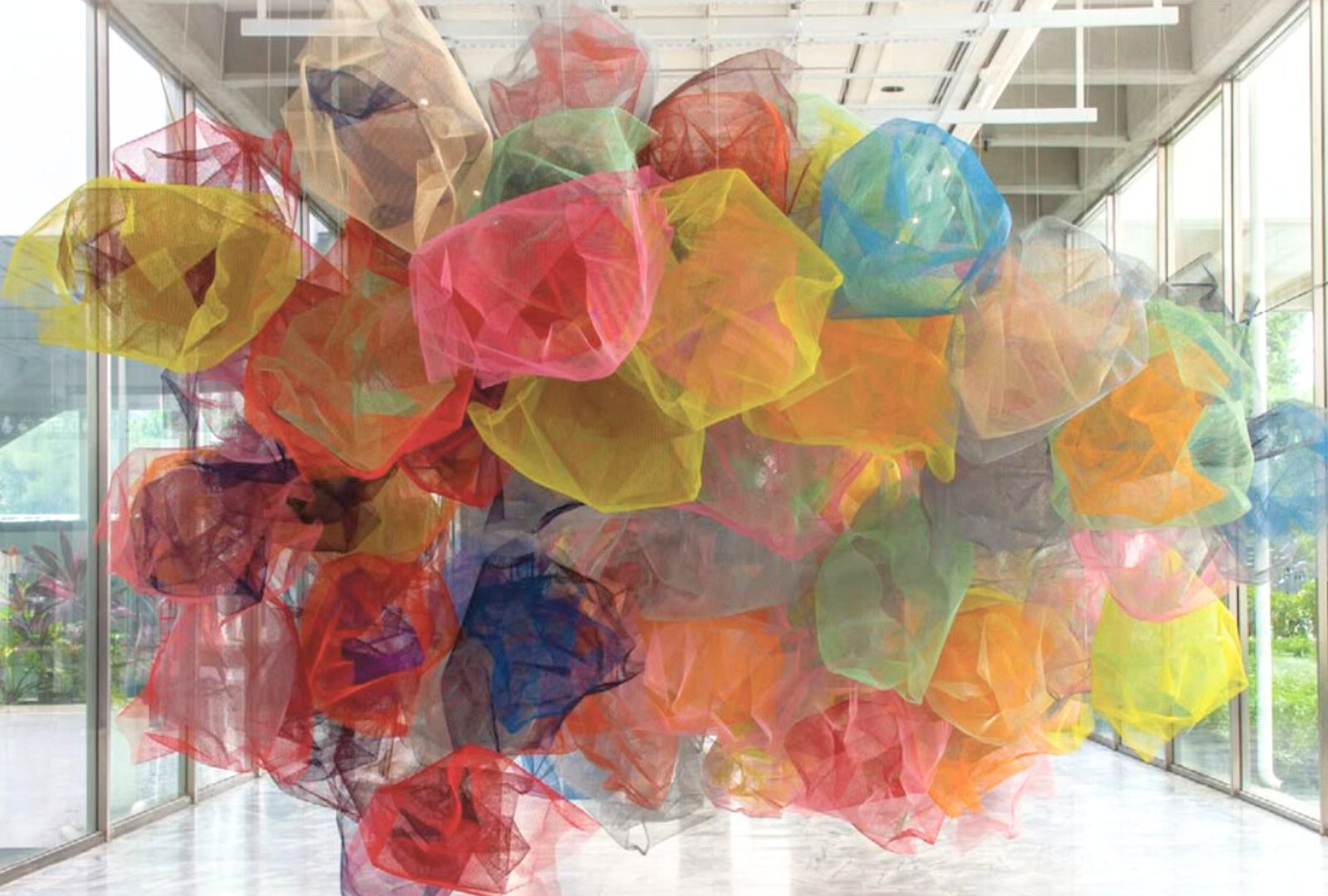
By Francesca Trovato. Cover image No. 1511 Mesh, Rana Begum courtesy
This is not an exhibition to rush through. The 14th Taipei Biennial asks for time, attention, and a willingness to sit with uncertainty. Whispers on the Horizon, on view at the Taipei Fine Arts Museum (TFAM) through March 29, 2026, is not concerned with offering answers, but with revealing tensions—those that shape the present and keep us suspended in a constant state of anticipation.
Curated by Sam Bardaouil and Till Fellrath, the Biennial brings together more than 54 artists from 35 cities, including 33 new commissions and site-specific works. Around half of the participating artists were born after 1984, underscoring a generational shift in how global realities are perceived and articulated. Using Taipei as a starting point, the exhibition addresses something profoundly universal: in a world shaped by disinformation, fractured identities, and increasingly fragile social bonds, desire is no longer a private matter. It becomes collective—a shared demand for clarity, connection, and belonging.
Within this complex landscape, desire is framed as an ongoing state rather than an end point, articulated through bodies, materials, and memory. Four artists, in particular, give this condition a precise and compelling form.
Gaëlle Choisne’s Fortune Cookies: Hidden Stories, Big Impact
At first glance, Fortune Cookies appears fragile. Thousands of hand-molded clay fortune cookies fill the space, each slightly different from the next. Inside, however, something is concealed: a seed, a message, a story waiting to be uncovered. Gaëlle Choisne works with invisibility—with lives that move through the world without truly being seen, reduced to objects, stereotypes, or functions.
Born in France in 1985 and based in Paris, Choisne has built a practice attentive to the political and cultural disorder of the contemporary world. Her work consistently addresses the overexploitation of natural resources and the unresolved legacies of colonial history, where Creole esoteric traditions, mythologies, and popular cultures intersect. This attention to what is marginal, overlooked, or systematically erased informs Fortune Cookies, a work that engages directly with questions of migration, invisible labor, and misattributed cultural symbols.
Often misunderstood as a Chinese tradition despite its American origins, the fortune cookie becomes here a vessel for displaced narratives and collective memory. Each object holds something hidden, suggesting a deferred encounter rather than immediate meaning. When the installation is activated through performance, the work shifts. Two performers interact with the audience, transforming the space into a site of exchange and negotiation.
Desire, in Choisne’s work, does not appear as promise or reward. It emerges instead as expectation—as the need to be seen, acknowledged, and remembered, even momentarily.
Ivana Bašić: Art After Trauma and Reconstruction
Entering Ivana Bašić’s work feels like stepping into a post-human landscape. Her sculptures appear cold, mechanical, and distant, yet they speak directly to something deeply emotional: trauma and the possibility of reconstruction. Shaped by the violent dissolution of the former Yugoslavia, Bašić transforms personal and collective memory into a rigorous material language.
In her practice, materials behave like bodies. Blown glass suggests breath and fragility; wax evokes exposed flesh; stone carries the weight of accumulated pressure; bronze functions as a form of protection; and stainless steel reflects the opposing forces of life and death acting upon the body.
In Bašić’s work, desire operates at a structural level, shaped by fracture and by what remains unresolved.
Rana Begum: Perception, Light, and the Architecture of Desire
Rana Begum’s work unfolds through movement and shifting perception. A suspended, cloud-like structure shifts in response to light and to the viewer’s position, producing an environment that is never visually fixed. There is no narrative to follow and no message to decode; perception itself becomes the subject.
Born in 1977 in Sylhet, Bangladesh, and based in London, Begum trained at the Chelsea College of Art and Design before completing an MA in Painting at the Slade School of Fine Art. Since the early 2000s, her practice has gained international visibility through exhibitions and biennials across public and private spaces, establishing a language that sits between sculpture, architecture, and light.
Drawing on the formal discipline of Islamic art and architecture, Begum works with repetition, geometry, and modulation. Her installations resist stability, requiring the viewer to adjust position and attention. Desire, here, is not expressed emotionally or symbolically. It is learned through looking—through the gradual awareness that perception is contingent, partial, and always in flux.
Henrique Oliveira: When Desire Takes Shape in Recycled Wood and Installations
Henrique Oliveira’s installations feel alive. They grow, expand, and invade the exhibition space like autonomous organisms. Built from recycled wood and reclaimed materials, their surfaces bear marks, tears, and scars. Nothing is clean, nothing is linear.
Like desire itself, Oliveira’s forms are irregular, layered, and difficult to contain. They speak of entangled identities, contaminated histories, and memories that cannot be separated without loss. Here, desire is not abstract—it is material: resistant, deformed, and unmistakably present.
Born in 1973, Oliveira is a renowned Brazilian painter and sculptor known for his monumental site-specific installations that blur the line between nature and urban architecture. He often works with recycled plywood—especially from construction site fences (tapumes)—to build organic, root-like structures that appear to “invade” exhibition spaces.


