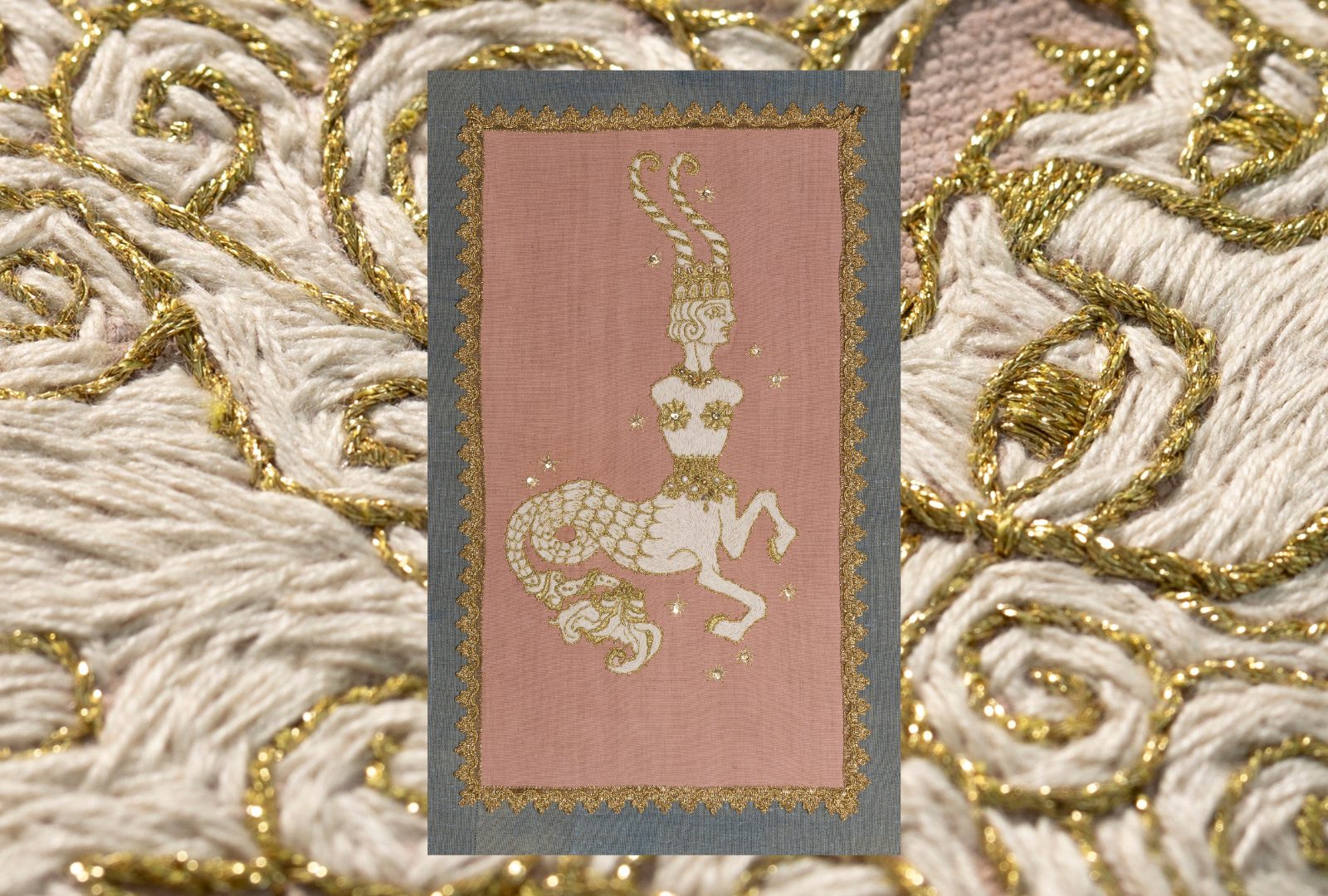
By Ginevra Barbetti. Cover image Astra Codex, ph Lorenzo Michelin
“Florence looks back to the stars through embroidery, a practice that requires absolute and profoundly poetic time,” says Daniele Davitti, says Daniele, a Florentine artist with a horizon already traced by creativity, constellations, and success. From this vision comes Astra Codex, a textile art exhibition hosted by the Istituto de’ Bardi until June 14, 2026, in the historic setting of Palazzo Capponi. Curated by Lavinia Pini, the exhibition aligns with the Institute’s long-standing commitment to the preservation and promotion of Florentine artistic craftsmanship, with the patronage of the Fondazione Cologni dei Mestieri d’Arte.
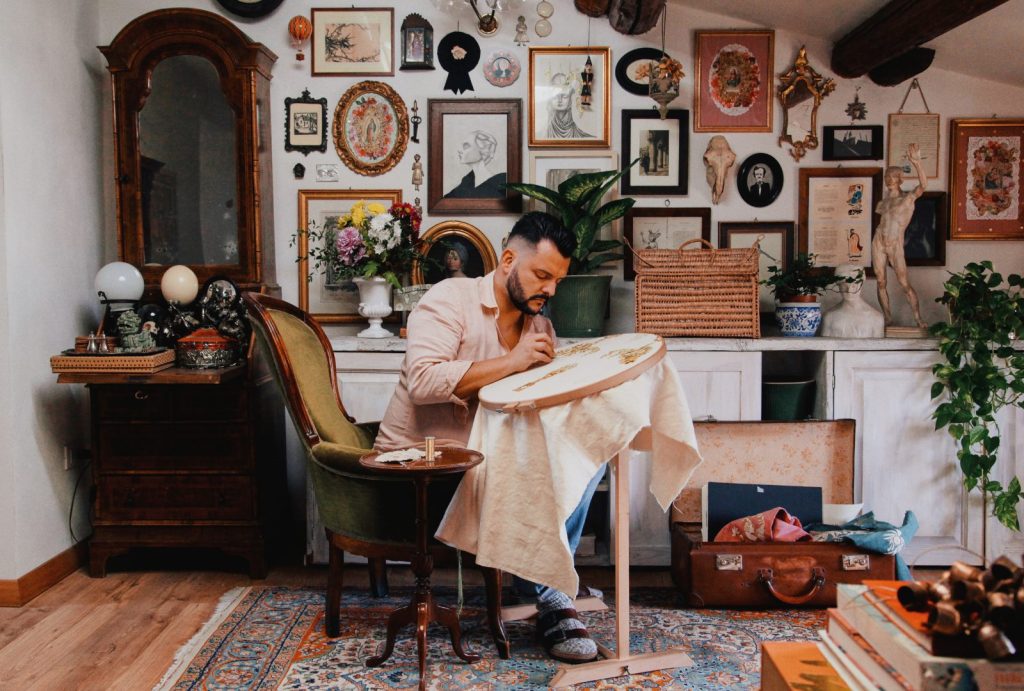
Twelve hand-embroidered panels reinterpret the zodiac signs through artworks and architectural details from Florence, forming a symbolic atlas in which astrology, memory, and urban history engage in dialogue. “The zodiac is a millennia-old tradition shared by everyone, yet always open to personal interpretations,” Davitti explains. The result is a map that moves through churches, palaces, bridges, museums, and gardens—from the solstitial sundial of San Miniato al Monte to the Fountain of Neptune—transforming each work into a small astrological summa and a precise homage to the city.
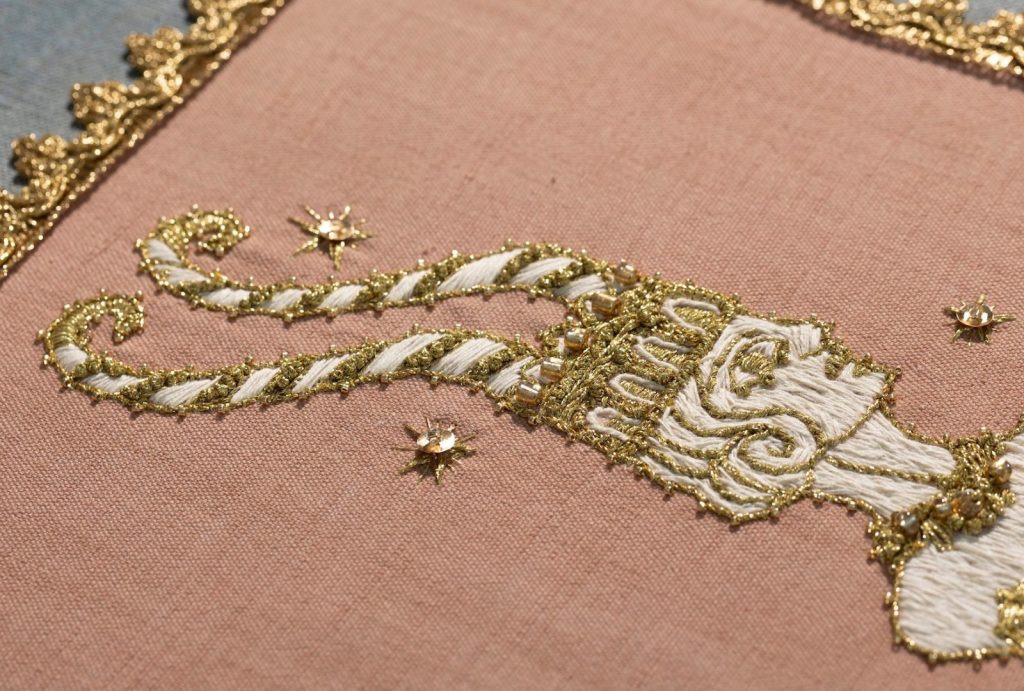
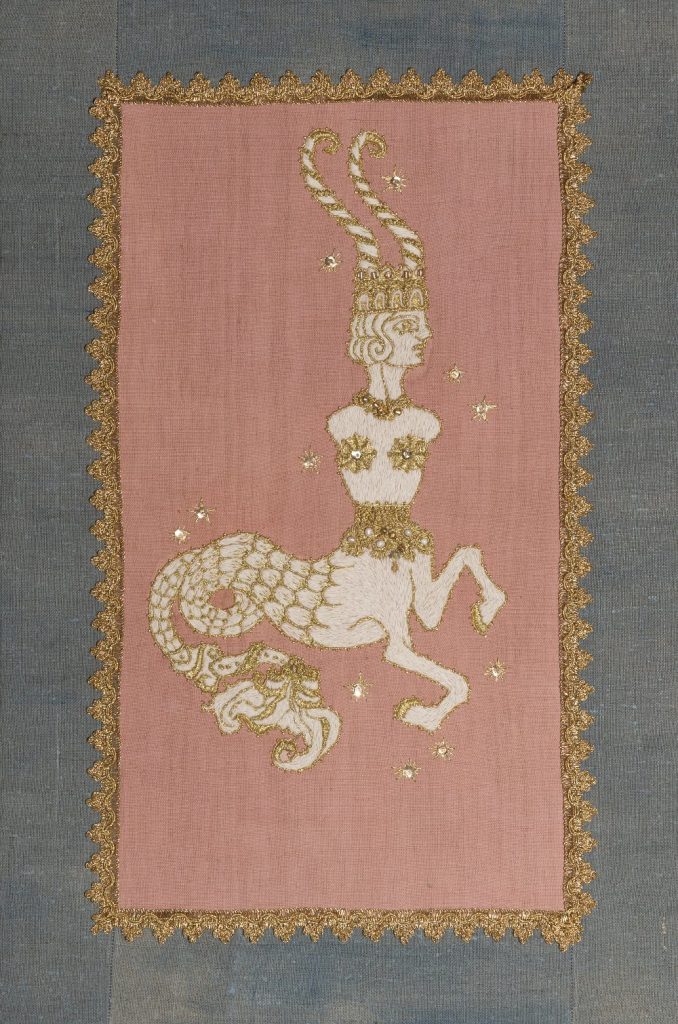
Made entirely by hand with white and gold threads on antique fabrics dyed antique pink, the works convey the value of “the time it takes,” a poetic measure of craftsmanship attuned to the rhythms of nature and the cosmos. Completing the exhibition is a program of talks and guided tours that delve deeper into its themes, spanning zodiacal iconography, Renaissance sculpture, and the fiber arts.
From Fashion Design to Textile Art: Davitti’s Creative Journey
What is your professional background and what do you do today?
I studied Fashion Design in Florence and completed my education at the Bunka Fashion College in Osaka, Japan. I began teaching Fashion Illustration at the age of twenty-five, while simultaneously working as an illustrator and painter. For many years I exhibited my work and taught both in Italy and abroad, including Australia and the United States. During the Covid period I began working with textile art. Today I am a professor of Illustration and Fashion Aesthetics at Polimoda, and I continue to pursue my artistic practice alongside teaching.
How the Zodiac Shapes Astra Codex Series
How did Astra Codex come about?
For some time I had wanted to create a series of works united by a single theme. Like many artists before me, I found the zodiac to be the ideal subject: it has a millennia-old tradition shared by everyone, yet it always remains open to personal interpretations. It is a true “family” of images ready to be redrawn and reimagined.
Astrology as Visual Language: Symbols, Myths, and Meaning
Why astrology as a key to reading your work?
I am not particularly involved in astrology in a practical sense, but I have always been fascinated by the esoteric and spiritual world—tarot, alchemy, spiritual philosophies. From an artistic perspective, these subjects are extraordinary: simple figures that convey symbols, values, and interpretations. For an artist, they form a rich and evocative vocabulary.
Florence Mapped Through the Zodiac: Art, Architecture, and Symbols
How does Florence become a symbolic map for the series?
I wanted to create a work that included Florence while avoiding the most traditional interpretive approaches. Studying the city, I realized that for centuries art and astrology shared common languages, even in relation to science and religion. I began identifying symbols scattered throughout the city, connected to political and artistic figures, as well as to emblematic buildings and artworks. The figure chosen for the exhibition’s invitation—the Capricorn—is linked to Cosimo I and appears literally everywhere, from Ponte Santa Trinita to the Boboli Gardens.
What interests you about the zodiac sign beyond its iconic value?
I am fascinated by their narrative power—the fact that a specific figure has been associated with a group of stars. I often ask myself why that particular one, and what effect it has on people. Being born under Pisces, I have always felt close to its iconography, just as I am drawn to the magnetism of Scorpio or the volatile genius of Aquarius.
How Embroidery Became the Center of Astra Codex
When did embroidery become your expressive language?
Embroidery has always been part of my education through the study of fashion, from medieval garments to haute couture, but for a long time I considered it only in decorative terms. I approached embroidery as an art form thanks to some contemporary textile artists. During lockdown I began studying stitches and techniques on my own, and through social media I learned to see embroidery as a true art form, freed from the context of clothing. Today I believe textile art is among the most compelling expressions of the contemporary scene.
Lurex, Vintage Fabrics and the Craft Behind the Panels
What was the most complex technical challenge of the exhibition?
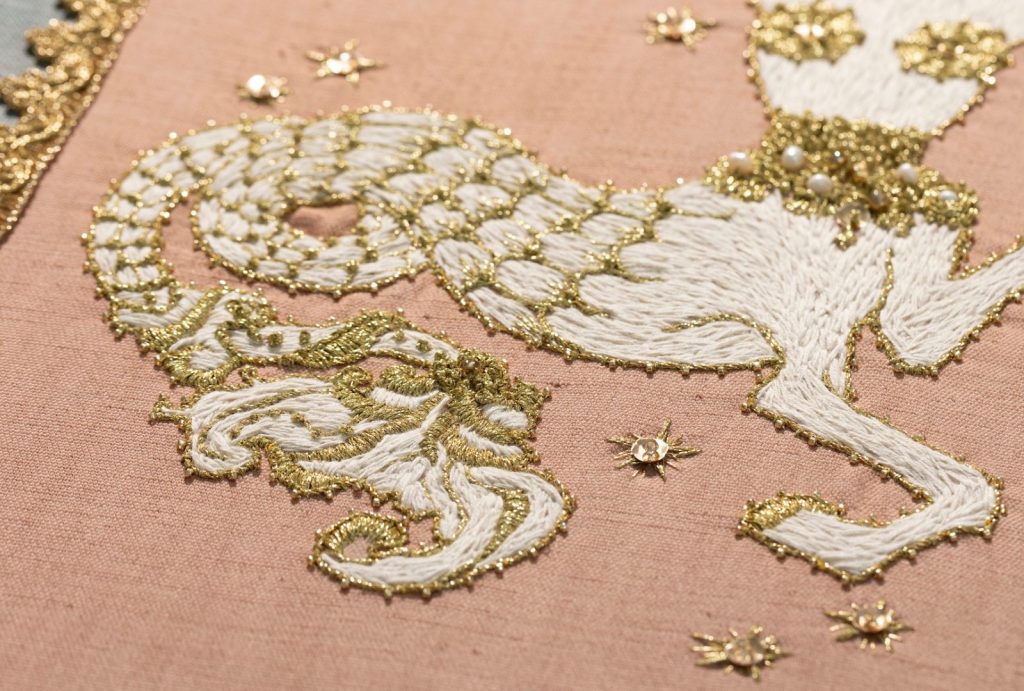
There were several. The first was using lurex, a thread I had almost always avoided; I had to learn to handle it like a completely new tool. Then there was the work with fabrics, almost all vintage or second-hand. In this case I worked on cotton handwoven by my grandmother in 1939, mounted on a vintage hemp fabric from the Italian Air Force—materials very different from one another and not easy to combine. Finally, coordinating with the other artisans and professionals involved, ensuring everyone had the right amount of time to work with quality.
Drawing First: The Starting Point of the Zodiac Series
What role does drawing play in your creative process?
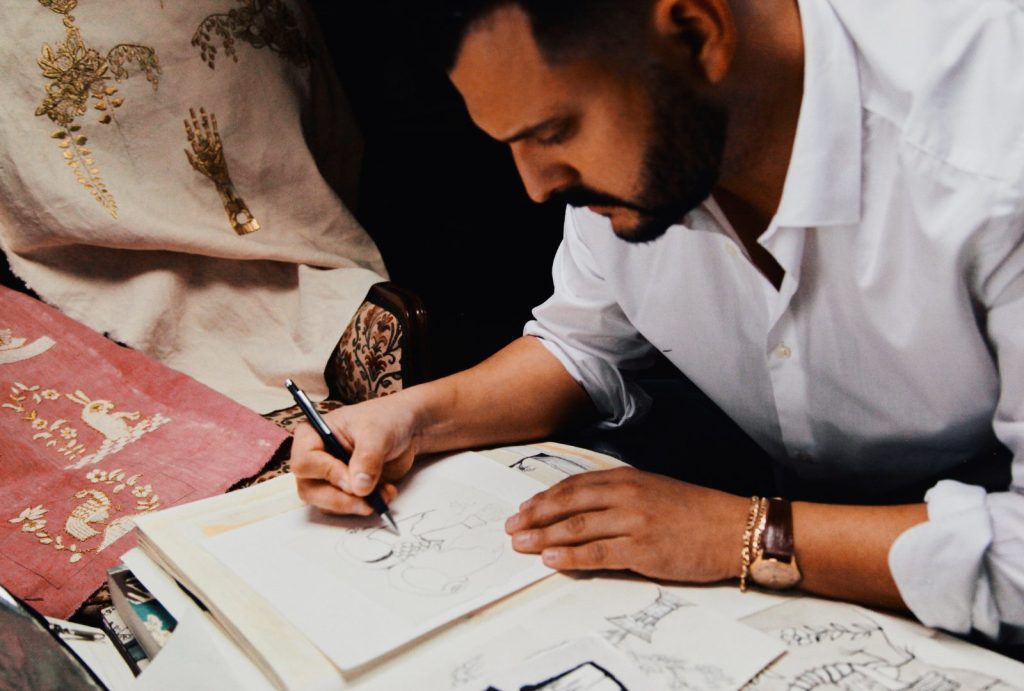
Drawing is my primary artistic medium—the most direct and spontaneous. I have always found it more natural to sketch an idea than to build a moodboard; in this sense I feel more like an artisan than a designer. The transition from painting to textile art was natural: today I draw with silk and wool threads instead of graphite and ink.
Why Craft Collaboration Is Essential to Astra Codex
How important is artisanal collaboration in your work?
It is one of the most beautiful and vital aspects of this journey. Coming into contact with unique stories, skills, and people is an extraordinary enrichment. For this exhibition I collaborated with Valentina and Laura Fiorini of Ratafià Firenze on dyeing the fabrics. The handmade dimension must be protected, but above all promoted and passed on to new generations—education is key.
Inside the Making of the Zodiac Panels
Why make the process visible, beyond the finished work?
We live in a world accustomed to consuming objects without knowing their production process, losing any sense of their value. Showing the backstage of artisanal production is essential to truly understand the final work. The exhibition includes a film by Lapo Quagli documenting eight months of work, making visible the hidden time behind every stitch and every detail.
What does the final screen represent as a single “code”?
The twelve panels are displayed separately, but the series is conceived to exist as a single work. Like the zodiac, the figures coexist under the same sky and are part of the same wheel. I chose a screen because I believe it is important to bring art back into everyday life and overcome the separation between art and craft.
The Slow Time of Embroidery and the Rhythm of the Cosmos
What is the relationship between the slow time of embroidery and cosmic time?
In the world of craftsmanship there is a phrase often used: “the time it takes”—an absolute and profoundly poetic measure, far removed from the inhuman rhythms of mass production. It is the same time as nature and the cosmos. This is one of the reasons I chose art and craftsmanship. I often think of Jan Vermeer: few works, but each one an absolute world, a perfect example of the time required.
Fabric as Memory: From Inheritance to Contemporary Textile Art
How does fabric become memory?
Historically, fabric was a precious good, often passed down as an inheritance or dowry. It has always been a vehicle for stories and memories, from the garments of Elizabeth I to the Bayeux Tapestry. Today this awareness re-emerges in second-hand culture and in contemporary textile art, which is restoring fabric’s full expressive power as an artistic language.


