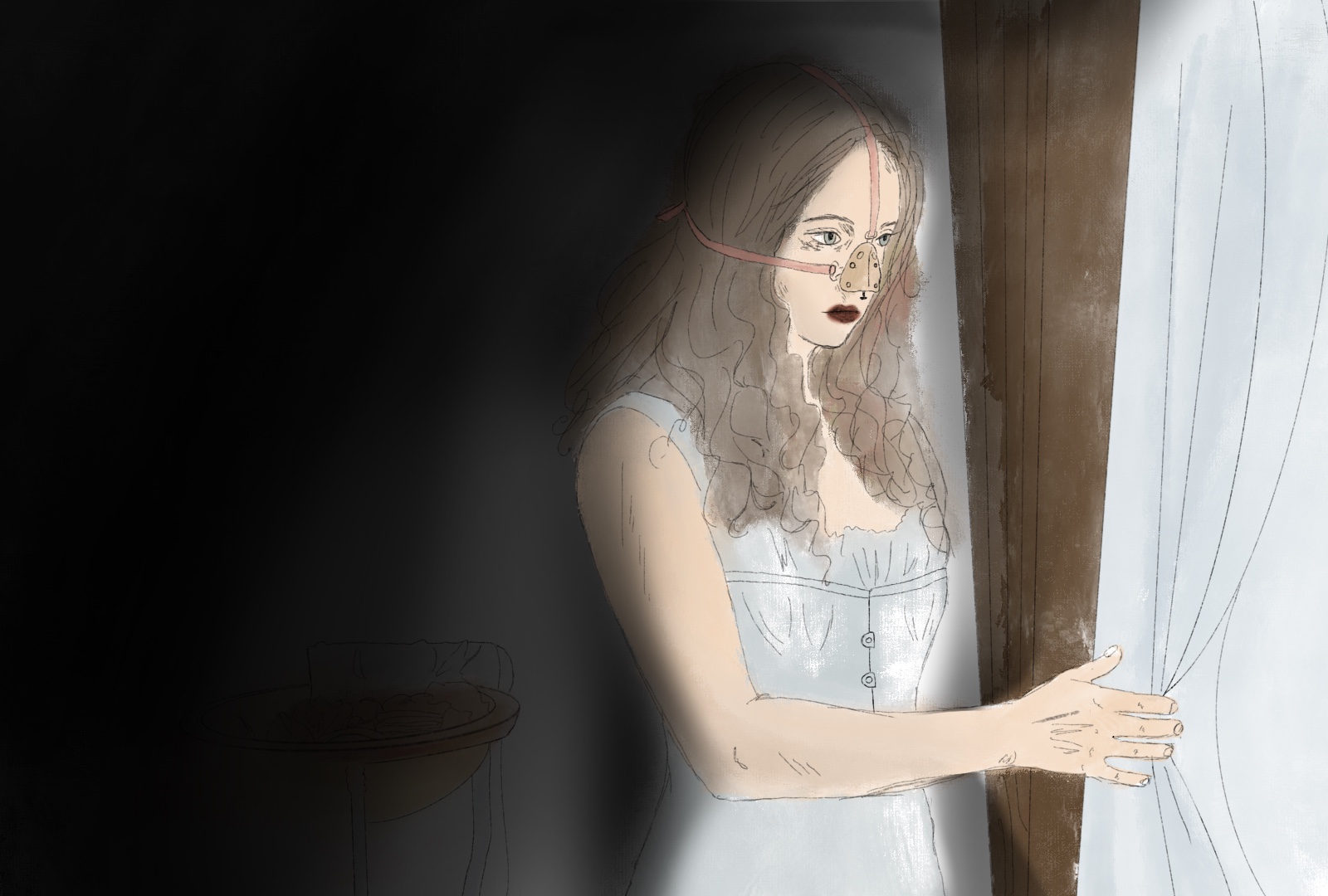
By Gynna Bella. Cover image by Rebeca Jin.
The Ugly Stepsister Review: Cinderella from the “Loser’s” Perspective
When we think of Cinderella, we often imagine a dreamy, magical tale about a kind yet unfortunate, beautiful girl who suffers at the hands of her stepfamily. Through magic and the goodness of her heart, she ultimately finds true love. However, The Ugly Stepsister is a movie that presents a different narrative. This dark, grim fairy tale serves as a harbinger of a troubling time that we may all be entering.
The Ugly Stepsister Review begins from Norwegian Director Emilie Blichfeldt’s Bold Debut
This new spin on the Cinderella story was directed by Norwegian filmmaker Emilie Blichfeldt in her directorial debut. Instead of the familiar feel-good Disney fairy tale, this version unfolds more like the original tale by the Brothers Grimm. The film is told from the perspective of Elvira, one of the two ‘ugly stepsisters’ from the original story.
Elvira, played by Lea Myren, falls in love with the Prince (Isac Calmroth) through the sweet words penned in the poetry book he published. She becomes enamoured with the idea of a romantic, tortured young prince and dreams of being his one true love. Despite her feelings, her mother, Rebekka (Ane Dahl Torp), dismisses her dreams as ridiculous, believing that Elvira does not fit the traditional mould of beauty.
However, Elvira’s dreams begin to feel urgent when her new stepfather dies unexpectedly, leaving her family threatened by financial ruin. Forced by these circumstances, Elvira undergoes extreme cosmetic modifications reminiscent of medieval tortures in order to become conventionally beautiful, especially considering her competition: the perfect, naturally beautiful Agnes (played by Thea Sofie Loch Næss).
Beauty’s Price: Nature vs. Nurture in a Patriarchal World
At the centre of the film’s story is Elvira’s growing bitterness towards Agnes, who embodies everything Elvira is not. Beautiful and aristocratic, Agnes has the right name, background and, most importantly, the right appearance. In contrast, Elvira is the overweight, unattractive daughter of a widow with no last name; she is referred to as “the Stepsister” (they literally announced her name as ‘von Stepsister’ during the ball).
In one scene, where they are all training for a performance for the ball, the dance instructor ridicules Elvira for her appearance and favours Agnes’s dancing. Elvira endures countless hardships and works twice as hard to be comparable to Agnes, yet ultimately, she still loses to her. Even if the prize is not worth it (the prince in this story turns out to be ungallant and definitely not charming), the movie raises the timeless question of who will prevail in the end: nature or nurture? Do inherent qualities overshadow hard work?
From Beauty Myths to Feminism’s Backlash: Why History Repeats Itself
The Ugly Stepsister serves as a commentary on the unrealistic beauty standards that society imposes on young women. The extreme lengths Elvira goes through to achieve beauty—such as bone-breaking ‘rhinoplasty’, using tapeworm eggs as diet pills, and sewn-on eyelash extensions—reflect the historical and contemporary pressures that women face.
Several years ago, our society experienced a significant advancement in the feminist movement. We became aware that beauty standards emphasising thinness and excessive cosmetic surgery, dictated by patriarchal ideals, did not empower women. Women started to encourage themselves to be confident in their abilities and appearances, focusing on independence.
However, as history often demonstrates, periods of progression are frequently followed by regression. As feminism gained strength, it became necessary for certain powers to push back against it to maintain the status quo. This regression now appears in the guise of ‘trends’ such as ‘Skinny is Back’, the rise of preventative botox procedures, a resurgence of ‘conservatism’, the phrase “I’m just a Girl”, and endorsements of the traditional wife lifestyle.
Sadly, the widespread popularity of these as trends ensures their success, as people tend to follow what is considered fashionable due to a herd mentality. As a result, we find ourselves back to square one.
The Ugly Stepsister and the Life We Choose: A Cautionary fairy Tale for Today
The Ugly Stepsister came out at a time when it served not only as a reflection of contemporary society but also as a cautionary tale about what lies ahead. Yes, it discusses the cost of beauty and the dangers of relying on someone else for salvation. However, if we delve deeply into the story, we discover that societal constructs underlie these issues. None of the women find true happiness in the end; no one truly ‘wins’. They are all victims of the patriarchal society they live in, where women struggle to support themselves independently, forcing them to go through extremes to enter into relationships they don’t genuinely desire.
Agnes, for instance, is not in love with the prince; she is actually in love with a humble stable boy who works in her household. To escape her stepmother’s control, she feels compelled to marry a rich man. Her stepmother, in turn, had to marry off her daughters to wealthy men to avoid poverty. None of them really had a choice. When a society continues to thrive on oppression, you will be forced to conform in order to survive.
Ultimately, we need to reflect on the kind of life we want to lead, the type of person we aspire to be, and the kind of society we wish to live in. Staying informed and educating ourselves, rather than following others mindlessly, are essential steps toward achieving our own versions of happily ever after.


